Category Archives: Uncategorized

Confudding, Confudded, and Confudsion

: synonyms: confusing. Result of spreading fear, uncertainty and doubt in the minds of new project participants. “The specification was confudding to most new developers.”

: synonyms: confused. An adjective describing the feelings of fear, uncertainty and doubt about a topic or concept. “The developers became confudded while trying to decipher the meaning, intent and practical application of the specification”.

: synonyms: confusion. A state of mind resulting from having feelings of fear, uncertainty and doubt about a topic. “The inaccurate feedback created a lot of confudsion with respect to the meaning, intent and practical application of the specification”.

5 Comments

Filed under Uncategorized

Refactoring UBL 2.2 business documents for enacting business processes on the blockchain [WIP]

Michael Herman (Toronto/Calgary/Seattle)
Hyperonomy Business Blockchain Project / Parallelspace Corporation
December 2018 (completed January 2019)

The purpose of this article is to describe the background and rationale for set of proposed extensions to the UBL 2.2 business document specification to make UBL schema better suited for  creating distributed business applications on the blockchain. The proposed set of extensions is referred to as the Universal UBL Extensions.

Hyperonomy Business Blockchain (HBB)

Hyperonomy Business Blockchain (HBB) is a horizontal software applications platform for supporting standards-based, end-to-end, general-purpose, trusted business processing on a global scale.

HBB Standards

A key characteristic of HBB is its reliance on prevailing standards for:

  1. Business document definitions (business document schema)
  2. Executable business process definitions (workflow template definitions)
  3. Digital identity
  4. General-purpose, programmable blockchain platforms
  5. Microsoft .NET Core Common Language Runtime (CLR) for virtual machine support

For business document schema, HBB is reliant on the UBL 2.2 (Universal Business Language) specification from the OASIS group.

For defining workflow templates, HBB is reliant on the BPMN 2.0 specification from the Object Management Group (OMG).

For digital identity support, HBB is leveraging:

Hyperledger Indy is a distributed ledger, purpose-built for decentralized identity. It provides tools, libraries, and reusable components for creating and using independent digital identities rooted on blockchains or other distributed ledgers so that they are interoperable across administrative domains, applications, and any other “silo.” [INDY]

Sovrin is a decentralized, global public utility for self-sovereign identity. Self-sovereign means a lifetime portable identity for any person, organization, or thing. It’s a smart identity that everyone can use and feel good about. Having a self-sovereign identity allows the holder to present verifiable credentials in a privacy-safe way. These credentials can represent things as diverse as an airline ticket or a driver’s license. [SOVRIN]

Decentralized Identifiers (DIDs) are a new type of identifier for verifiable, “self-sovereign” digital identity. DIDs are fully under the control of the DID subject, independent from any centralized registry, identity provider, or certificate authority. DIDs are URLs that relate a DID subject to means for trustable interactions with that subject. DIDs resolve to DID Documents — simple documents that describe how to use that specific DID. Each DID Document contains at least three things: cryptographic material, authentication suites, and service endpoints. Cryptographic material combined with authentication suites provide a set of mechanisms to authenticate as the DID subject (e.g., public keys, pseudonymous biometric protocols, etc.). Service endpoints enable trusted interactions with the DID subject. [DID]

[Sovrin] DIDs are created, stored, and used with verifiable claims. [The Sovrin DID Method Specification] covers how these DIDs are managed. It also describes related features of Sovrin of particular interest to DID owners, guardians, and developers. [SOVRINREGISTRY]

For general-purpose, programmable blockchain platform support, HBB is reliant on:

  • Stratis Platform for creating highly composable, performant, reliable, and trustworthy custom blockchain platforms, and
  • .NET Core Common Language Runtime (CLR) for virtual machine support.

The Stratis Full Node is the engine that powers the Stratis blockchain network. A future-proof and environmentally sustainable consensus protocol, which uses a Proof-Of-Stake (PoS) algorithm, drives each Full Node in the network.

.NET Core is an open-source, general-purpose development platform maintained by Microsoft and the .NET community on GitHub. It’s cross-platform (supporting Windows, macOS, and Linux) and can be used to build device, cloud, and IoT applications.

UBL (Univeral Business Language) Specification

UBL documents are conceived for the purpose of interchange between disparate systems to replace existing trade documents. [HOLMAN1]

UBL is an OASIS specification that defines schema for the 81 most common digital business documents used in supply chain or other online commerce scenarios. The current version of the UBL specification is known as OASIS Universal Business Language version 2.2.

The OASIS Universal Business Language (UBL) is intended to help solve these problems by defining a generic XML interchange format for business documents that can be restricted or extended to meet the requirements of particular industries. Specifically, UBL provides the following [UBL22]:

  • A suite of structured business objects and their associated semantics expressed as reusable data components and common business documents.
  • A library of XML schemas for reusable data components such as “Address”, “Item”, and “Payment”—the common data elements of everyday business documents.
  • A set of XML schemas for common business documents such as “Order”, “Despatch Advice”, and “Invoice” that are constructed from the UBL library components and can be used in generic procurement and transportation contexts.

A key premise of a UBL business document schema is that is complete, standalone, physical representation of the underlying conceptual business or application object. The primary intended purpose of documents conformant with the UBL specification is: electronic document exchange and rendering/printing.

An example receiver application is a print facility that can print any instance of a given UBL document type without having to perform any calculations nor need even know the underlying calculation model.

For the purposes of this article, the following UBL Invoice schema serves as the primary use case. The first page of  the UBL Invoice schema looks like the following.

UBL-InvoiceFigure 1. UBL Invoice Schema Example (Partial)

Each one of the 81 UBL business document schema is a complete, holistic representation of a particular business document (e.g. Invoice, Business Card, Bill of Lading, Order, Request for Quotation, Forwarding Instructions, etc.).

Blockchain Requirements for UBL Business Documents

To represent UBL Business Documents more effectively and more efficiently for use in blockchain-based distributed business applications, the following requirements are important:

  1. Extremely compact and efficient binary serialization of each entity (and subentity)
  2. Refactoring/normalization/decomposition of large aggregated entities into small, separate, external subentities (e.g. 5-10 properties per entity) aggregated together by-reference (vs. by-value)
  3. Re-use of existing (non-fungible) subentities wherever and whenever possible to conserve space and eliminate replication and redundancy wherever and whenever possible
  4. Secure, permanent, immutable, and trusted (“trusted in a trust-less way”)

Detailed Requirements

Universal UBL (UUBL) is a set of extensions to (or superset of) the UBL 2.2 specification that provides enhanced support for storing and interacting with digital business documents on a digital identity/general-purpose blockchain hybrid applications platform.  The UUBL extensions are an answer to the 4 blockchain requirements outlined in the previous section.

Requirement 1. Compact and Efficient Binary Serialization

The requirement for extremely compact and efficient binary serialization of each entity (and subentity) can be fulfilled by various software serialization solutions including SerentityData Variable-byte, Statistically-based Entity Serialization. The SerentityData project can be found on Github. SerentityData is the author’s preferred solution.

Requirement 2. Refactoring/Normalization/Decomposition

By definition the UBL schema definitions are both complete and monolithic – they completely description a particular digital business document in its entirety.

For storage on a blockchain and for direct reference by (a) code running in a traditional smart contact or (b) a new generation of business process workflow templates running directly on a workflow-engine-based virtual machine, the potentially large size of a typical, monolithic UBL business document makes them prohibitively large and prohibitively expense to store, process, and manage on a typical general-purpose programmable blockchain.

A replicable solution for refactoring/normalizing/decomposing each UBL document schema into a collection of subentity schema is need.  A solution is proposed by the author in the section Universal UBL: Extensions for the Blockchain.

Requirement 3. Re-use of Subentities

Closely couple with Requirement 2, is the re-use of existing subentities wherever and whenever possible to conserve space and eliminate replication and redundancy wherever and whenever possible. Backing this requirements is the knowledge that most every-day business documents (i.e. those representable by the 81 UBL business document schema) are in fact permanent (subject an organization’s retention policies), immutable, constant-valued documents once they are created.  The simplest example is Waybill.  Once you have created your (Federal Express or DHL) Waybill, it is a permanent, immutable, constant-valued business document once it has been created and printed (and is not destroyed before it is used).

Given these characteristics of business document in general (and UBL business documents in particular), business documents represent a proper subset of a broader class of entities called Non-Fungible Entities (or NFEs).  Another significant class of NFEs are NFTs (Non-Fungible Tokens) …of which, the Ethereum-based CryptoKitties are the penultimate example.

The author’s thesis is that, given business documents stature as NFEs, business documents (and NFEs generally) can be implemented and best managed using the emerging digital identity, in particular the self-sovereign identity (SSI) platforms, that are “coming to market”.

The best platform, from amongst these, in the author’s opinion, is the Hyperledger Indy SSI software platform operated under the stewardship of the Sovrin SSI governance framework.

Requirement 4. Secure, Permanent, Immutable, Trusted and Friction-less

This set of adjectives, plus a few others, symbolize and capture the essence of the intersection between the world of digital business documents and the world (sometimes what I call the religion) of the blockchain.

It is in this intersection between digital business documents and the blockchain that the greatest opportunities lie for supporting friction-less, trusted, standards-based end-to-end business process on a global scale.

Universal UBL: Extensions for the Blockchain

The following sections detail the envisioned solution for each of the above 4 requirements.

Requirement 1. Compact and Efficient Binary Serialization

Solution: SerentityData Variable-Byte Entity Serialization

The goal of the serentitydata project is to provide support the design and development of enterprise and Internet class distributed applications using blockchain technologies. This includes tools and libraries (code), frameworks, how-to documentation, and best practices for enterprise distributed application development. The serentitydata project has a specific focus on the robust and efficient design and management of immutable, historized, and auditable data stored on a blockchain.

TODO

Requirement 2. Refactoring/Normalization/Decomposition

Solution: Refactoring/Normalization/Demposition of UBM 2.2 Schema into Subentities Supported by the W3C DID (Decentralized Identifiers) Specification.

TODO

UUBL-InvoiceFigure 2. UUBL Invoice Schema Example
<ucbc:DID>did:hbb:00AE77FF-13F5-4268-A8EE-BF62FE904F50</ucbc:DID>

TODO

UUBL-AccountingSupplierPartyFigure 3. UUBL Accounting Supplier Party Schema Example
<ucbc:DID>did:hbb:00AE77FF-13F5-4268-A8EE-BF62FE904F51</ucbc:DID>


TODO

UUBL-PartyFigure 4. UUBL Party Schema Example
<ucbc:DID>did:hbb:00AE77FF-13F5-4268-A8EE-BF62FE904F53</ucbc:DID>

TODO
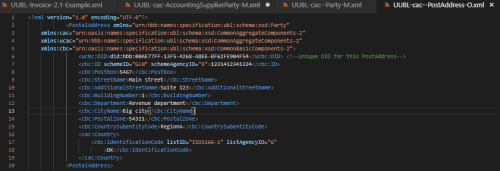
UUBL-PostAddressFigure 5. UUBL Postal Address Schema Example
<ucbc:DID>did:hbb:00AE77FF-13F5-4268-A8EE-BF62FE904F54</ucbc:DID>

TODO

Requirement 3. Re-use of Subentities

TODO

Requirement 4. Secure, Permanent, Immutable, Trusted and Friction-less

TODO

TODO

References

Appendix A – Ken Holman – Personal Communication – December 2, 2018 6:38 PM

From: G. Ken Holman <g.ken.holman@gmail.com>
Sent: December 2, 2018 6:38 PM
To: Michael Herman (Parallelspace) <mwherman@parallelspace.net>; William Olders <wolders@xalgorithms.org>; stephenrowlison@gmail.com
Cc: Michael Blanchet <michael.blanchet@gmail.com>; Larry Strickland <lstrickland@dkl.com>
Subject: RE: Introduction by Ken between Michael and Bill – Business Document “Facts”

At 2018-12-02 14:13 +0000, Michael Herman (Parallelspace) wrote:
Ken, Bill and Stephen, I do have a question…

I’ll take on the answer … this is the area of my contribution to the project. I’ve copied Michael and Larry just for their curiosity as I think they’ll find this discussion interesting.

In the <http://docs.oasis-open.org/ubl/os-UBL-2.2/xml/UBL-Invoice-2.1-Example.xml>http://docs.oasis-open.org/ubl/os-UBL-2.2/xml/UBL-Invoice-2.1-Example.xml example, if the value of the <cac:AccountingSupplierParty. cac:PostalAddress component/subelement of an Invoice already exists as a “separate document” somewhere addressable by a URL (or indirectly locatable via a URN)…

* Is there a standard/recommended/off-the-wall way for a specific Invoice to specify the value of AccountingSupplierParty. PostAddress by reference …instead of “by value” (i.e. instead of the long-hand, replicated approach seen in the example)?

No. That isn’t the UBL way. In UBL all values must be manifest and redirecting selective components to copies found elsewhere in the document is not accommodated:

http://docs.oasis-open.org/ubl/os-UBL-2.2/UBL-2.2.html#S-MANIFEST-VALUES

Of course it is necessary to point out to other documents, but there is, say, no XPath or other addressing mechanism built into the UBL serialization to accommodate shared fragmentation.

The UBL committee has been standardizing a semantic library of the business documents and their business objects, and a number of syntactic serializations of those semantics have been specified, XML being the only normative one.
Others in ASN.1 and JSON are available, but they are not normative.

* What does/would an acceptable XML “syntax” look like/might look like?

I would use XPath for addressing a point into an XML document. XPointer would be used if you wanted to point to a range of items found in an XML document. Within an XML document I would use ID/IDREF, but those properties are not available in UBL.

Not many people realize that UBL was not built using XML/XSD, it was built using CCTS. CCTS doesn’t have ID/IDREF concepts.

* Is there standard terminology for referring generally to a subcomponent/subelement of an Invoice (or any other) UBL document? I’m currently using the term Fact to refer to each of the subcomponents (applied recursively if necessary)?

No such terminology is used within the committee … such a concept isn’t leveraged because the syntax is but a straightforward manifest serialization of the semantic components. This is best for interchange between independent platforms and also for things such as rendering.

A recipient of a UBL document should have everything they need without needing to calculate anything … the calculus of the values cannot be assumed to be known by the recipient.

UBL documents are conceived for the purpose of interchange between disparate systems to replace existing trade documents.

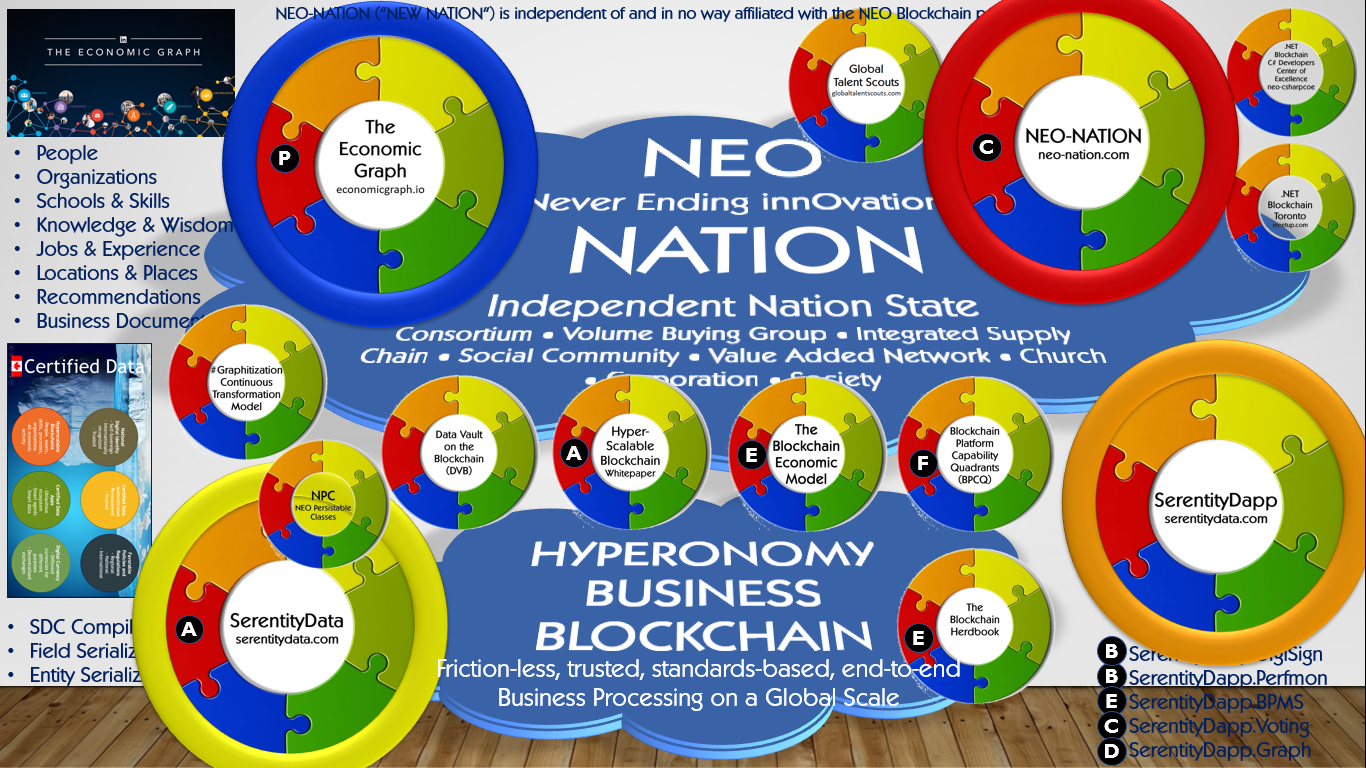
Appendix B – NEO-NATION and HYPERONOMY BUSINESS BLOCKCHAIN Infographic

TODO
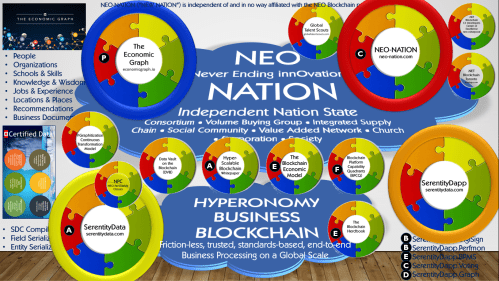
NEO-NATION1

TODO

Appendix C – SerentityData Variable-byte, Statistically-based Entity Serialization

The SerentityData Entity Serialization and Field Encoding library fulfills Blockchain Requirement 1 for the Universal UBL (UUBL) extensions to the UBL 2.2 business document schema specification.

The SerentityData Entity Serialization and Field Encoding description has been moved to its own article located here: SerentityData Variable-byte, Statistically-based Entity Serialization & Field Encoding.

Best regards,

Michael Herman (Toronto/Calgary/Seattle)

1 Comment

Filed under Uncategorized

Are Canadian banks trafficking in the digital identities of millions of Canadians?

In light of the recent Zuckerberg testimony in front of the U.S. Congress, the May 2018 deadline for organizations to implement General Data Protection Regulation (GDPR) data privacy regulations[7], and the imminent release of the SecureKey verify.me digital identity system, an important question is:

Are Canadian banks guilty of trafficking in, monetizing, and profiting from the digital identities of millions of Canadians, with the support of IBM and SecureKey as their key technology partners?

On October 18, 2016, SecureKey Technologies Inc., a Toronto-based provider of identity and authentication solutions, announced that it has raised:

“$27 million CAD in growth capital to fund the commercial rollout of a privacy-enhancing digital identity network. Teaming up with SecureKey on this initiative and participating in the funding round are leading financial institutions: BMO Bank of Montreal, Bank of Nova Scotia, CIBC, Desjardins, Royal Bank of Canada and TD.”[1]

On March 20, 2017, IBM and SecureKey announced that they were:

“working together to enable a new digital identity and attribute sharing network based on IBM [Hyperledger Fabric] Blockchain.”[2]

Subsequently in early 2018, SecureKey released two additional documents[4][5] that describe both the business model and technology platform for the verify.me digital identity system. Verify.me is SecureKey’s IBM Hyperledger distributed ledger (blockchain) based digital identity system supported by Canada’s largest 5 banks (as well as other institutions):

  • The Toronto-Dominion Bank (TD Bank)
  • Bank of Montreal (BMO)
  • Canadian Imperial Bank of Commerce (CIBC)
  • Bank of Nova Scotia (Scotiabank)
  • Royal Bank of Canada (RBC)

Additional details on the verify.me digital identity system were also presented at the Australian Payments Network conference in August, 2017[3].

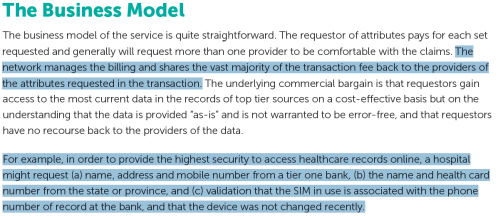
The Business Model

The most concerning part of this partnership between SecureKey, IBM, and the Canadian banks is the partnership’s intent to monetize and profit from the trafficking of digital identities of individual Canadians based on the following and similar excerpts from [4][5]:

The Business Model-Healthcare

Figure 1. SecureKey verify.me Business Model

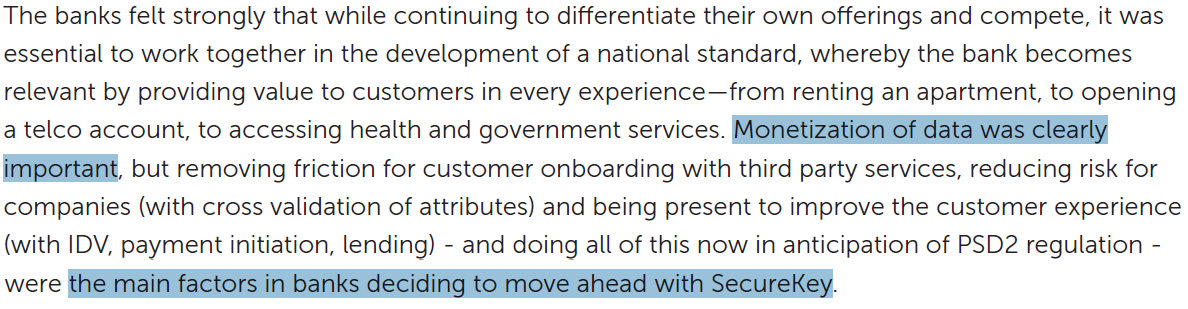
The SecureKey documents’ rationale for SecureKey and the Canadian banks to pursue this business model was driven by a perceived threat by the banks from many fronts including encroachment by non-banking businesses into the domain of the Canadian banks and pending new regulations (e.g. PSD2).

Monetization of data was clearly important

Figure 2. Banking industry rationale for monetizing customers’ digital identites

The Technology Platform

IBM is providing SecureKey with the Hyperledger products, technologies, services, and know-how to create what is, in effect, a digital identity dark web [8] for the Canadian banking industry to engage in trade of their customers’ digital identity information with SecureKey and SecureKey’s digital identity requester clients.

The primary technology platform is the open source Hyperledger Fabric v1.0 project – an open-source distributed ledger project used almost exclusively for private and consortium applications[6].

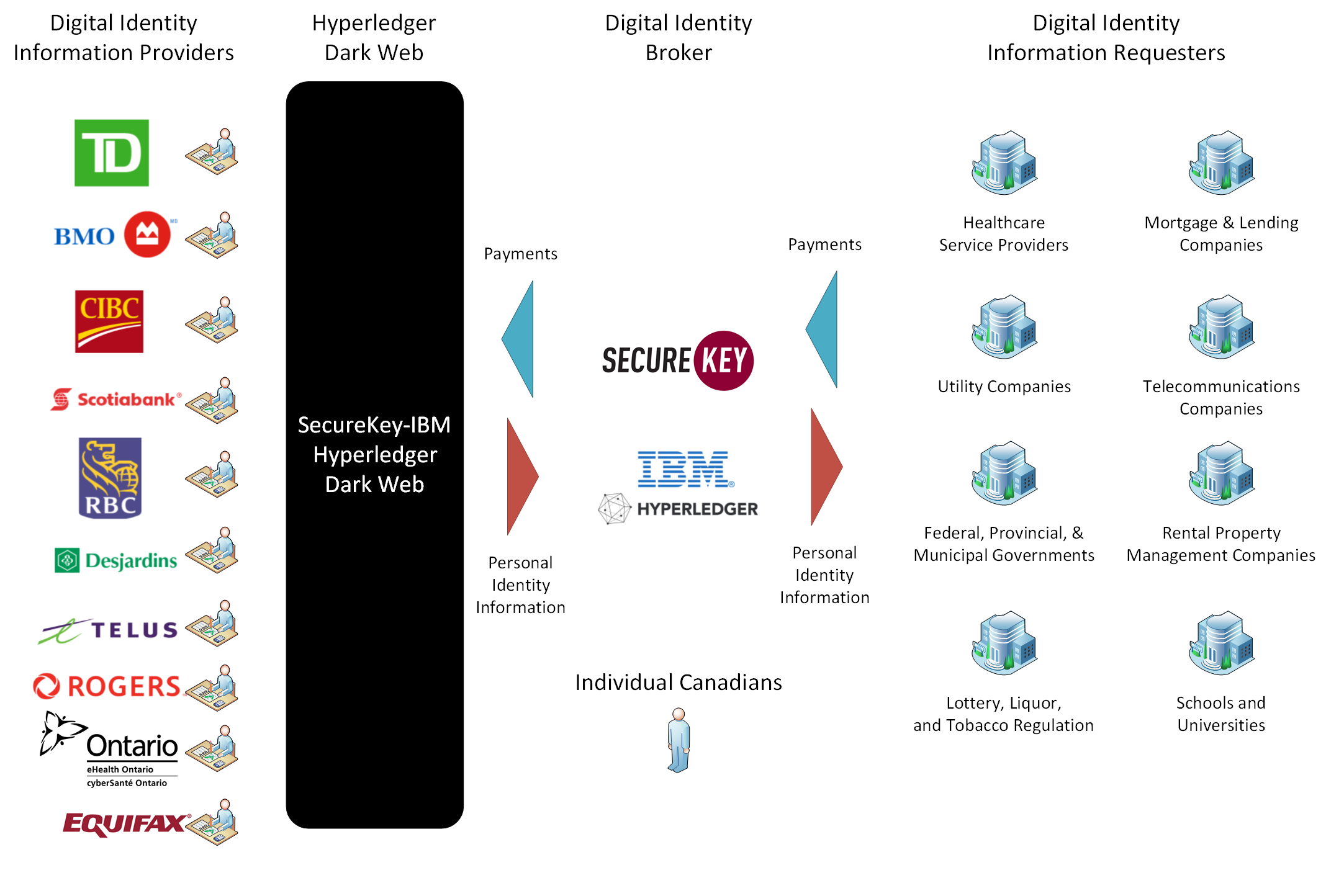
The following diagram represents a consolidation of the information presented in the SecureKey references mentioned at the end of this article.

SecureKey-verify.me

Figure 3. SecureKey verify.me Digital Identity Dark Web

SecureKey brokers digital identity information requests (claims) from Digital Identity Information Requesters.  SecureKey satisfies these claims (requests for digital identity information) by using the SecureKey digital identity dark web it has implemented with its banking partners (Digital Identity Information Providers) using the Hyperledger technology.

Information and Privacy Risk

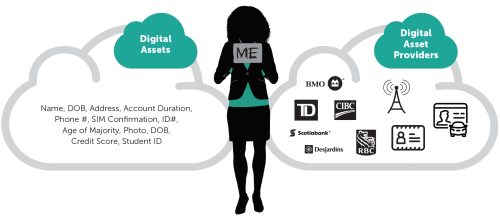
SecureKey’s February 2018 documents highlight initial set of digital identity information (digital assets) that will be provided by the Digital Identity Information Providers as illustrated in the following diagram[4][5].

SecureKey-Digital Assets

Figure 4. Information and Privacy Risk

Without adequate governance and government regulation, once in place, the verify.me digital identity system can be used to satisfy any digital identity claim from any requester including health information, additional financial information, and other personal data.  A lot is at stake for individual Canadians.

Conclusions

Why are the Canadian banks and SecureKey being allowed to monetize and profit from individual Canadians’ digital identity information? A person’s digital identity is like their digital heart and digital soul. Individual Canadians need to own and control both of these – all of their digital identity data.  The role of industry and government should be to act as validators of each person’s digital identity …and no more.  Who is watching out for the future of Canadians?

References

[1] SecureKey Technologies Inc., “Press Release: SecureKey Completes $27 Million Strategic Investment Round”, https://securekey.com/press-releases/securekey-completes-27-million-strategic-investment-round/, October 18, 2016.

[2] SecureKey Technologie Inc., “Press Release: IBM and SecureKey Technologies to Deliver Blockchain-Based Digital Identity Network for Consumers”, https://securekey.com/press-releases/ibm-securekey-technologies-deliver-blockchain-based-digital-identity-network-consumers/, March 20, 2017.

[3] Australian Payments Network, “Digital Identity” Session, https://www.slideshare.net/AusPayNet/australian-payments-network-digital-id-session, slides 41-59, August 2017.

[4] SecureKey Technologies Inc., “Identity Now (Banking Edition)”, http://securekey.com/wp-content/uploads/2017/07/SecureKey_Whitepaper_Banking_Final_Feb2018.pdf, February 2018.

[5] SecureKey Technologies Inc., “Identity Now (Telcom Edition)”, http://securekey.com/wp-content/uploads/2017/07/SecureKey_Whitepaper_Telecom_FINAL_Feb2018.pdf,  February 2018.

[6] Wikpedia, “Hyperledger”, https://en.wikipedia.org/wiki/Hyperledger, Last edited on 12 April 2018, at 16:12.

[7] European Commission, “Data protection: Rules for the protection of personal data inside and outside the EU”, https://ec.europa.eu/info/law/law-topic/data-protection_en, January 2018.

[8] Wikipedia, “Dark Web”, https://en.wikipedia.org/wiki/Dark_web, Last edited on 21 April 2018, at 15:12.


Leave a comment

Filed under Uncategorized

#Graphitization of the Amazon Leadership Principles (introducing Personal Leadership Principle Maps) – Iteration 1

COPYRIGHT © 2016-2017 by Michael Herman, Toronto, Canada. All rights reserved.

PLEASE POST A COMMENT ABOUT WHY THIS PAGE IS IMPORTANT TO YOU.
This particular page is 1 of my top 5 most viewed pages (ever) and I’d like to understand why. Thank you!

[Click on any figure to enlarge it to its full, original size.]

The motivation and goals for Iteration 1 of this project are simple:

  1. Make the Amazon Leadership Principles visually more understandable and more memorable
  2. Introduce the concept of a Personal Leadership Principles Map where one’s personal career and personal belief system is mapped to each of the Amazon Leadership Principles
  3. Promulgate the use and application of #Graphitization beyond its traditional roots in Enterprise Architecture.

This article is structured as follows:

  • Appendix B – Amazon Leadership Principles is copy of the original text (non-graphitized) version of the Amazon Leadership Principles from the Amazon Jobs website.
  • Appendix A – Amazon Leadership Principles (and Subprinciples) contains an ArchiMate enterprise architecture model that depicts the (and then decomposes) the 14 Amazon Leadership Principles into multiple levels of subprinciples. Scroll down to the bottom of this article to check it out.
    NOTE: The underlining in Appendix A attempts to highlight the individual Subprinciples and Relationships found in the text description of each of the 14 Principles.
  • The first real section Amazon Leadership Principles, Core Entities, and Relationships presents a new innovative way to learn, remember, understand, and apply the Amazon Leadership Principles as highly visual web (or mesh or graph) of principles, concrete entities, abstract entities, and relationships.
  • The last section (just before Appendix A), entitled Personal Leadership Principle Maps, depicts how the experiences and accomplishments of one person’s career (mine) can be (formally) mapped the Amazon Leadership Principles.

Let’s start the journey. If you’re not familiar with the Principles, start by reading:

  • Appendix B – Amazon Leadership Principles; then
  • Appendix A – Amazon Leadership Principles (and Subprinciples)

All of the figures in this article represent different graphitized views of the Amazon Leadership Principles (click here) …all built from a single underlying graph model (which, in total, is referred to as the #Graphitization of the Amazon Leadership Principles).

Visually, the model is expressed using the ArchiMate 3.0 visual language standard for enterprise architecture. The model was built with the latest version of Archi 4.0, the open-source, free enterprise architecture modeling platform.

If you would like to work directly with the ArchiMate model for the Amazon Leadership Principles,

This article concludes with a list of possible Next Steps for Iteration 2.

Enjoy.

Amazon Leadership Principles, Core Entities, and Relationships

The text of the Amazon Leadership Principles references specific:

  • Roles
  • Concrete entities,
  • Abstract Entities, as well as, more importantly,
  • Relationships between these entities

These are collectively referred to as the Core Entities. Roles include:

  • Leader
  • Owner
  • Customer
  • Competitor
  • Partner
  • etc.

Concrete Entities include:

  • The Amazon Organization (presented by an employee directory or org chart)
  • Employee Team (same including virtual teams documented in project documents)
  • Standards (assuming they are written down or, in other words, documented)
  • Products
  • Services
  • Processes
  • etc.

Abstract Entities include:

  • Speed
  • Calculated Risks
  • Decisions
  • Actions
  • Inputs
  • Results
  • Bold Directions
  • Capabilities
  • etc.

Relationships include:

  • Leaders obsess over Customers
  • Leaders pay attention to Competitors
  • Leaders earn and keep Customer Trust
  • Constraints breed Resourcefulness
  • Constraints breed Self-Sufficiency
  • Constraints breed Invention
  • etc.

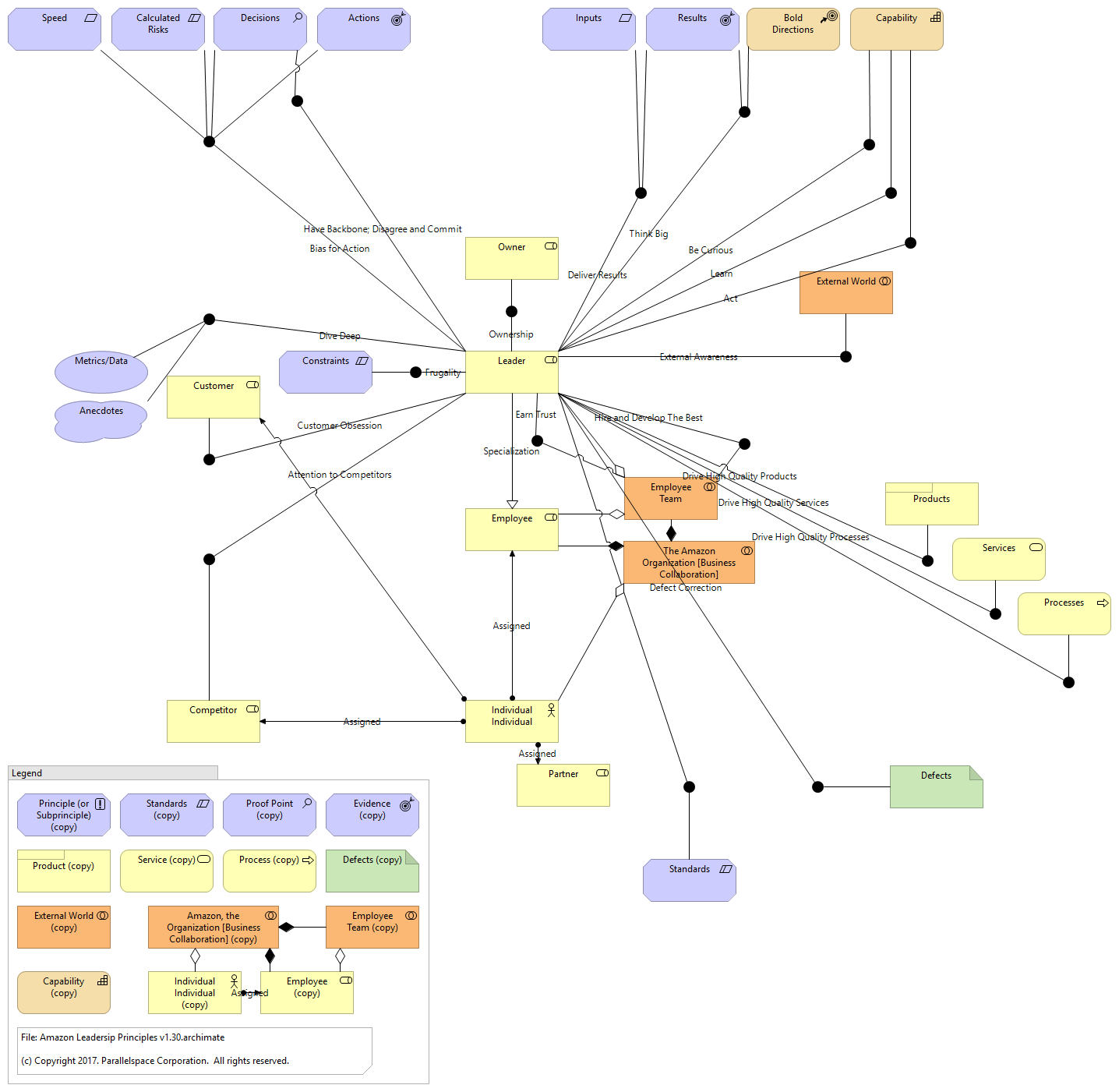
All of the entities and relationships are depicted in Figure 1 below (assuming none or only a few have been overlooked). (Click the figure to enlarge it.)

The entities and relationships were deduced by inspection and analysis of each of the 14 Amazon Leadership Principles (classic business analysis, more or less).

Parallelspace-Amazon Leadership Principles, Roles, and Relationships-P00-Core Entities v1.30

Figure 1. Amazon’s Principles, Core Entities, and Relationships: The Core Model

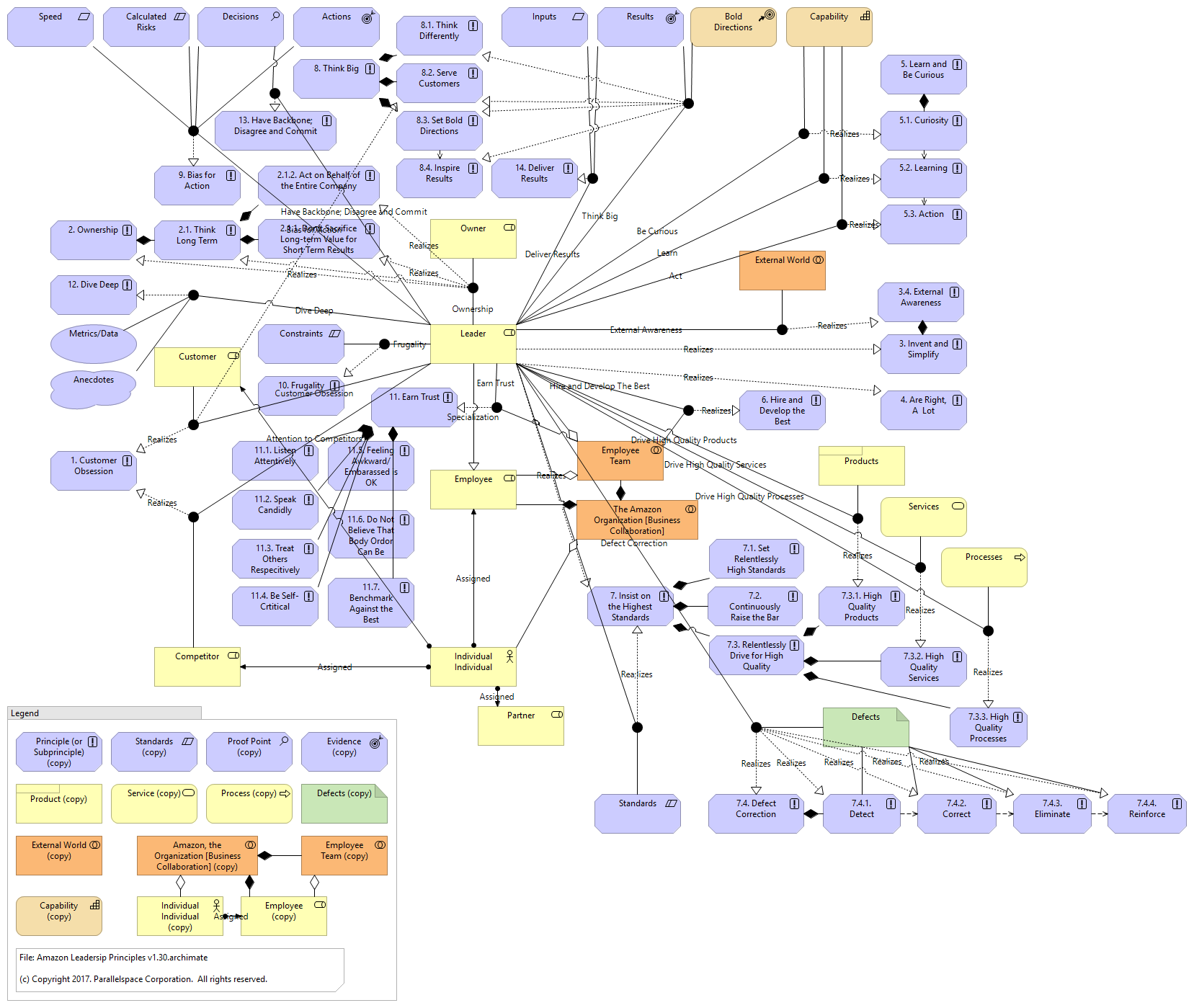
The existence, enablement, creation and/or execution of each group of relationships gives rise to (or realizes) one or more of the 14 Principles (and/or their Subprinciples). When these realization relationships are added to the Core Entities depicted in Figure 1,  Figure 2., the “Complete Model”, is the result. (Click to enlarge.)

Parallelspace-Amazon Leadership Principles, Roles, and Relationships-P00-All v1.30

Figure 2. Amazon’s Principles, Core Entities, and Relationships: The Complete Model

To simplify the understanding of the model, 14 new views were created – one for each of the 14 Principles – each overlayed on the original Core Model (Figure 1). Figure 3 is an example drawn from one of these 14 views: Principle 1. Customer Obsession.

Parallelspace-Amazon Leadership Principles, Roles, and Relationships-P01 v1.30

Figure 3. Amazon’s Principles, Core Entities, and Relationships: Principle 1. Customer Obsession

Located in the lower-left side of Figure 3, the Customer Obsession Principle is realized by:

  • a) a Leader’s focus or “obsession over Customers”, and
  • b) a Leader’s “attention to the Competition”.

Figure 4. below is an animation of the Complete Model overlayed, principle-by-principle, against the Core Model.

This slideshow requires JavaScript.

Figure 4. Amazon’s Principles, Core Entities, and Relationships: Principle-by-Principle Animation overlayed against the Core Model

The individual views of the 14 Amazon Leadership Principles can be downloaded from here: https://www.facebook.com/mwherman/media_set?set=a.10155018158800932.1073741988.635655931&type=3.

So far, we’ve addressed the “what” of the Amazon Leadership Principles depicted as a #Graphitization model projected as a number of different views.

In the next section, the Amazon Leadership Principles are used as a framework for cataloging one’s lifetime experiences and accomplishments. Personal Leadership Principle Maps is an Amazon Leadership Principles application – it’s the Amazon Leadership Principles put into action.

Personal Leadership Principle Maps

Have you been living an Amazon Leadership Principled career/faith/life?

Figure 5. is a copy of my Personal Leadership Principle Map (PLPM).

  • ArchiMate Assessment entities are used to model specific experiences and accomplishments.
  • ArchiMate Outcome entities are used to model specific evidence, learnings, or proof that one has been able to apply the specific principle in their career, faith and/or life.

Parallelspace-Amazon Leadership Principles-Personal Leadership Principle Map-Michael Herman v1.30

Figure 5. Amazon’s Principles: Michael’s Experiences and Accomplishments

In my case, for Principle 7. Insist on the Highest Standards, I have specific experiences related to the recent Toronto Salesforce 2017 Tour, working at Parallelspace Corporation, the IBM Canada Toronto Software Lab, and at Microsoft.

Specific evidence includes:

  • Parallelspace trust framework (Relationships-Reputation-Trust)
  • Working as an ISO-9000 Quality Analyst and a certified Quality Assurance Auditor
  • A concept I call focusing on the success of an Individual Individual
  • Various and diverse experiences working for Microsoft as a full-time employee (blue badge) and as a Microsoft partner

Next Steps for Iteration 2

Possible next steps include:

  • Federation of Personal Leadership Principle Maps – at the Employee Team, business unit, or Organization level to discover the aggregates collective experiences and accomplishments for the purpose of rebalancing hiring objectives (Principle Gap Analysis), accumulating customer as well as competitive intelligence, etc. to support Customer Obsession, Ownership, Invent and Simplify, etc. goals and objectives. Identifying the best sources of experiences and accomplishments for specific Principles based on a Team’s or Organization’s previous roles, education, or training.
  • Use of both the Core Model and the Complete Model as well as the Federate Personal Leadership Principle Maps to create a graph database repository to real-time query analysis and visualization (e.g. using the Neo4j graph database).
  • To support Amazon’s operational data analysis needs (e.g. Amazon Marketplace 3rd Party Retail Data).
  • Apply the Parallelspace principles

References

  1. Continuous Transformation and Transformative Change are key principles of the Total Enterprise Architecture Model (TEAM) (click here)
  2. To dig deeper, check out Graphitization of the Enterprise (click here)
  3. [Enterprise Architecture, Big Data, CRM, ERP, …] Tools and Methods Don’t Generate Business Value (click here)

Appendix A – Amazon Leadership Principles (and Subprinciples)

Below is an ArchiMate enterprise architecture model that depicts (and then decomposes) the 14 Amazon Leadership Principles into multiple levels of subprinciples (as appropriate/as required).

These are based on the text-based defintions of the 14 Principles found in Appendix B – Amazon Leadershp Principles.

Parallelspace-Amazon Leadership Principles (and Subprinciples) v1.30

Figure 6. Amazon’s Principles (and Subprinciples)

Appendix B – Amazon Leadership Principles

The following Leadership Principles are taken directly from the Amazon Jobs website.

  • The sequential numbering (in parenthesis) was added by me.
  • The underlining attempts to highlight the individual Subprinciples and Relationships found in the text description of each of the 14 Principles.

Leadership Principles

Our Leadership Principles aren’t just a pretty inspirational wall hanging. These Principles work hard, just like we do. Amazonians use them, every day, whether they’re discussing ideas for new projects, deciding on the best solution for a customer’s problem, or interviewing candidates. It’s just one of the things that make Amazon peculiar.

Customer Obsession (1)

Leaders start with the customer and work backward. They work vigorously to earn and keep customer trust. Although leaders pay attention to competitors, they obsess over customers.

Ownership (2)

Leaders are owners. They think long term and don’t sacrifice long-term value for short-term results. They act on behalf of the entire company, beyond just their own team. They never say “that’s not my job”.

Invent and Simplify (3)

Leaders expect and require innovation and invention from their teams and always find ways to simplify. They are externally aware, look for new ideas from everywhere, and are not limited by “not invented here”. As we do new things, we accept that we may be misunderstood for long periods of time.

Are Right, A Lot (4)

Leaders are right a lot. They have strong judgment and good instincts. They seek diverse perspectives and work to disconfirm their beliefs.

Learn and Be Curious (5)

Leaders are never done learning and always seek to improve themselves. They are curious about new possibilities and act to explore them.

Hire and Develop the Best (6)

Leaders raise the performance bar with every hire and promotion. They recognize exceptional talent and willingly move them throughout the organization. Leaders develop leaders and take seriously their role in coaching others. We work on behalf of our people to invent mechanisms for development like Career Choice.

Insist on the Highest Standards (7)

Leaders have relentlessly high standards – many people may think these standards are unreasonably high. Leaders are continually raising the bar and driving their teams to deliver high-quality products, services, and processes. Leaders ensure that defects do not get sent down the line and that problems are fixed so they stay fixed.

Think Big (8)

Thinking small is a self-fulfilling prophecy. Leaders create and communicate a bold direction that inspires results. They think differently and look around corners for ways to serve customers.

Bias for Action (9)

Speed matters in business. Many decisions and actions are reversible and do not need extensive study. We value calculated risk taking.

Frugality (10)

Accomplish more with less. Constraints breed resourcefulness, self-sufficiency, and invention. There are no extra points for growing headcount, budget size or fixed expense.

Earn Trust (11)

Leaders listen attentively, speak candidly, and treat others respectfully. They are vocally self-critical, even when doing so is awkward or embarrassing. Leaders do not believe their or their team’s body odor smells of perfume. They benchmark themselves and their teams against the best.

Dive Deep (12)

Leaders operate at all levels, stay connected to the details, audit frequently, and are skeptical when metrics and anecdote differ. No task is beneath them.

Have Backbone; Disagree and Commit (13)

Leaders are obligated to respectfully challenge decisions when they disagree, even when doing so is uncomfortable or exhausting. Leaders have conviction and are tenacious. They do not compromise for the sake of social cohesion. Once a decision is determined, they commit wholly.

Deliver Results (14)

Leaders focus on the key inputs for their business and deliver them with the right quality and in a timely fashion. Despite setbacks, they rise to the occasion and never settle.

Best regards,

Michael Herman
Enterprise Architect and Data Scientist
Parallelspace Corporation
M: 416 524-7702
E: mwherman@parallelspace.net
B: http://hyperonomy.com
L: https://www.linkedin.com/in/mwherman/recent-activity/posts/
Skype: mwherman2000

Living at the intersection of Enterprise Architecture, Enterprise Knowledge, and Data Science

3 Comments

Filed under ArchiMate, Architecture Reference Models, Business Value, continuous transformation, Definitions, Enterprise Architecture, graph database, Graphitization, How do we think, ModelMate, Process, Product Management, Uncategorized

Why Would You Prefer to Work for Amazon (or Facebook) over Microsoft (or Salesforce)? [WIP]

COPYRIGHT © 2016-2017 by Michael Herman, Toronto, Canada. All rights reserved.

This article is a work-in-progress [WIP] placeholder.

Why would you prefer to work for Amazon (or Facebook) over Microsoft (or Salesforce)?

Scenario 1: These are organizations with an unrelenting, unbelievable, and successful focus on happy customers. …a true, genuine, deliberate focus on building and maintaining positive relationships with their customer and partners? Would you choose to work for a Scenario 1 organization? …maybe.

Scenario 2: These are the other companies that really need your help and are willing to hire you to help make the important changes necessary to develop the same sort of unrelenting focus on building and maintaining positive customer and partner relationships Would you choose to work for a Scenario 1 organization? …maybe.

I have the option (luxury) to consider all 4 types of opportunities and in each case, work with some brilliant people. Which organization(s) would you pick?

With a Scenario 2 company, you’re starting work working for an organization in a net deficit position with respect to customer happiness, respect, and trust. Job one is to move the organization from a net negative position to a net neutral or, hopefully, positive position in the marketplace; then build of there. If you know or deeply understand the Scenario 2 company, you’re likely being asked “to return and to help” as a trusted soldier. You likely know and understand the root causes that have landed the organization at the bottom of the ladder of customer satisfaction.

With a Scenario 1 company, you’re starting work working for an organization in a net positive position with respect to customer happiness, respect, and trust. There is no Job one because the organization already has a great positive report with its customer and partners – not just its largest revenue-generating customers but all customers; from

  • Individual individuals

up through

  • Single-person corporations,
  • Two-person partnerships,
  • Small businesses/enterprises,
  • Medium size businesses/enterprises,
  • Large businesses/enterprises, and
  • Extra large businesses/enterprises.

Scenario 1 organizations are already at or near the top of the customer satisfaction mountain and are only striving to be even better. They and yourself are not starting work each day working in a negative hole. Thriving is thriving …thriving to be your best from a positive starting position of customer and partner happiness, respect, and trust.

Scenario 2 organizations start work each day in a negative hole. Yes, there may be places where, on some days, you can stand on something to see over the top of the hole and things don’t look so dreary …but it’s not guaranteed …and it’s neither fun nor enjoyable to work there every day. Thriving is equivalent to surviving.  #NotFun

Amazon

TODO

#Graphitization of the Amazon Leadership Principles (introducing Personal Leadership Principle Maps) – Iteration 1

#Graphitization of the Amazon Leadership Principles (introducing Personal Leadership Principle Maps) – Iteration 1

TODO

Facebook

TODO

Microsoft

TODO

Salesforce

TODO

Best regards,

Michael Herman
Enterprise Architect and Data Scientist
Parallelspace Corporation
M: 416 524-7702
E: mwherman@parallelspace.net
B: http://hyperonomy.com
L: https://www.linkedin.com/in/mwherman/recent-activity/posts/
Skype: mwherman2000

Living at the intersection of Enterprise Architecture, Enterprise Knowledge, and Data Science

Leave a comment

Filed under Uncategorized

High-Velocity Service Packages and Envelopes [WIP]

COPYRIGHT © 2016-2017 by Michael Herman, Toronto, Canada. All rights reserved.

This article is a work-in-progress [WIP] placeholder.

TODO

Introduction

TODO

Scenario

TODO

Problem

TODO

Analysis

TODO

Options

TODO

Solution

TODO

High-Velocity Service Envelopes (HVSE)

TODO

High-Velocity Service Packages (HVSP)

TODO

Results

TODO

Next Steps

TODO

Conclusions

TODO

Best regards,

Michael Herman
Enterprise Architect and Data Scientist
Parallelspace Corporation
M: 416 524-7702
E: mwherman@parallelspace.net
B: http://hyperonomy.com
L: https://www.linkedin.com/in/mwherman/recent-activity/posts/
Skype: mwherman2000

Living at the intersection of Enterprise Architecture, Enterprise Knowledge, and Data Science

Leave a comment

Filed under Uncategorized

Isomorphic Weighted Graph Databases and Graph Algorithm Non-Collinearity [WIP]

COPYRIGHT © 2016-2017 by Michael Herman, Toronto, Canada. All rights reserved.

This article is a work-in-progress.

Introduction

TODO

Isomorphic Weighted Graphs

TODO

Definitions

TODO

isomorphic

TODO

Weighted Graph Database Scenarios

TODO

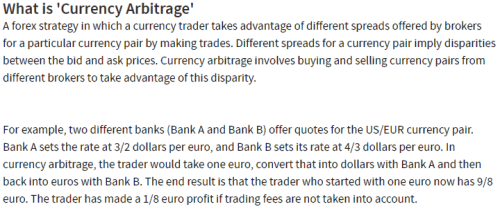
  1. Project “Matt-itrage”: Real-time, Multiple Provider, Foreign Currency Arbitrage
  2. “Expedia for Azure, AWS, and/or Salesforce”: Automated Cloud Services Composition
  3. Project “Boston”: Personal, Hyper-scalable Homeland Security Databases – Federation Optional
  4. TEAM: Large Scale, Automated Total Enterprise Architecture Management
  5. TEBD: Large Scale, Automated Total Enterprise Big Data Routing and Streaming

TODO

1. Project “Matt-itrage”: Real-time, Multiple Provider, Foreign Currency Arbitrage

TODO

Currency Arbitrage

TODO

2. “Expedia for Azure, AWS, and/or Salesforce”: Automated Cloud Services Composition

TODO

3. Project “Boston”: Personal, Hyper-scalable Homeland Security Databases (Federation Optional)

TODO

4. TEAM: Large Scale, Automated Total Enterprise Architecture Management

TODO

5. TEBD: Large Scale, Automated Total Enterprise Big Data Routing and Streaming

TODO

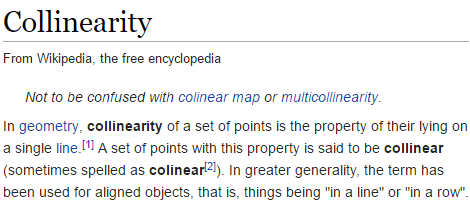
Graph Algorithm Non-Collinearity

TODO

Definitions

TODO

collinear

TODO

collinearity

TODO

Best regards,

Michael Herman
Enterprise Architect and Data Scientist
Parallelspace Corporation
M: 416 524-7702
E: mwherman@parallelspace.net
B: http://hyperonomy.com
L: https://www.linkedin.com/in/mwherman/recent-activity/posts/
Skype: mwherman2000

Living at the intersection of Enterprise Architecture, Enterprise Knowledge, and Data Science

1 Comment

Filed under Uncategorized

Structuring Small Powerful Documents

COPYRIGHT © 2016-2017 by Michael Herman, Toronto, Canada. All rights reserved.

For the past couple weeks now, I’ve been on the left coast visit with friends and colleagues and having an extraordinary time. Often, the conversation returns to what is the best way to convince someone or some group to do this or that.  Here’s some ideas and templates to consider based on my past experiences:

  • Notes from the Field
  • Product Planning Cycles
  • Project Business Charter
  • Preliminary Vision and Scope Document
  • Jeff Bezzo’s Amazon 6-Pager

Notes from the Field

Parts

  • Introduction
  • Scenario
  • Problem
  • Analysis
  • Options
  • Solution
  • [Preliminary] Results
  • Summary

Sample Templates

Product Planning Circles

Sample Templates

Project Business Charter

Parts

  • Business Project Description
  • Deliverables
  • Project Scope / Boundaries / Assumptions
  • Project Accountability
  • Stakeholders
  • Project Execution Risks Summary and Mitigation Options
  • Project Cost Estimate
  • Links to Supporting Documentation

Sample Templates

Preliminary Vision and Scope Document

Also known as an Engagement Transition Document

Parts

  • OVERVIEW
  • PROBLEM STATEMENT
  • BUSINESS OBJECTIVES
  • EXISTING ENVIRONMENT
  • USER PROFILES
  • SOLUTION VISION
  • PROJECT SCOPE
  • CRITICAL SUCCESS FACTORS
  • IMPORTANT DATES
  • OTHER ASSUMPTIONS AND CONSTRAINTS

Sample Templates

Jeff Bezo’s Amazon 6-Pager

Parts

[The six-page narratives are structured] like a dissertation defense:

  1. The context or question.
  2. Approaches to answer the question – by whom, by which method, and their conclusions
  3. How is your attempt at answering the question different or the same from previous approaches
  4. Now what? – that is, what’s in it for the customer, the company, and how does the answer to the question enable innovation on behalf of the customer?

(via Amazon: How are the 6 page “narratives” structured in Jeff Bezos S-Team meetings? – Quora)

Sample Templates

  • None available (yet)

Best regards,
Michael Herman (Toronto)
Parallelspace Corporation
mwherman@parallelspace.net

Leave a comment

Filed under Uncategorized

Crossing the EA Chasm: Re-visioning ArchiMate 3.0 Elements as Adjectives [WIP]

COPYRIGHT © 2016-2017 by Michael Herman, Toronto Canada. All rights reserved.

[NOTE: This is a work-in-progress (WIP) placeholder for an article I plan to write …likely sooner rather than later …but there’s no specific schedule.]

Basic Concepts: Nouns and Adjectives

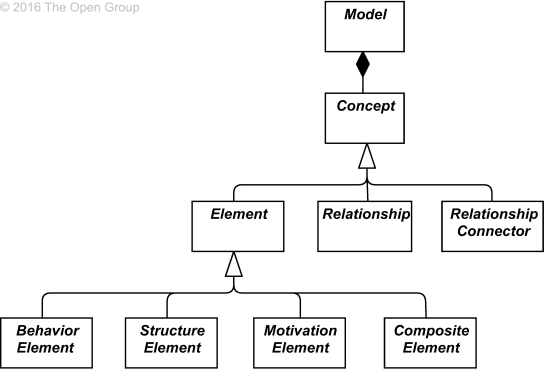
Referring to Figure 1 below, imagine that there are only a small number of concrete concepts in the ArchiMate language:

  • Model,
  • Concept

…and the remaining concepts are simply derivations of the one of these two Nouns: Model or Concept.

figure-1-top-level-hierarchy-of-archimate-concepts

Figure 1. Top-Level Hierarchy of ArchiMate Concepts (The Open Group)

Model and Concept become new Nouns in the next to-be-updated version of the ModelMate Information Architecture for ArchiMate.

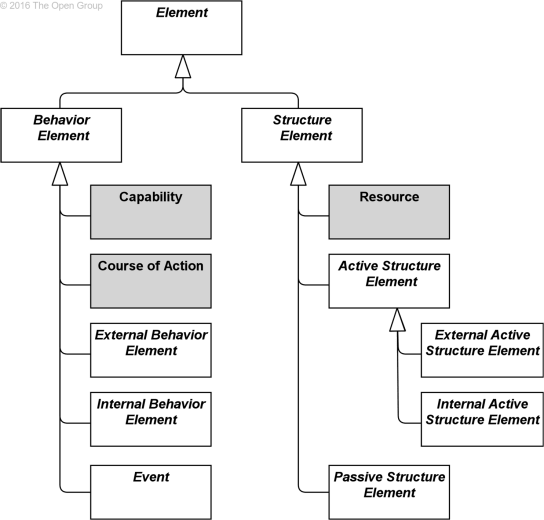
The remaining concepts in Figure 1 and Figure 2 become Adjectives (i.e. abstract or virtual concepts) that modify or specialize the behavior of the target concept. The purpose of an Adjective (and more often a collection of Adjectives) is to support specialization of a Noun.

For example, in Figure 2 below, the box entitled “Capability” is a Concept which inherits the following Adjectives (specializations):

  • Element_ModelMate30_Parallelspace
  • BehaviorElement_ModelMate30_Parallelspace

figure-4-hierarchy-of-behavior-and-structure-elements

Figure 2. Hierarchy of Behavior and Structure Elements (The Open Group)

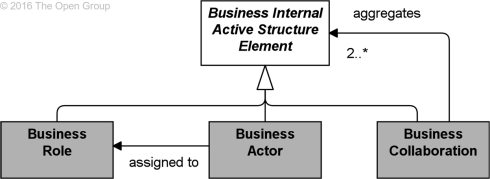
For a more elaborate example (see Figure 3 below), Business Role, Business Actor, and Business Collaboration are Nouns which inherit the following Adjectives:

  • Element_ModelMate30_Parallelspace
  • BusinessElement_ModelMate30_Parallelspace
  • InternalActiveStructureElement_ModelMate30_Parallelspace

figure-50-business-internal-active-structure-elements

Figure 3. Business Internal Active Structure Elements (The Open Group)

Windows Server Windows Service Example

TODO

1 Comment

Filed under Uncategorized

How do I model “X” using ArchiMate?

As a follow-on to a recent “How to I model X using ArchiMate” question in the LinkedIn ArchiMate group  (Modelling Blockchain technology), there are some standard questions that need to be answered before one can provide a good answer to a “How to I model X using ArchiMate” question:

  • In terms of level of detail, are you looking for a
    • Conceptual architecture view
    • Logical architecture view
    • Physical architecture view
    • Ecosystem view
  • Which architecture layers are you primarily interested in?
    • Corporate Strategy
    • Enterprise Architecture Strategy
    • Business Architecture
    • Application Architecture
    • Technology Architecture
    • Physical Architecture
    • Implementation and Migration Plan
    • …or, in the case of the Blockchain example, are you interested in a model of the entire ecosystem?

For example, at the highest level, are you interested in an ArchiMate representation of an entire ecosystem? …the Blockchain ecosystem, in this example.

firstpartner-blockchain-market-map_evaluation-v1-0-30-11-15-page-001

Figure 1. Blockchain Ecosystem (2016)

…or the following? …a conceptual ArchiMate model of the Blockchain protocol (which is the key technical essence or differentiator that Blockchain represents).

parallelspace-blockchain-procotol-archimate-1-0-1

Figure 2. Blockchain Protocol: Conceptual Architecture

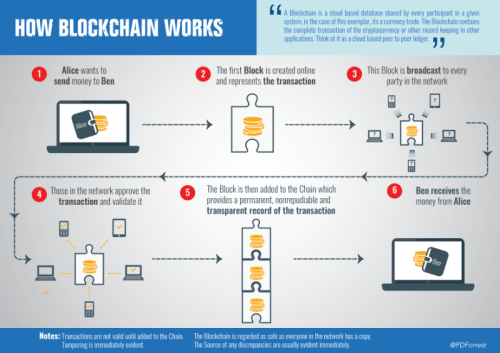
…or something in between like the following process model (if represented in ArchiMate)? For example, the following diagram is a standard diagram used in a large number of Blockchain presentations.

how-blockchain-works-linkedin

Figure 3. “How Blockchain Works” Process Model

Best regards,
Michael Herman (Toronto)
Parallelspace Corporation
mwherman@parallelspace.net

*ArchiMate is a registered trademark of The Open Group.

2 Comments

Filed under Uncategorized