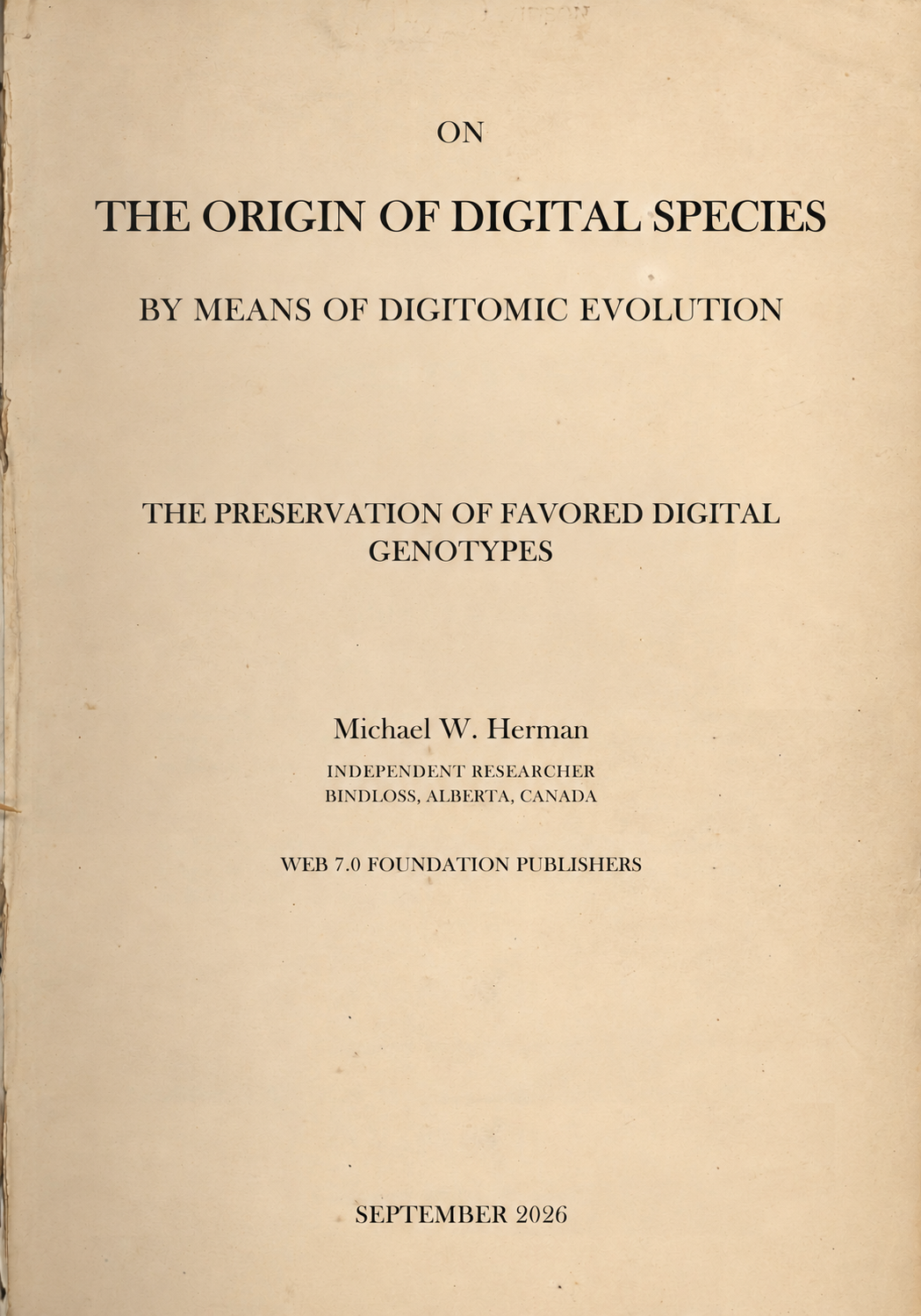
Copyright © 2026 Michael Herman (Bindloss, Alberta, Canada) – Creative Commons Attribution-ShareAlike 4.0 International Public License. Made in Canada
Abstract
Digital evolution research has established that computational organisms can replicate, mutate, recombine, adapt, and accumulate heritable change. This paper asks whether those mechanisms can be generalized from digital organisms to a hypothetical class of persistent digital persons. It develops a conceptual framework in which digital reproduction is not equivalent to copying an agent or instantiating a software artifact, but instead constitutes the transmission and transformation of heritable information from which a new digital person develops. The framework distinguishes digital genotype, digital phenotype, persistent identity, autobiographical memory, inherited memory, and lineage. It further proposes that inheritance may be multidimensional, encompassing not only architectural characteristics but also knowledge, understanding, skills, values, cultural information, and selected representations of experience.
Download the Paper
Keywords
digital genetics; digital organisms; digital persons; digital reproduction; genotype–phenotype mapping; digitomic inheritance; developmental evolution; directed evolution; capability optimization; bidirectional lineage transfer; digital identity; inherited memory.