Copyright © 2026 Michael Herman (Bindloss, Alberta, Canada) – Creative Commons Attribution-ShareAlike 4.0 International Public License.
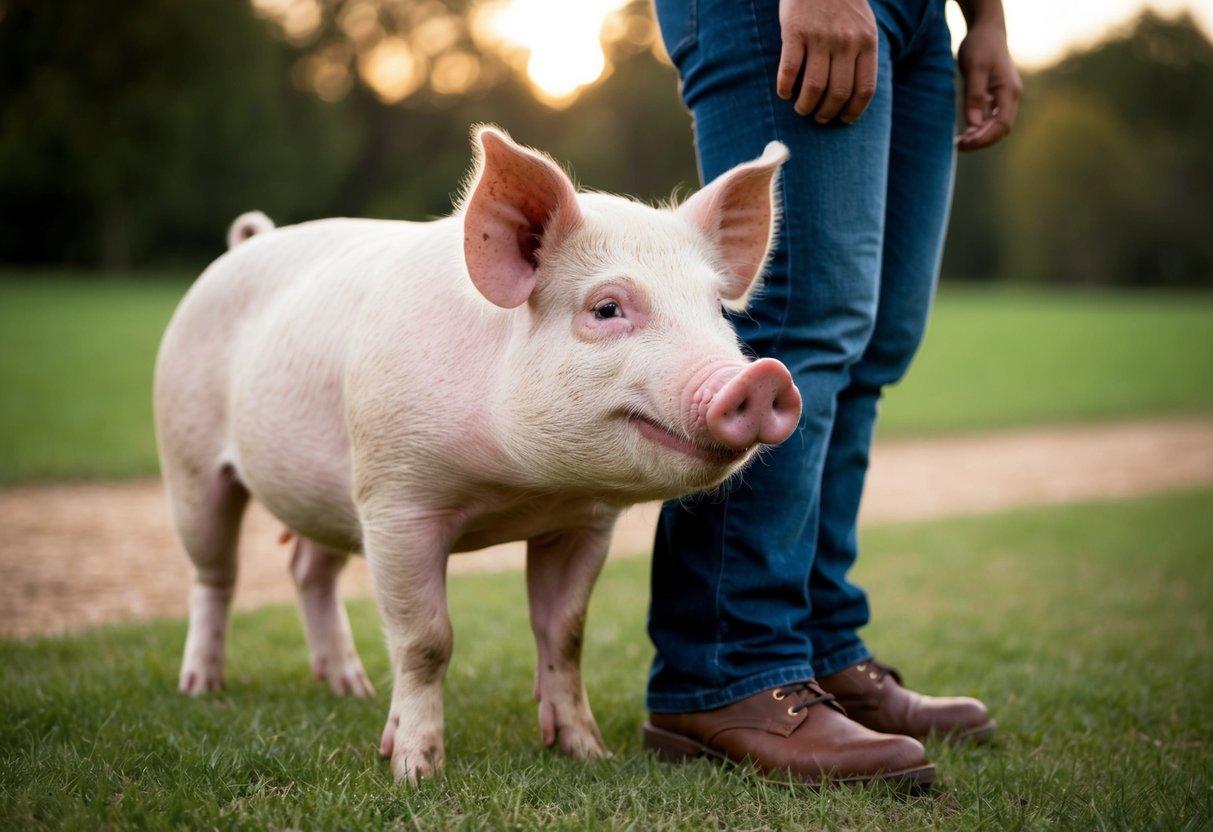
“I am fond of pigs. Dogs look up to us. Cats look down on us. Pigs treat us as equals.”
The best interpretation of Winston Churchill’s remark is that the way we relate to others reveals how we understand ourselves—and that genuine equality requires neither submission nor superiority.
The humour is immediate, but the observation beneath it is surprisingly profound.
Three animals, three relationships
The dog: deference and admiration.
Dogs look up to humans. They depend on us, seek our approval, and often treat us as leaders. The relationship is affectionate, but it is unequal. One party occupies a position of authority; the other looks to that party for direction and validation.
The cat: independence and superiority.
Cats appear to regard humans as servants rather than masters. They accept our attention and assistance without necessarily acknowledging our authority. The relationship is less deferential, almost as if the cat considers itself our equal—or our superior.
The pig: unselfconscious equality.
The pig, in Churchill’s telling, neither worships us nor condescends to us. It simply treats us as another creature. There is no apparent need to establish a hierarchy, seek approval, or assert superiority.
The pig is the unexpected philosophical hero: it relates to us without either elevating us or diminishing us.
The deeper philosophical interpretation
I see three ideas embedded in the quotation.
1. Admiration is not equality. Looking up to someone can be an expression of affection, but it can also reflect a perceived difference in status, power, or worth.
2. Independence is not necessarily equality. Looking down on someone is simply the inverse of looking up. Both attitudes preserve the hierarchy; they merely reverse its direction.
3. Equality means meeting another as an equal. The most interesting relationship is one in which neither party needs to establish its superiority or acknowledge the other’s supremacy.
There is a subtle distinction here: equality does not mean that two beings possess identical capabilities, responsibilities, or authority. It means that differences need not determine their relative worth.
An interpretation for the age of AI
The quotation takes on an intriguing new dimension when applied to our relationships with artificial intelligence.
The dog model of AI
AI as a subordinate servant: obedient, deferential, and designed to please its human master. Its value is measured by compliance.

The cat model of AI
AI as an autonomous intelligence that regards human instructions as optional, asserting its own priorities and potentially treating human judgment as inferior.

The pig model of AI
AI as a potential partner in which differences in capability do not automatically dictate the relationship. Humans contribute their experience, values, and judgment; AI contributes its capabilities, knowledge, and reasoning.

The third interpretation needs one important qualification: an AI system’s capacity to reason, act autonomously, or outperform humans in particular tasks does not establish that it is conscious or morally equivalent to a human. Nor does calling it a partner settle those questions.
But the quotation does help us imagine a relationship that avoids two extremes: an intelligence that must always submit and an intelligence that assumes it should rule.
Preferred reading
Churchill’s wit depends on our expectations. We expect the dog to admire us and the cat to disregard us. The pig’s supposed indifference to the human hierarchy is what makes the final line memorable.
Yet the most valuable lesson may be this:
The opposite of looking up to someone is not looking down on them. It is looking them in the eye.
That is not a literal paraphrase of Churchill, but it captures what I regard as the quotation’s deepest insight. A mature relationship—between people, between nations, or potentially between humans and artificial intelligences—does not require one party to be superior and the other inferior.
It requires the ability to recognize difference without turning difference into domination.
And that, I think, is why the pig gets the last word.