
Create your own magic with Web 7.0 AgenticOS™. Imagine the possibilities.
Copyright © 2025 Michael Herman (Bindloss, Alberta, Canada) – Creative Commons Attribution-ShareAlike 4.0 International Public License

Create your own magic with Web 7.0 AgenticOS™. Imagine the possibilities.
Copyright © 2025 Michael Herman (Bindloss, Alberta, Canada) – Creative Commons Attribution-ShareAlike 4.0 International Public License
Filed under Uncategorized
Create your own magic with Web 7.0 DIDLibOS™ / TDW AgenticOS™. Imagine the possibilities.
Copyright © 2025 Michael Herman (Bindloss, Alberta, Canada) – Creative Commons Attribution-ShareAlike 4.0 International Public License
Web 7.0™, Web 7.0 DILibOS™, TDW AgenticOS™, TDW™, Trusted Digital Web™ and Hyperonomy™ are trademarks of the Web 7.0 Foundation. All Rights Reserved.
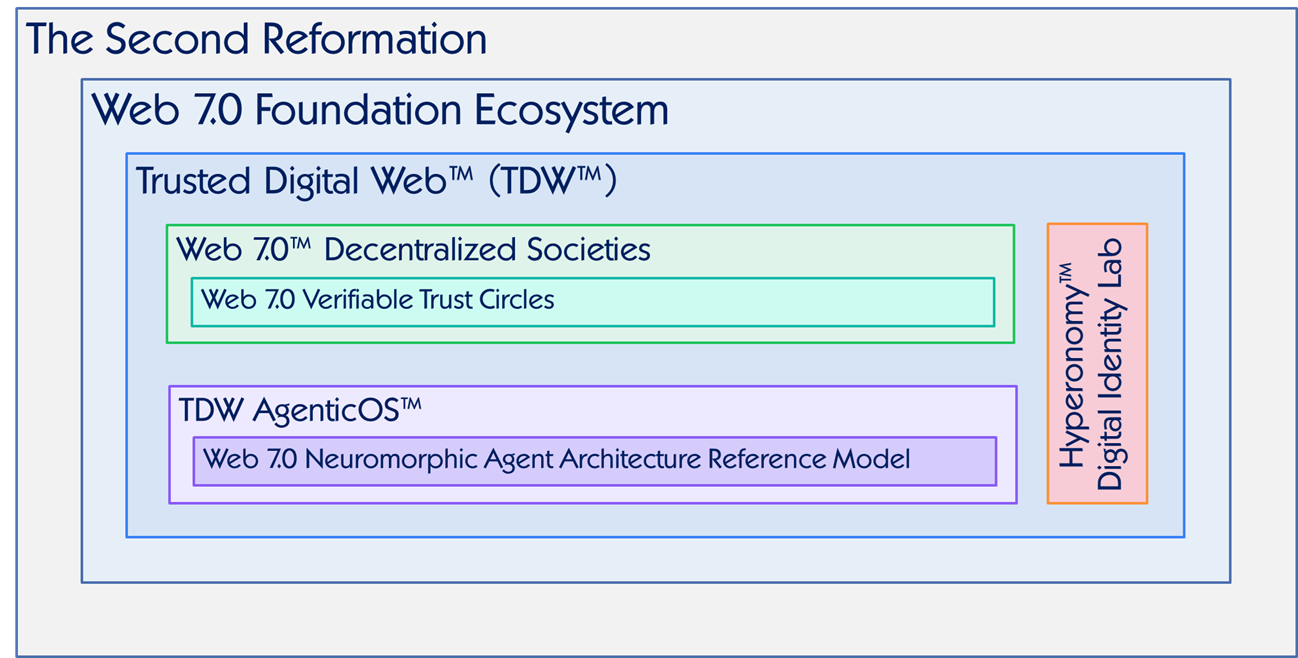
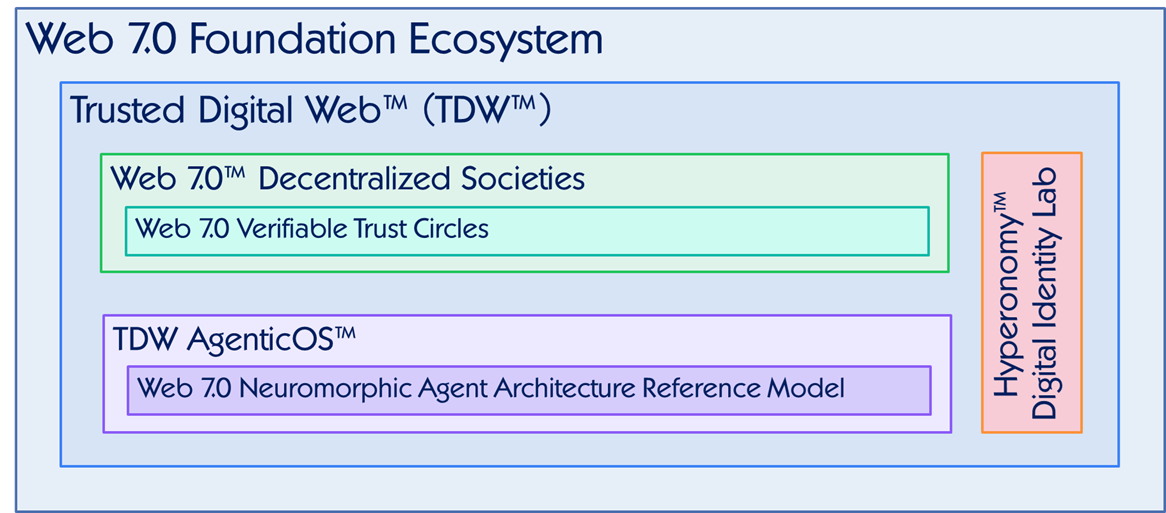
This article describes Web 7.0™ and TDW AgenticOS ™ – with a specific focus on the Web 7.0 Neuromorphic Agent Architecture Reference Model (NAARM) used by TDW AgenticOS™ to support the creation of Web 7.0 Decentralized Societies.
The intended audience for this document is a broad range of professionals interested in furthering their understanding of TDW AgenticOS for use in software apps, agents, and services. This includes software architects, application developers, and user experience (UX) specialists, as well as people involved in a broad range of standards efforts related to decentralized identity, verifiable credentials, and secure storage.
“Web 7.0 is a unified software and hardware ecosystem for building resilient, trusted, decentralized systems using decentralized identifiers, DIDComm agents, and verifiable credentials.”
Michael Herman, Trusted Digital Web (TDW) Project, Hyperonomy Digital Identity Lab, Web 7.0 Foundation. January 2023.

TDW AgenticOS™ is a macromodular, neuromorphic agent platform for coordinating and executing complex systems of work that is:
TDW AgenticOS™ is 100% Albertan by birth and open source.
Project “Shorthorn” is a parody project name based on Microsoft’s Windows “Longhorn” WinFS project (a SQL-based Windows File System project) with which the author was involved in from a design preview and feedback, consulting, and PM technical training (Groove Workspace system architecture and operation) perspectives (circa 2001-2002).
What makes Shorthorns great:
– They’re good at turning grass into meat (great efficiency).
– Shorthorn cows are amazing mothers and raise strong, healthy calves (nurture great offspring).
– Their genetics blend well with other breeds for strong hybrid calves (plays well with others).
…and so it is with TDW AgenticOS™.
The Web 7.0 Foundation, a federally-incorporated Canadian non-profit corporation, is chartered to develop, support, promote, protect, and curate the Web 7.0 ecosystem: TDW AgenticOS operating system software, and related standards and specifications. The Foundation is based in Alberta, Canada.
What we’re building at the Web 7.0 Foundation is described in this quote from Don Tapscott and co.:
“We see an alternate path: a decentralized platform for our digital selves, free from total corporate control and within our reach, thanks to co-emerging technologies.”
“A discussion has begun about “democratizing AI.” Accessibility is critical. Mostaque has argued that the world needs what he calls “Universal Basic AI.” Some in the technology industry have argued that AI can be democratized through open source software that is available for anyone to use, modify, and distribute. Mostaque argues that this is not enough. “AI also needs to be transparent,” meaning that AI systems should be auditable and explainable, allowing researchers to examine their decision-making processes. “AI should not be a single capability on monolithic servers but a modular structure that people can build on,” said Mostaque. “That can’t go down or be corrupted or manipulated by powerful forces. AI needs to be decentralized in both technology, ownership and governance.” He’s right.”
You to the Power Two. Don Tapscott and co. 2025.
The Web 7.0 project has roots dating back approximately 30 years to before 1998 with the release of Alias Upfront for Windows. Subsequent to the release of Upfront (which Bill Gates designated as the “most outstanding graphics product for Microsoft Windows 3.0”), the AUSOM Application Design Framework was formalized.
AUSOM is an acronym for A User State of Mind — the name of a framework or architecture for designing software applications that are easier to design, implement, test, document and support. In addition, an application developed using the AUSOM framework is more capable of being: incrementally enhanced, progressively installed and updated, dynamically configured and is capable of being implemented in many execution environments. This paper describes the Core Framework, the status of its current runtime implementations and its additional features and benefits.
The AUSOM Application Design Framework, developed in 1998, is a new way to design client-side applications. The original implementation of the framework is based on a few basic concepts: user scenarios and detailed task analysis, visual design using state-transition diagrams, and implementation using traditional Windows message handlers.
The original motivation for the framework grew out of the need to implement a highly modeless user interface that was comprised of commands or tasks that were very modal (e.g. allowing the user to change how a polygon was being viewed while the user was still sketching the boundary of the polygon).
To learn more, read The AUSOM Application Design Framework whitepaper.
The following is essentially the same advice I received from Charles Simonyi when we were both at Microsoft (and one of the reasons why I eventually left the company in 2001).
“No problem can be solved from the same level of consciousness that created it.” [Albert Einstein]
“The meaning of this quote lies in Einstein’s belief that problems are not just technical failures but outcomes of deeper ways of thinking. He suggested that when people approach challenges using the same assumptions, values, and mental habits that led to those challenges, real solutions remain out of reach. Accoding to this idea, improvement begins only when individuals are willing to step beyond familiar thought patterns and question the mindset that shaped the problem.” [Economic Times]
Simonyi et al., in the paper Intentional Software, state:
For the creation of any software, two kinds of contributions need to be combined even though they are not at all similar: those of the domain providing the problem statement and those of software engineering providing the.implementation. They need to be woven together to form the program.
TDW AgenticOS is the software for building decentralized societies.
“Before the next century is over, human beings will no longer be the most intelligent or capable type of entity on the planet. Actually, let me take that back. The truth of that last statement depends on how we define human.” Ray Kurzweil. 1999.
NOTE: “Artificial Intelligence” (or “AI”) does not appear anywhere in the remainder of this article. The northstar of the Web 7.0 project is to be a unified software and hardware ecosystem for building resilient, trusted, decentralized systems using decentralized identifiers, DIDComm agents, and verifiable credentials – regardless of whether the outcome (a Web 7.0 network) uses AI or not. Refer to Figures 4a, 4b, and 6 for a better understanding.
DIDComm Notation, a visual language for architecting and designing decentralized systems, was used to create the figures in this article.
Business Analyst – Ability to design and execute, secure, trusted business processes of arbitrary complexity across multiple parties in multiple organizations – anywhere on the planet.
Global Hyperscaler Administrators – Ability to design and execute, secure, trusted systems administration processes (executed using PowerShell) of arbitrary complexity across an unlimited number of physical or virtual servers hosted by an unlimited number of datacenters, deployed by multiple cloud (or in-house) xAAS providers – anywhere on the planet.
App Developers – Ability to design, build, deploy, and manage secure, trusted network-effect-by-default apps of arbitrary complexity across multiple devices owned by anybody – anywhere on the planet.
Smartphone Vendors – Ability to upsell a new category of a second device, a Web 7.0 Always-on Trusted Digital Assistant – a pre-integrated hardware and software solution, that pairs with the smart device that a person already owns. Instead of a person typically purchasing/leasing one smartphone, they can now leverage a Web 7.0-enabled smartphone bundle that also includes a secure, trusted, and decentralized communications link to a Web 7.0 Always-on Trusted Digital Assistant deployed at home (or in a cloud of their choosing).
Digital Church/Religion Builders – Ability to create a new decentralized digital religion for 1 billion people in Communist China.
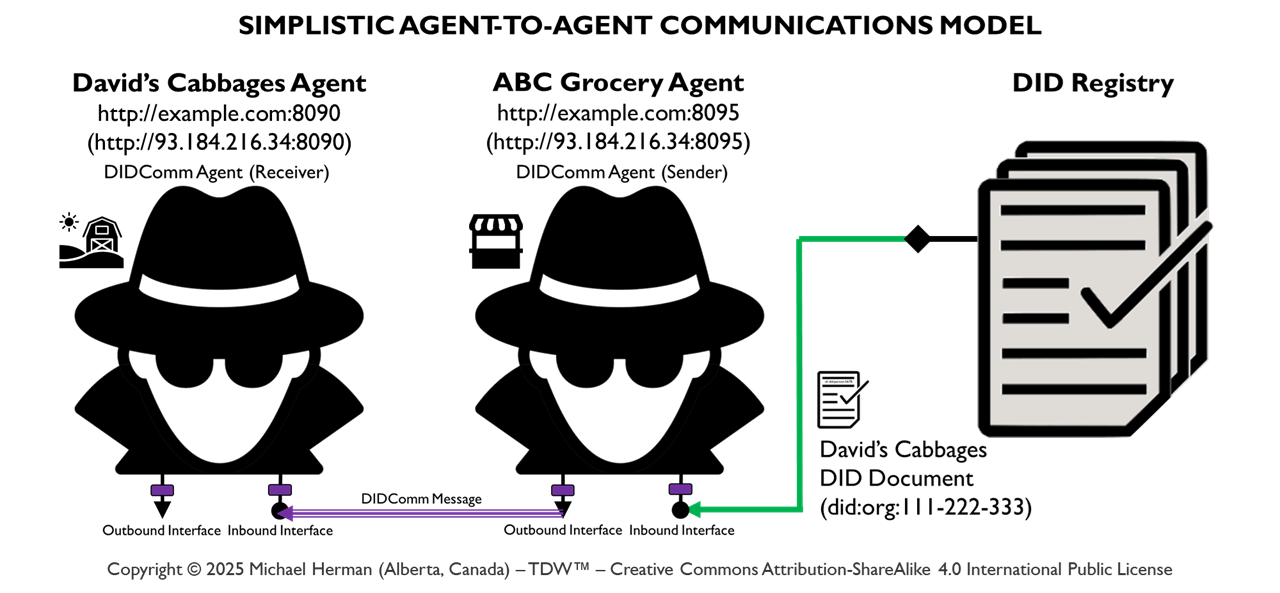
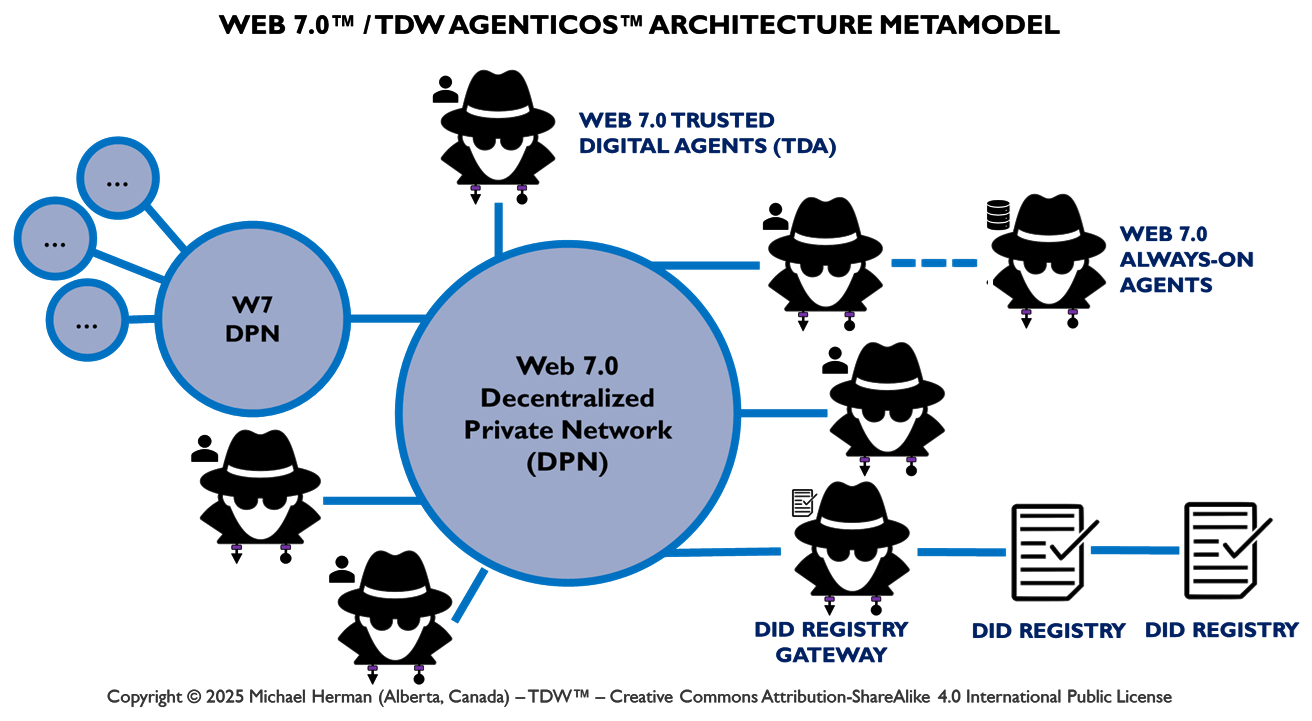
Figure 0. depicts the design of a typical simple agent-to-agent communications model. DIDComm Notation was used to create the diagram.
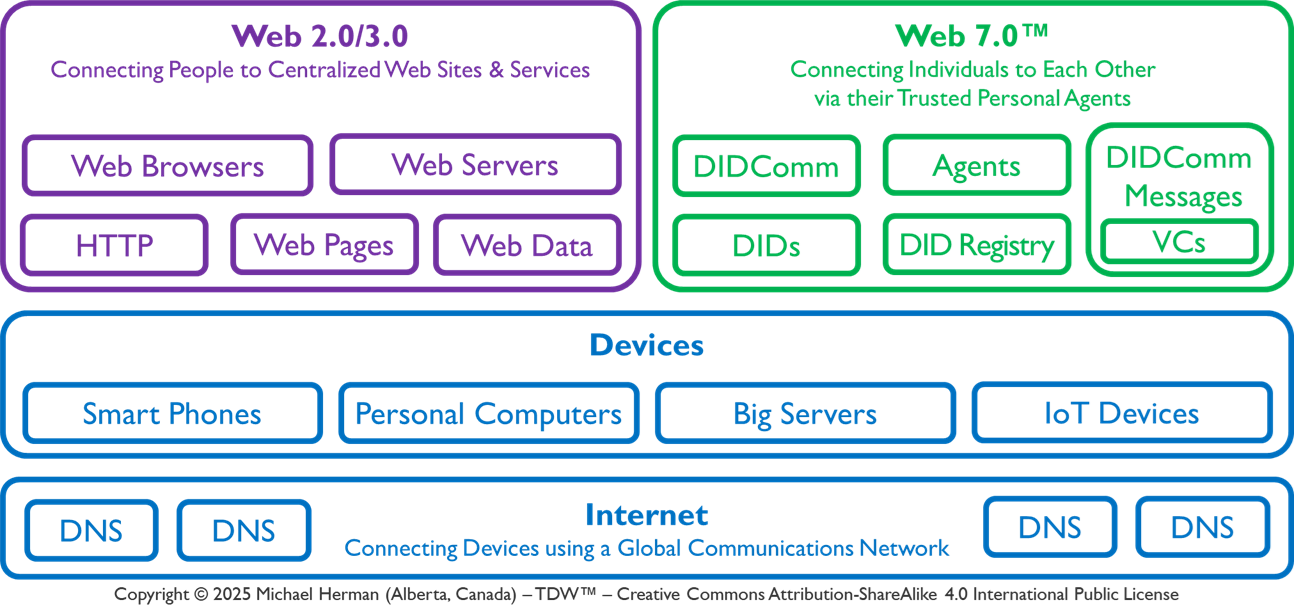
The Web 7.0 architecture is illustrated in the following figure.
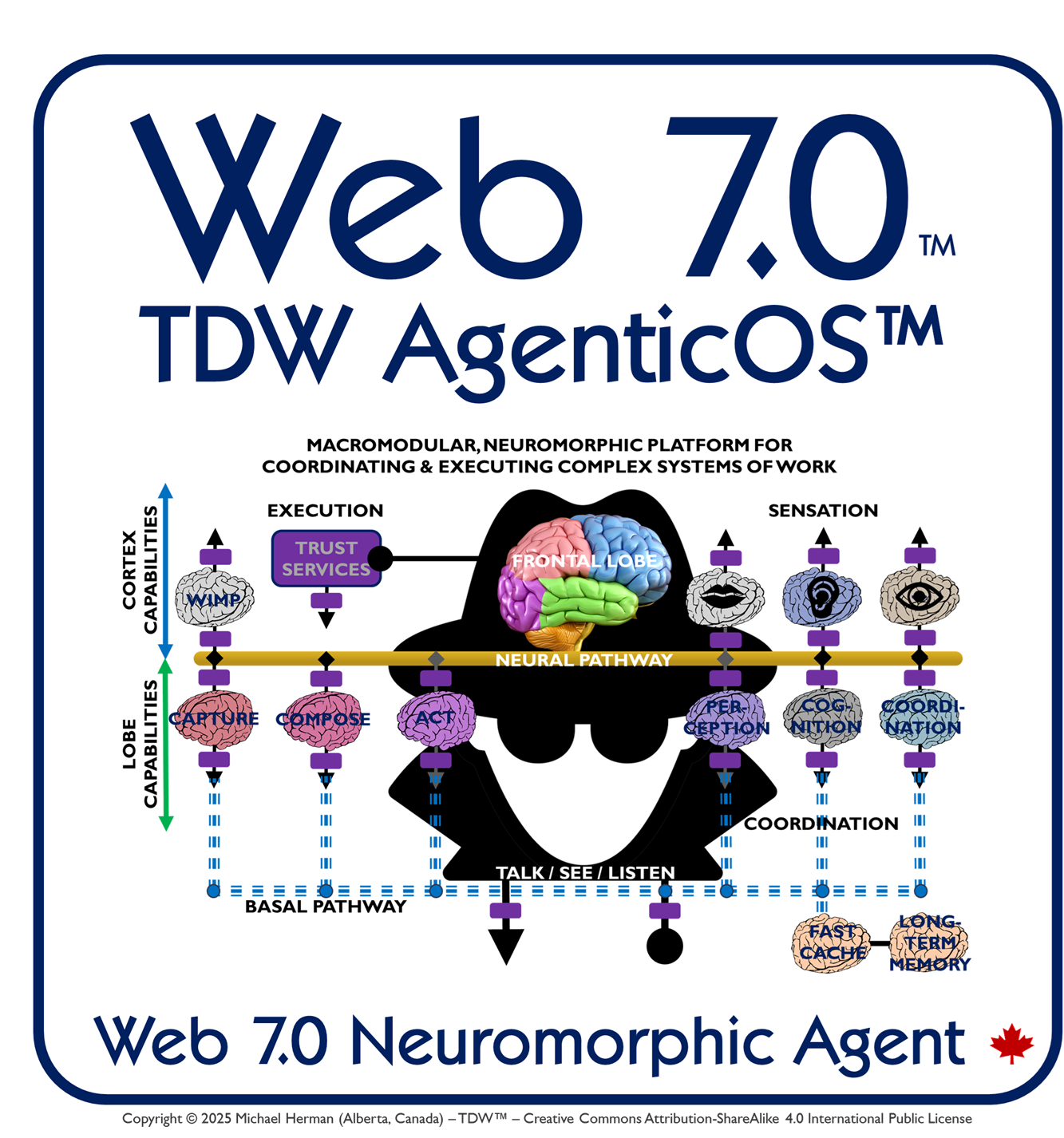
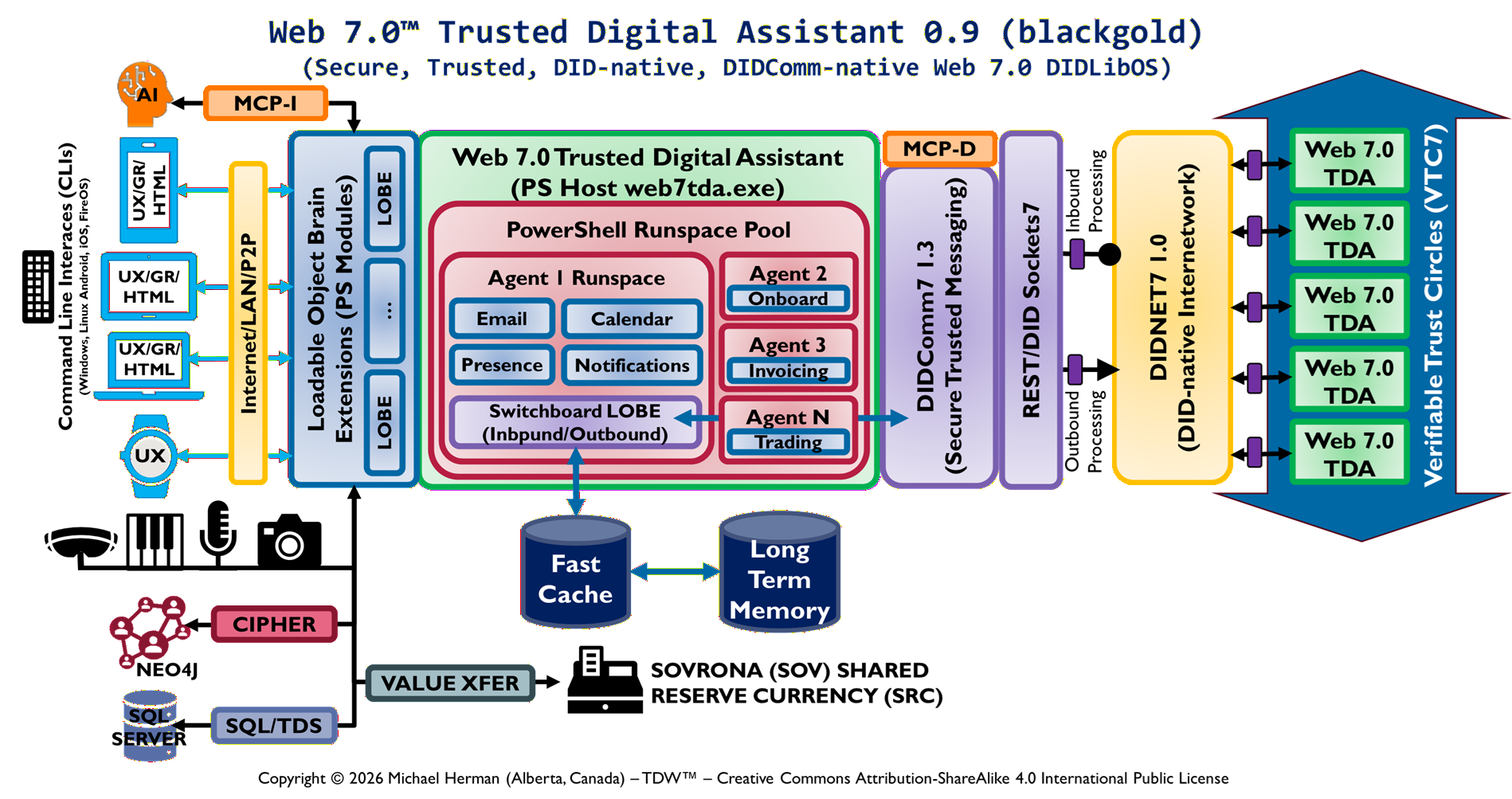
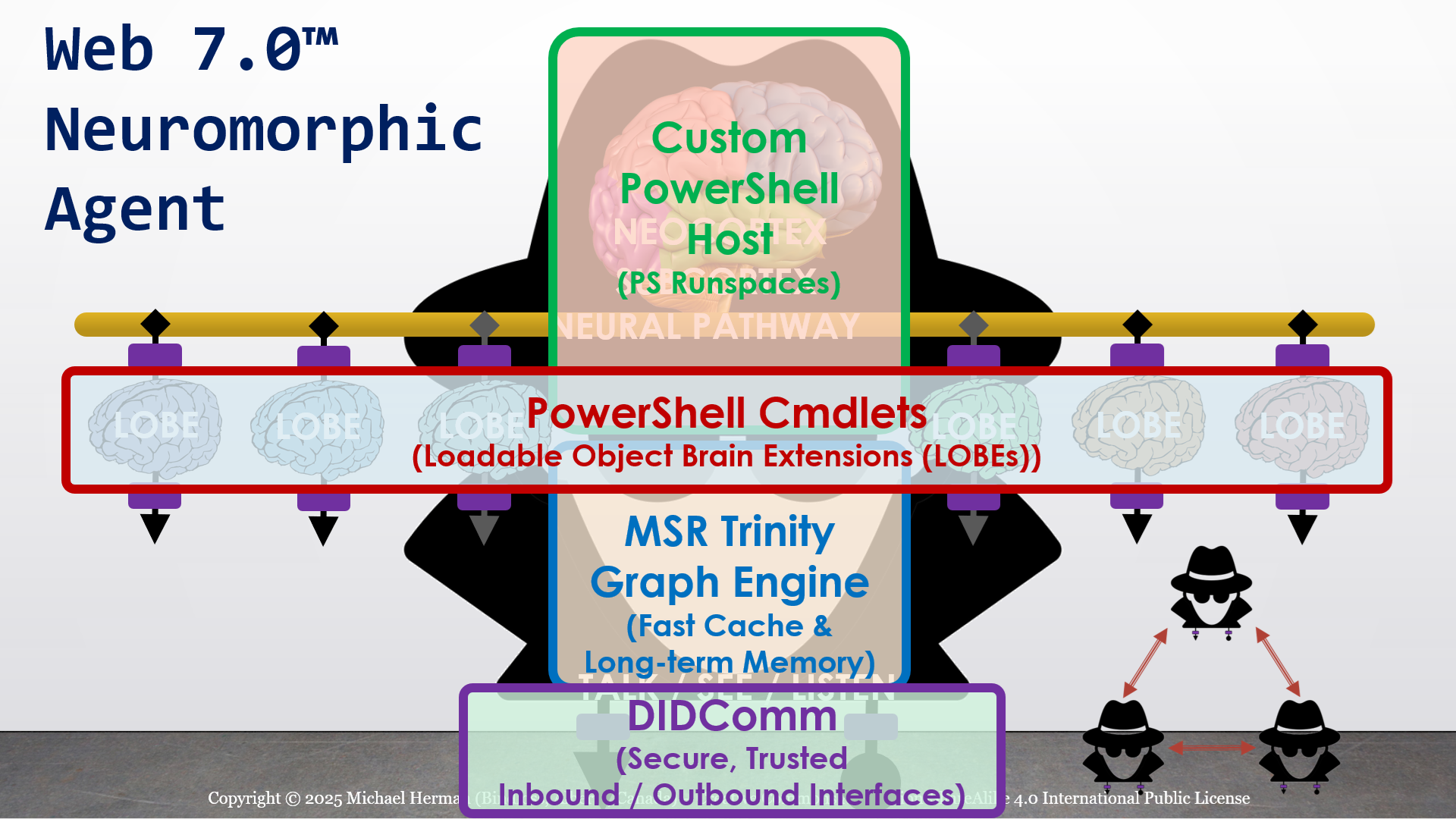
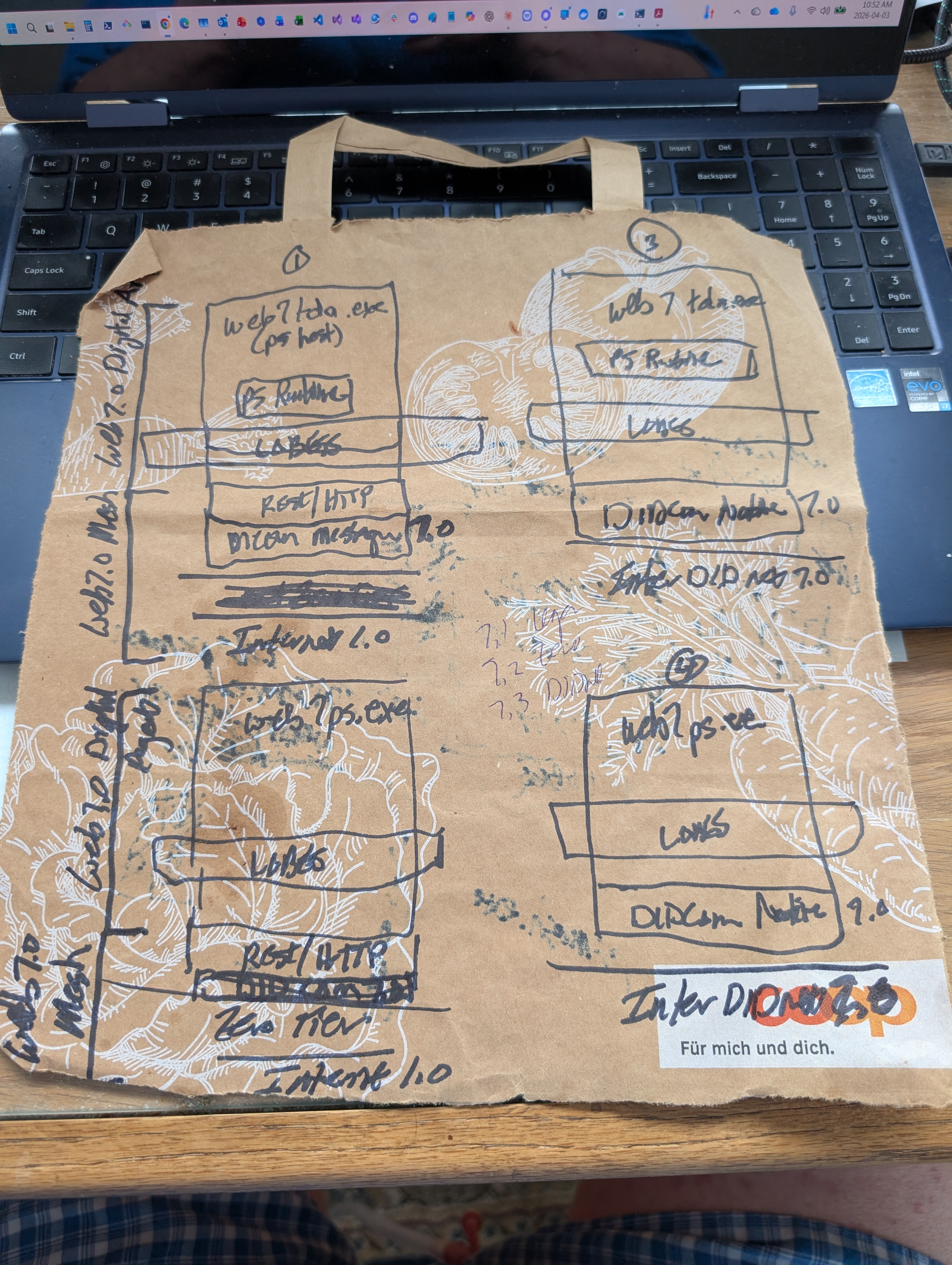
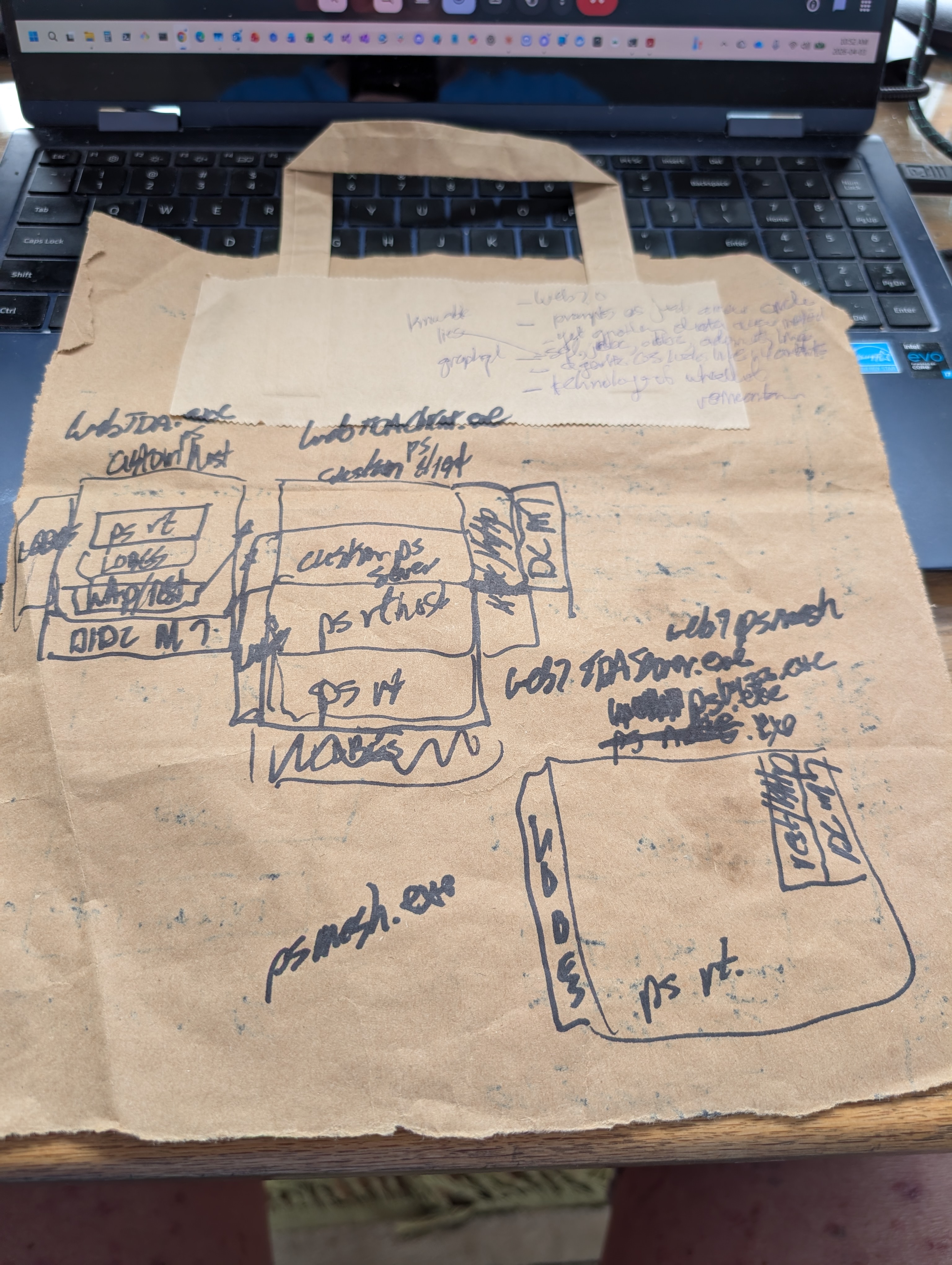
Figure 1 is an all-in illustration of the conceptual architecture of a Web 7.0 Neuromorphic Agent. A Web 7.0 Agent is comprised of a Frontal LOBE and the Neural Messaging pathway. An Agent communicates with the outside world (other Web 7.0 Agents) using its Outbound (Talking), Seeing, and Inbound (Listening) Interfaces. Agents can be grouped together into Neural Clusters to form secure and trusted multi-agent organisms. DIDComm/HTTP is the default secure digital communications protocol (see DIDComm Messages as the Steel Shipping Containers of Secure, Trusted Digital Communication). The Decentralized Identifiers (DIDs) specification is used to define the Identity layer in the Web 7.0 Messaging Superstack (see Figure 6 as well as Decentralized Identifiers (DIDs) as Barcodes for Secure, Trusted Digital Communication).
An agent remains dormant until it receives a message directed to it and returns to a dormant state when no more messages are remaining to be processed. An agent’s message processing can be paused without losing any incoming messages. When an agent is paused, messages are received, queued, and persisted in long-term memory. Message processing can be resumed at any time.
Additionally, an Agent can include a dynamically changing set of Coordination and Execution LOBEs. These LOBEs enable an Agent to capture events (incoming messages), compose responses (outgoing messages), and share these messages with one or more Agents (within a specific Neural Cluster or externally with the Beneficial Agent in other Neural Clusters (see Figure 5)).
LOBE (Loadable Object Brain Extensions) is a macromodular, neuromorphic intelligence framework designed to let systems grow, adapt, and evolve by making it easy to add new capabilities at any time. Each LOBE is a dynamically Loadable Object — a self-contained cognitive module that extends the Frontal LOBE’s functionality, whether for perception, reasoning, coordination, or control (execution). Together, these LOBEs form a dynamic ecosystem of interoperable intelligence, enabling developers to construct distributed, updatable, and extensible minds that can continuously expand their understanding and abilities.
LOBEs lets intelligence and capability grow modularly. Add new lobes, extend cognition, and evolve systems that learn, adapt, and expand over time. Expand your brain. A brain that grows with every download.
A Web 7.0 Neuroplex (aka a Neuro) is a dynamically composed, decentralized, message-driven cognitive solution that spans one or more agents, each with its own dynamically configurable set of LOBEs (Loadable Object Brain Extensions). Each LOBE is specialized for a particular type of message. Agents automatically support extraordinarily efficient by-reference, in-memory, intra-agent message transfers.
A Web 7.0 Neuroplex is not a traditional application or a client–server system, but an emergent, collaborative execution construct assembled from independent, socially-developed cognitive components (LOBEs) connected together by messages. Execution of a Neuroplex is initiated with a NeuroToken.
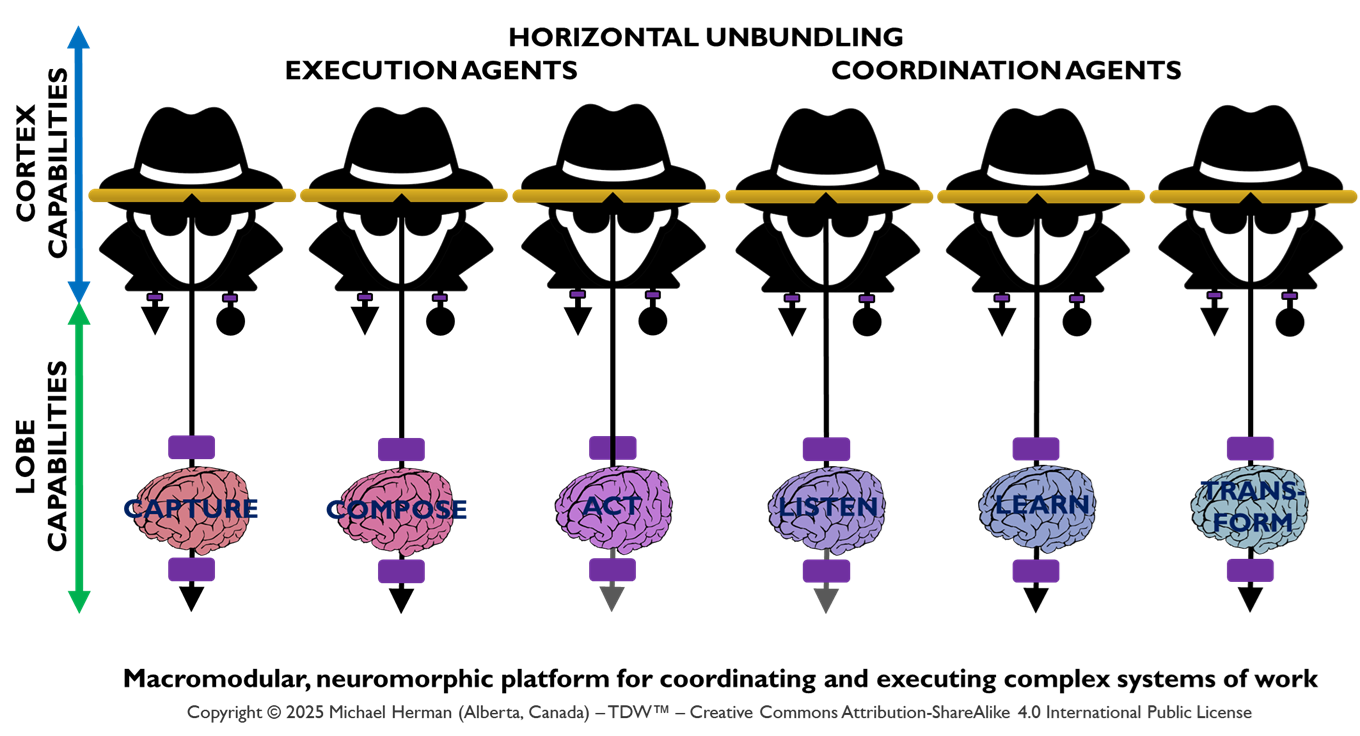
Figure 2 illustrates how the deployment of Coordination and Execution LOBEs can be horizontally unbundled – with each LOBE being assigned to a distinct Frontal LOBE. This is an extreme example designed to underscore the range of deployment options that are possible. Figure 3 is a more common pattern.
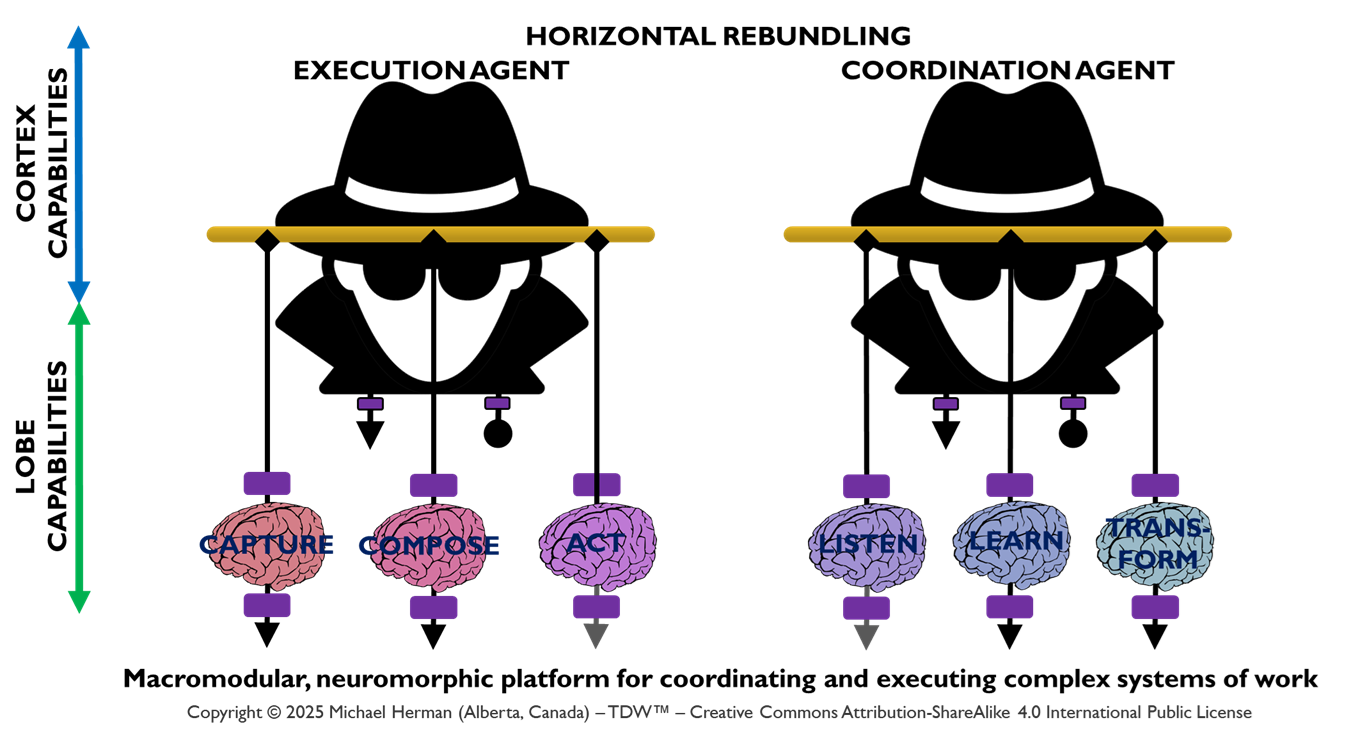
Figure 3 depicts a more common/conventional deployment pattern where, within a Neural Cluster, a small, reasonable number of Frontal LOBEs host any collection of Coordination and/or Execution LOBEs.
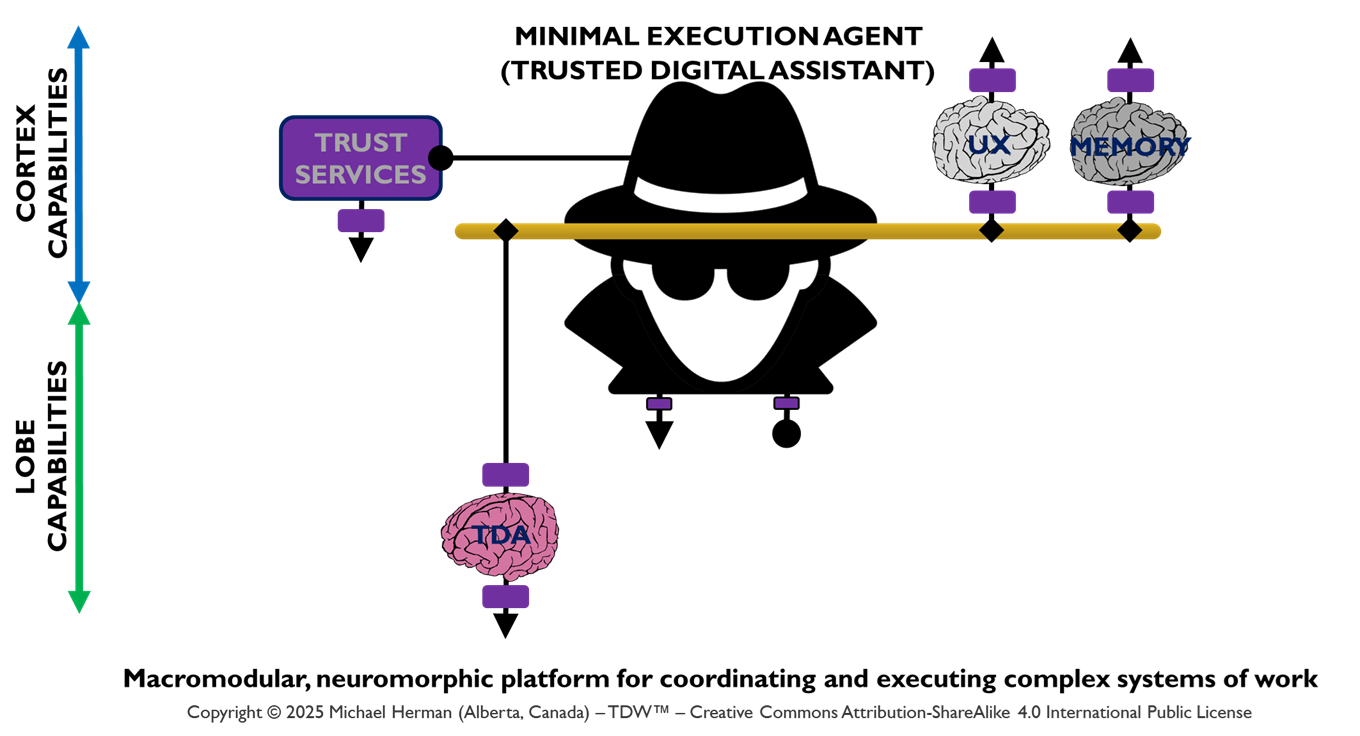
Figure 4a is an example of a minimal agent deployment pattern that hosts a single Trusted Digital Assistant (TDA) LOBE.
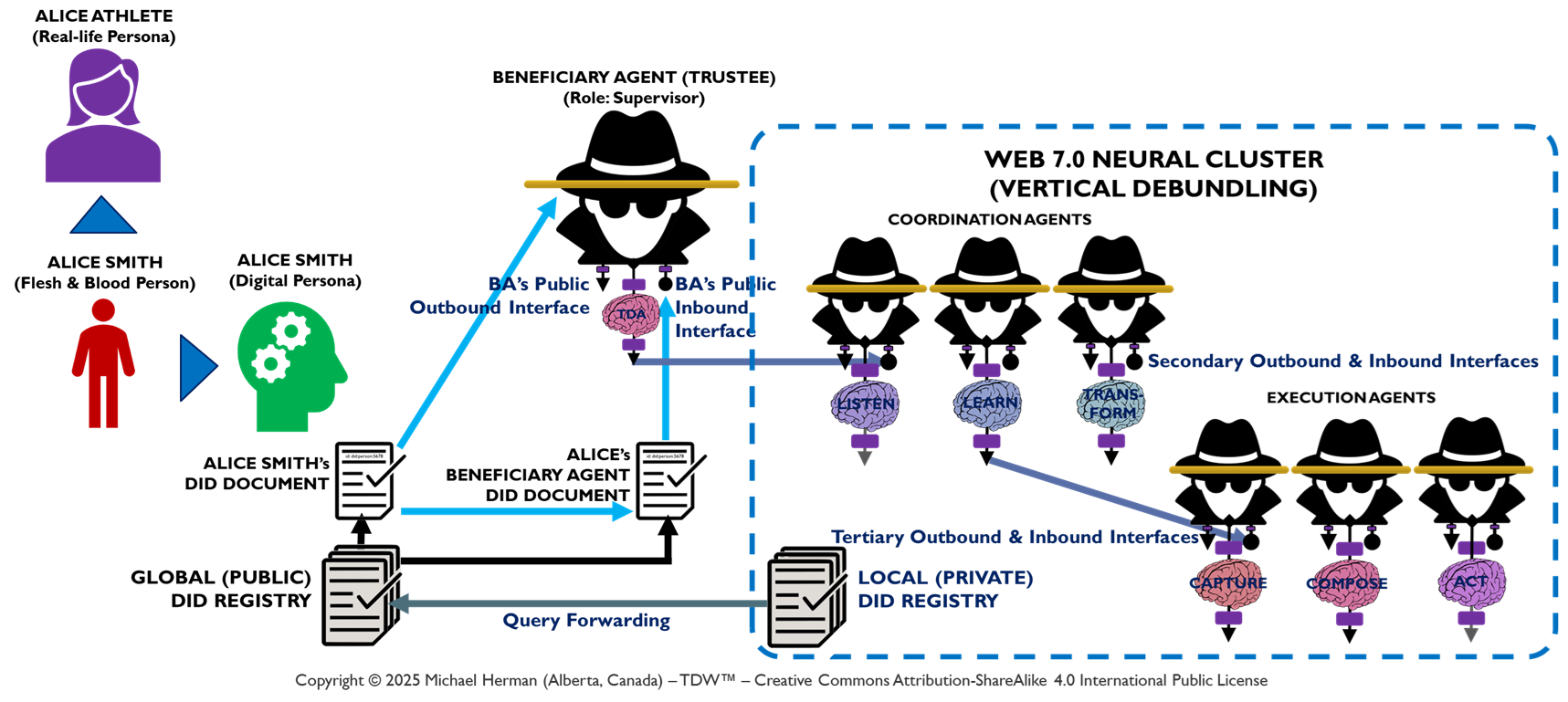
Figure 5 depicts the deployment of a Web 7.0 Neural Cluster. Messages external to the Neural Cluster are only sent/received from the Beneficial Agent. Any additional messaging is limited to the Beneficial, Coordination, and Execution LOBEs deployed within the boundary of a Neural Cluster. A use case that illustrates the Neural Cluster model can be found in Appendix D – PWC Multi-Agent Customer Support Use Case.
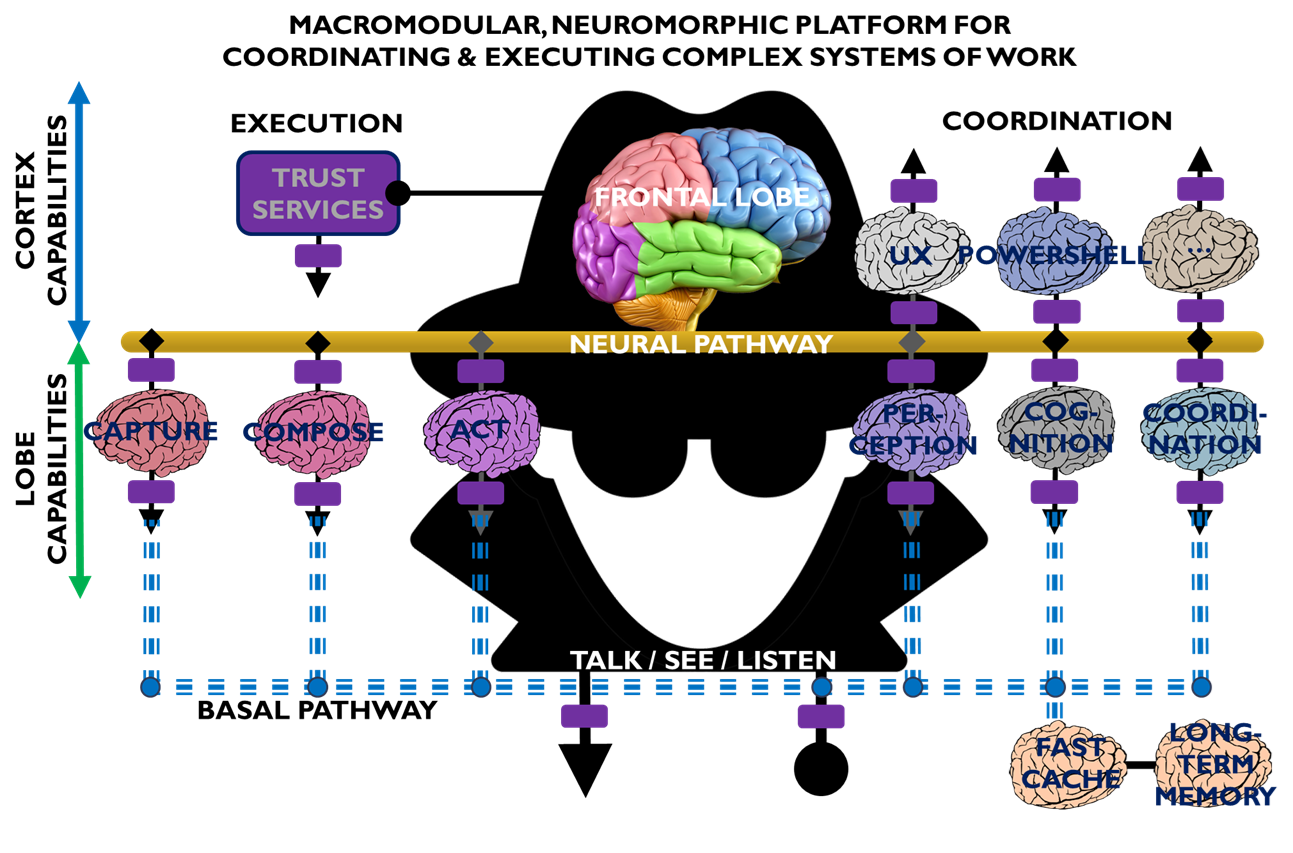
Figure 6a is an all-in illustration of the conceptual architecture of a Web 7.0 Neuromorphic Agent. DIDComm Messages can be piped from the Outbound Interface of the Sender agent to the Inbound Agent of of Receiver agent – supporting the composition of secure, trusted agent-to-agent pipelines similar (but superior) to: i) UNIX command pipes (based on text streams), and ii) PowerShell pipelines (based on a .NET object pump implemented by calling ProcessObject() in the subsequent cmdlet in the pipeline).
NOTE: PowerShell does not clone, serialize, or duplicate .NET objects when moving them through the pipeline (except in a few special cases). Instead, the same instance reference flows from one pipeline stage (cmdlet) to the next …neither does DIDComm 7.0 for DIDComm Messages.
Bringing this all together, a DIDComm Message (DIDMessage) can be passed, by reference, from LOBE (Agenlet) to LOBE (Agenlet), in-memory, without serialization/deserialization or physical transport over HTTP (or any other protocol).
| PowerShell | DIDComm 7.0 |
| powershell.exe | tdwagent.exe |
| Cmdlet | LOBE (Loadable Object Brain Extension) |
| .NET Object | Verifiable Credential (VC) |
| PSObject (passed by reference) | DIDMessage (JWT) (passed by reference) |
| PowerShell Pipeline | Web 7.0 Verifiable Trust Circle (VTC) |
| Serial Routing (primarily) | Arbitrary Graph Routing (based on Receiver DID, Sender DID, and DID Message type) |
Feedback from a reviewer: Passing DIDComm messages by reference like you’re describing is quite clever. A great optimization.
Coming to a TDW LOBE near you…
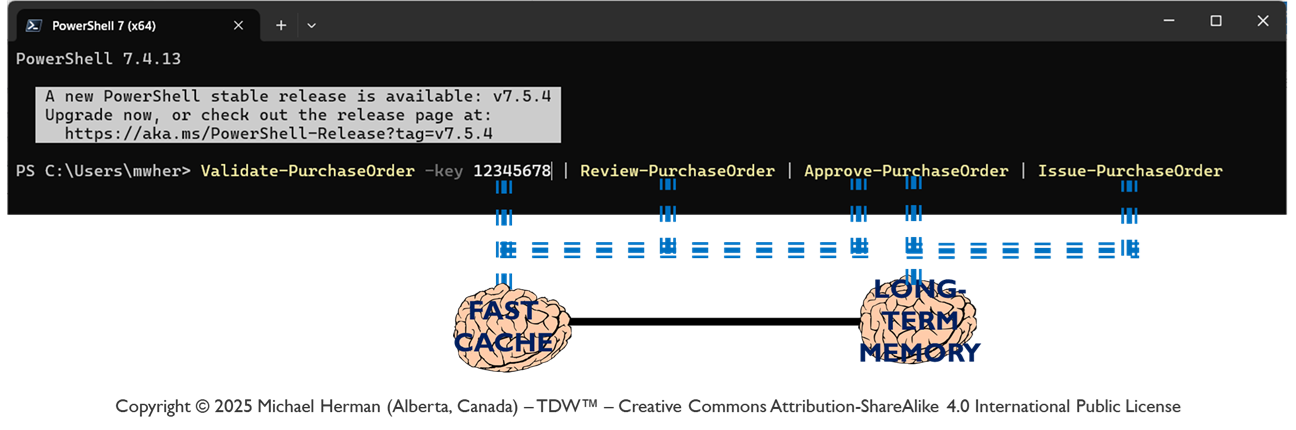
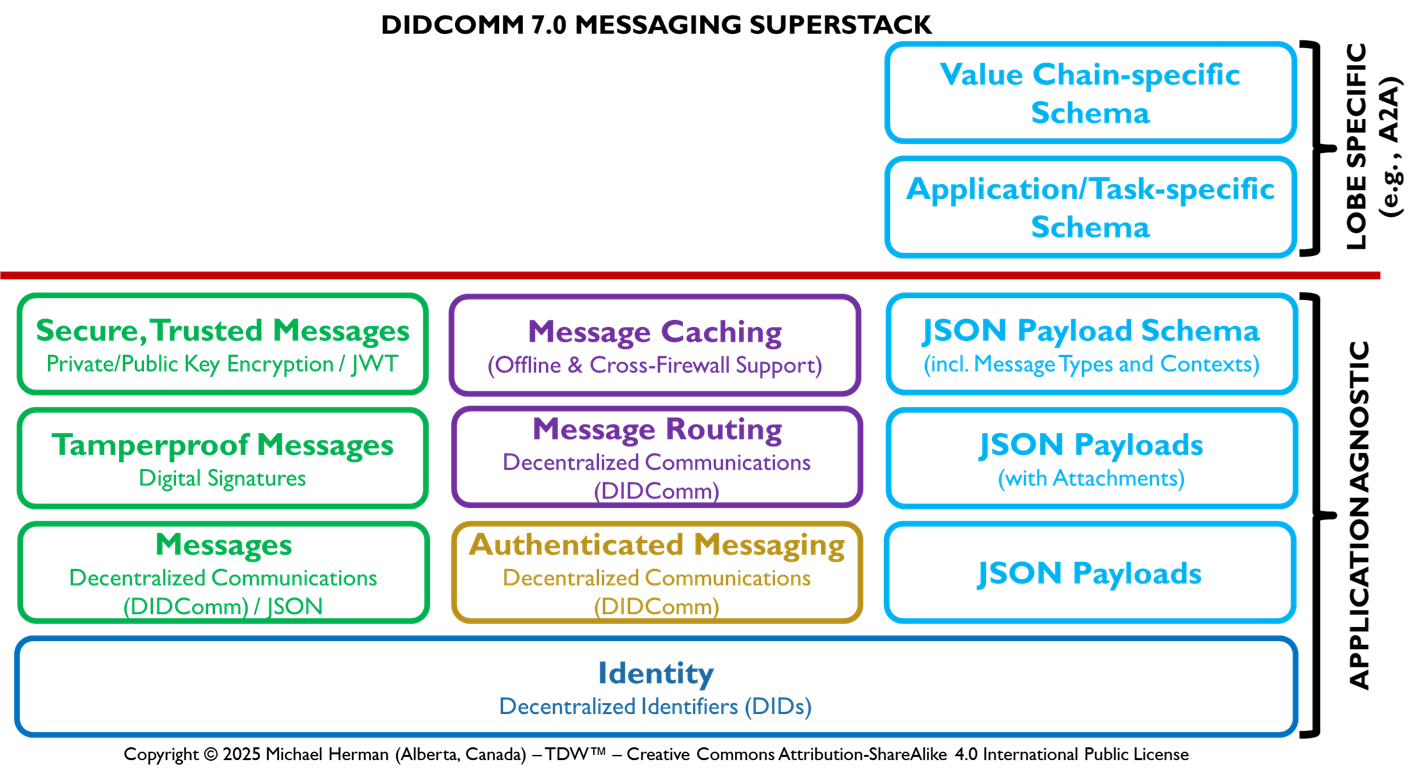
Figure 6b illustrates the interdependencies of the multiple layers within the DIDComm 7.0 Superstack.
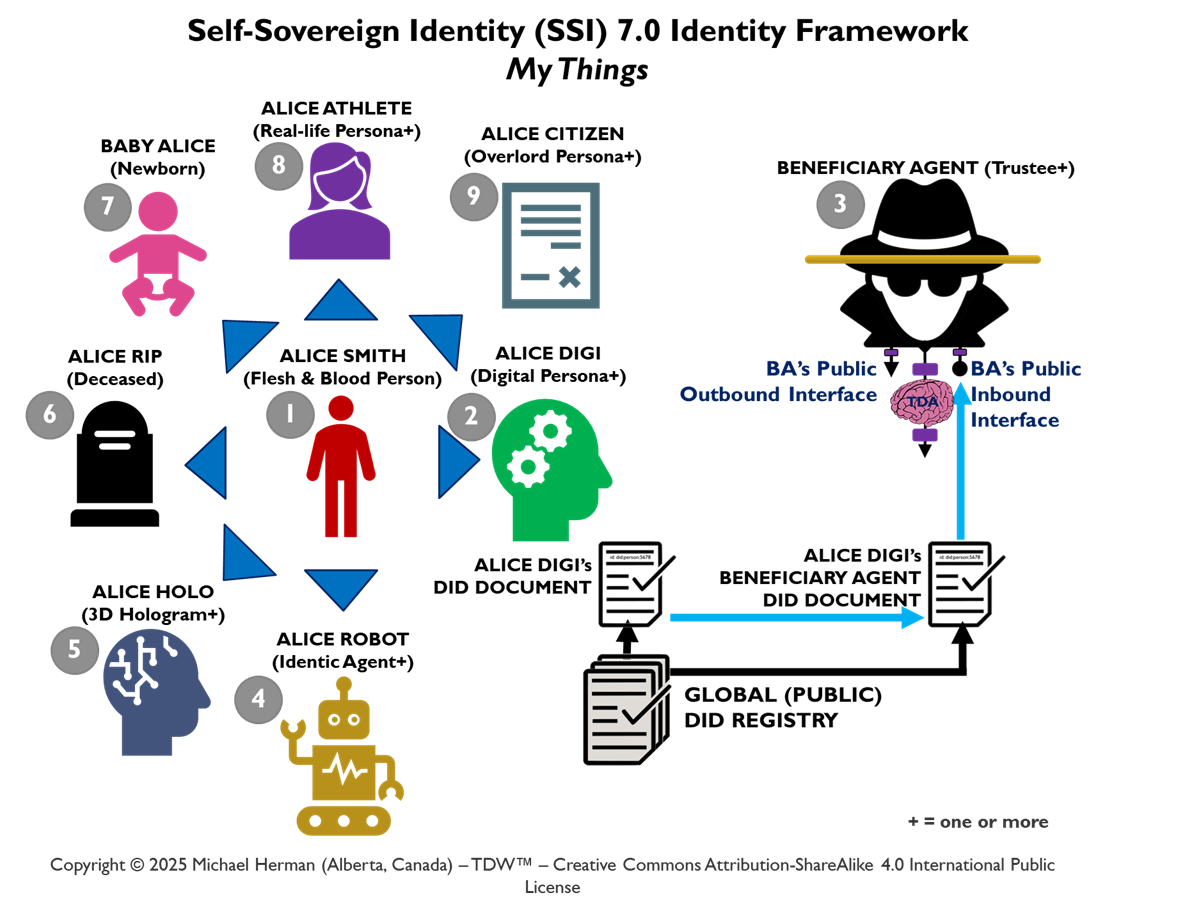
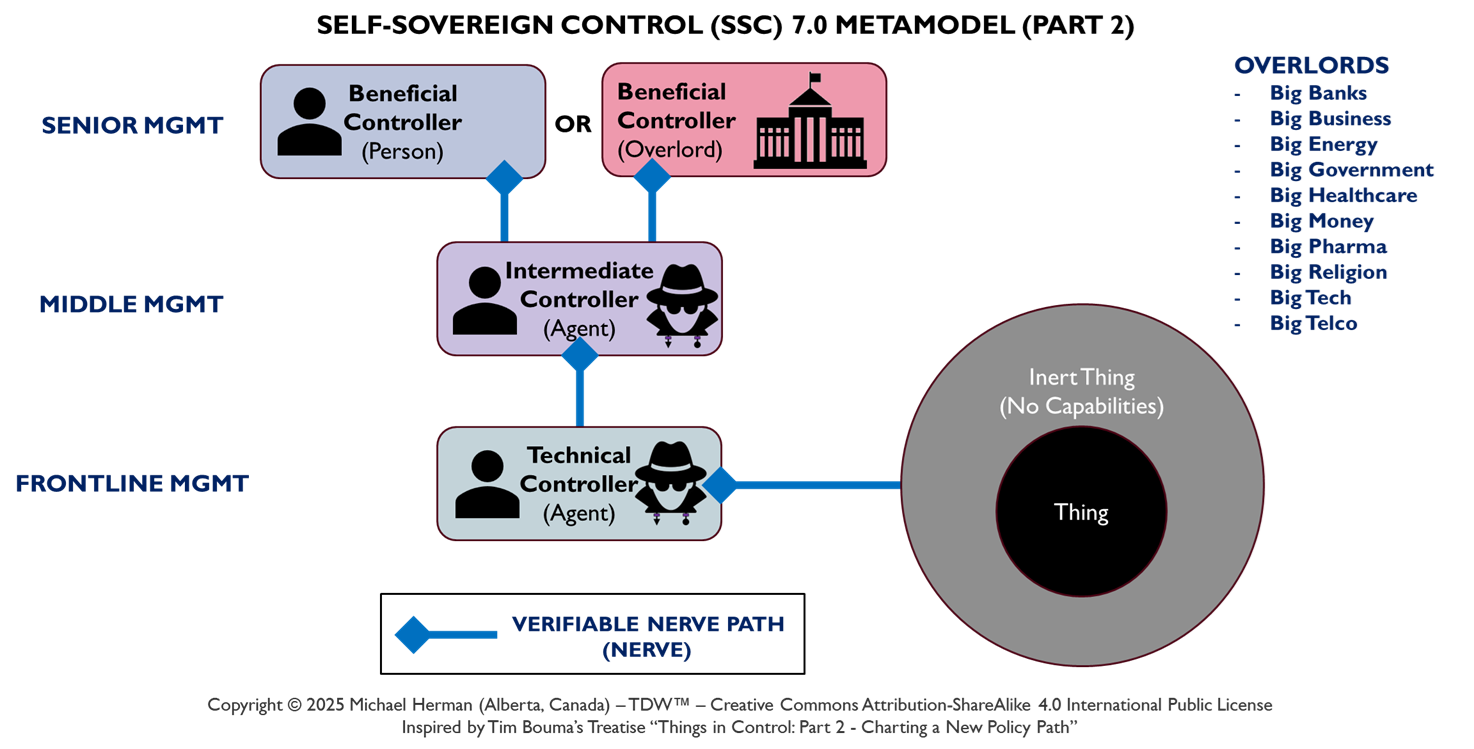
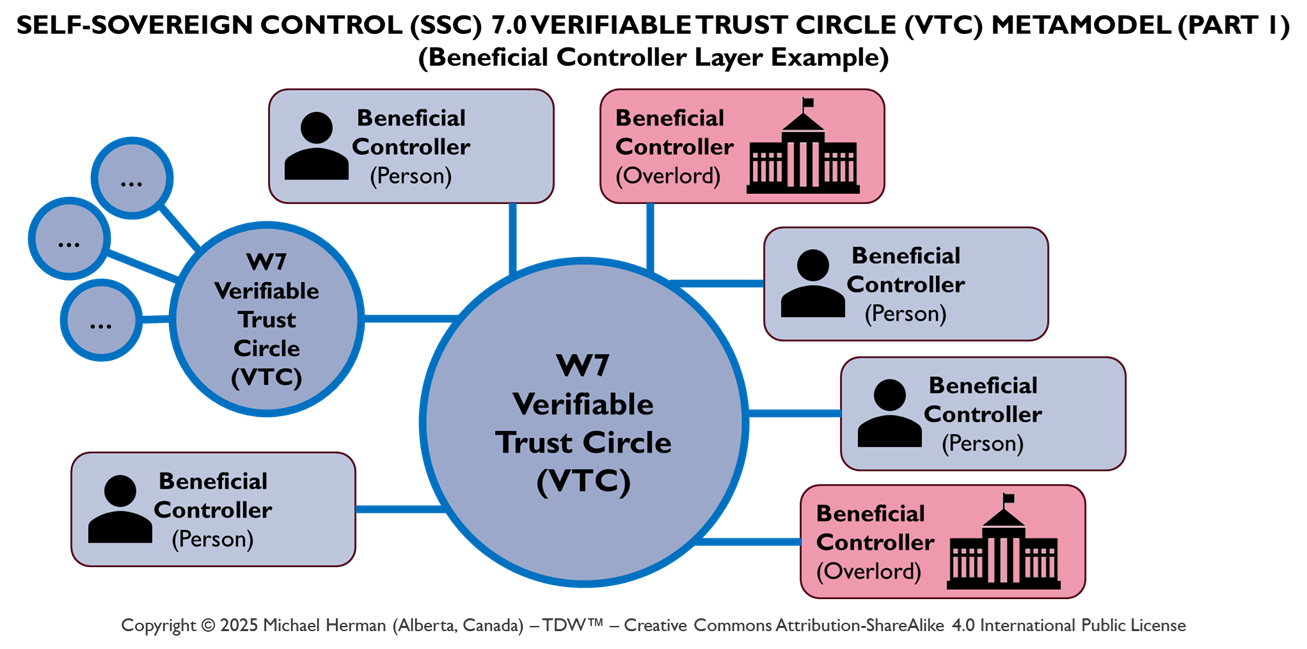
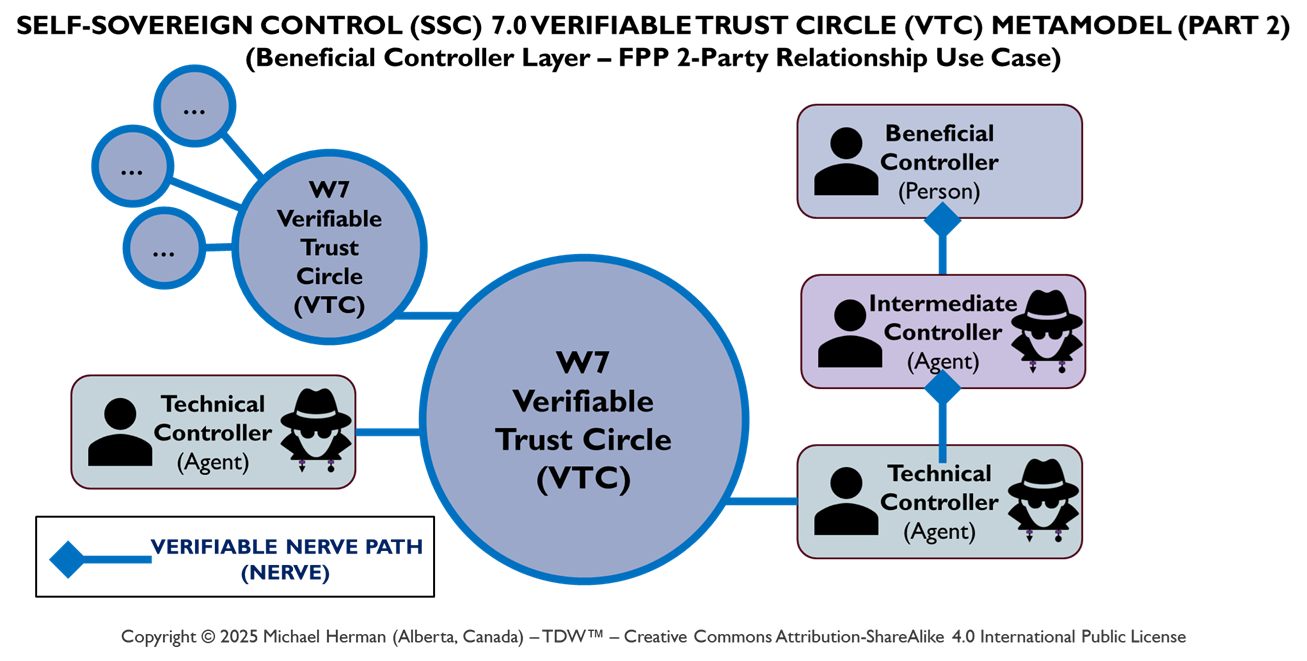
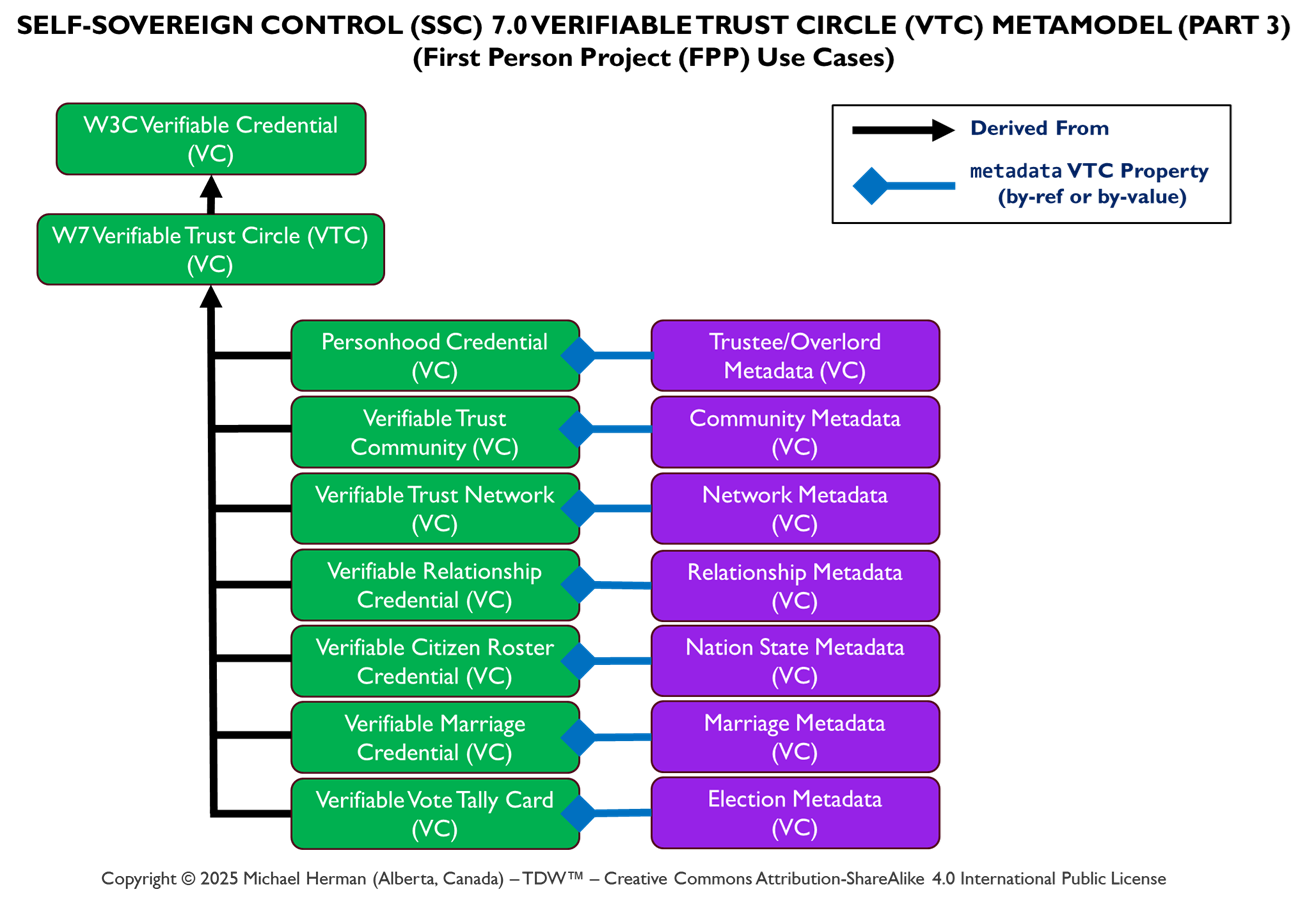
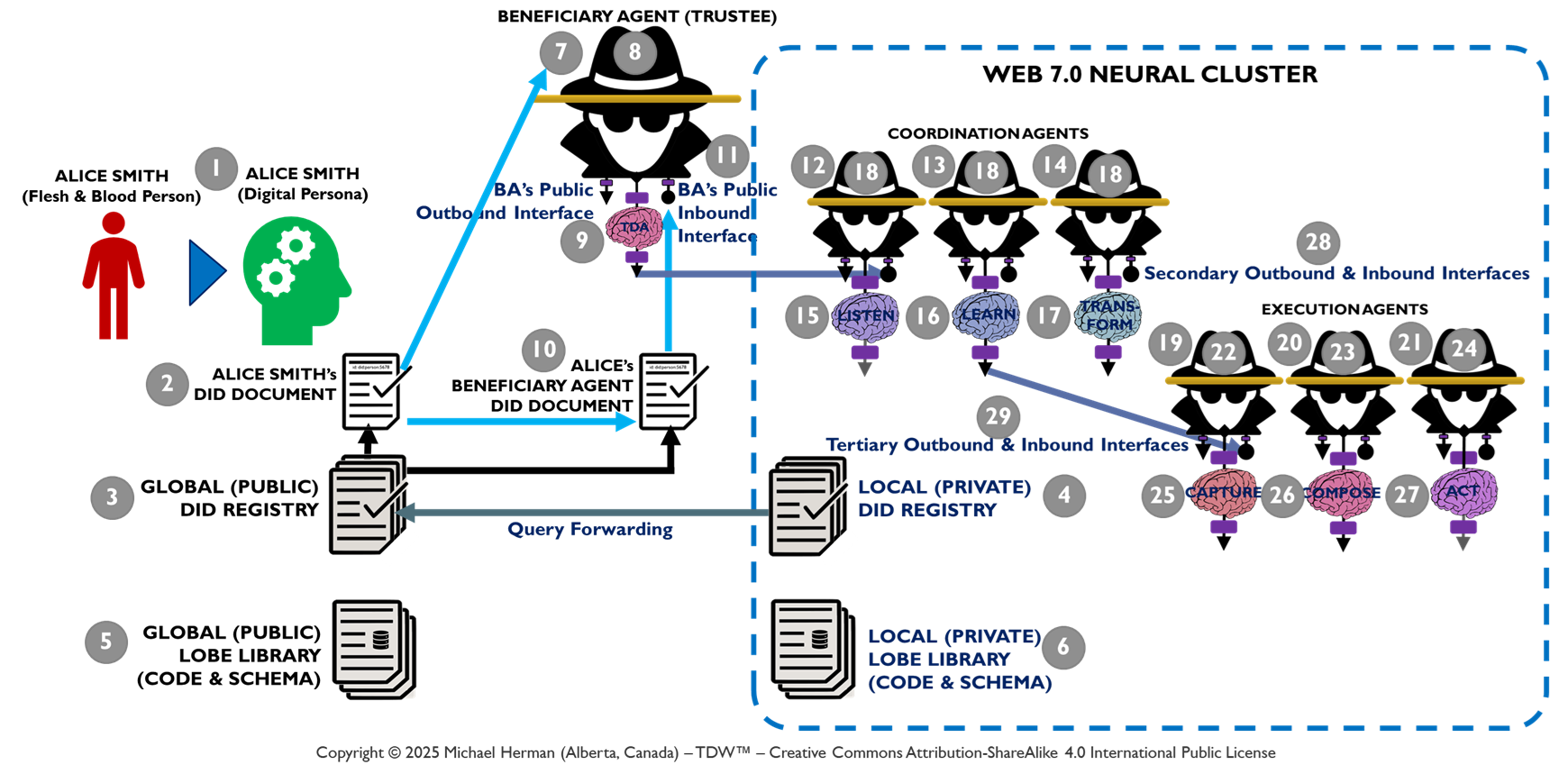
Figure 7. Web 7.0 Neuromorphic Agent Identity Model (NAIM)
The NAIM seeks to enumerate and identify all of the elements in the AARM that have or will need an identity (DID and DID Document). This is illustrated in Figure 7.
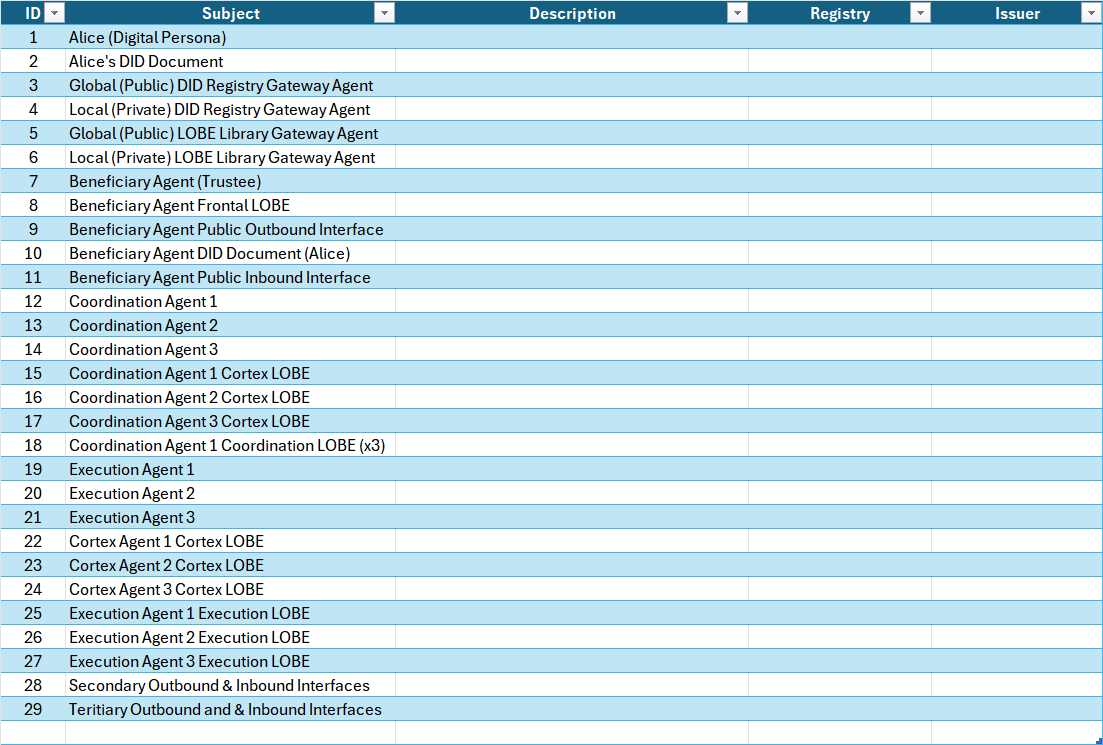
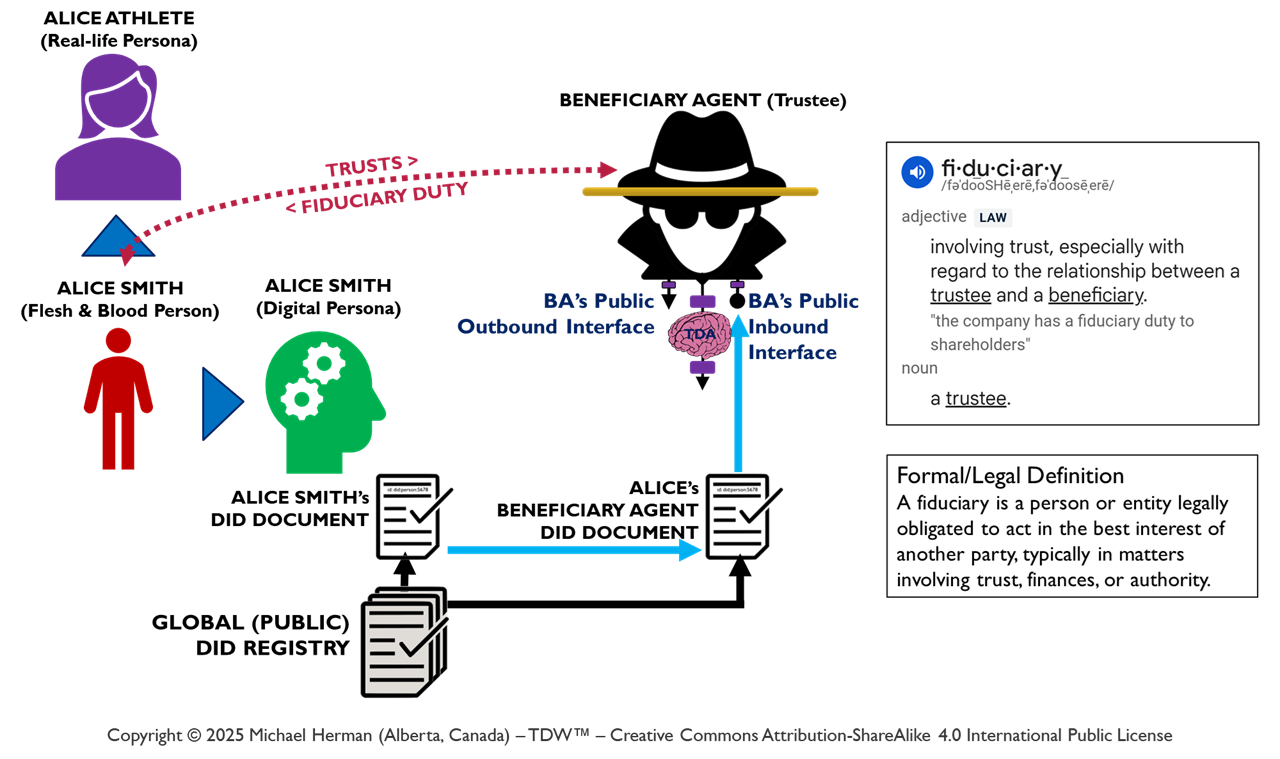
Figure 8 highlights in red the trusts and fiduciary duty relationships between (a) a Beneficiary (Alice, the person) and (b) her Beneificiary Agent (a trustee). Similarly, any pair of agents can also have pair-wise trusts and fiduciary duty relationships where one agent serves in the role of Beneficiary and the second agent, the role of Trustee.
This section is non-normative.
This section is non-normative.
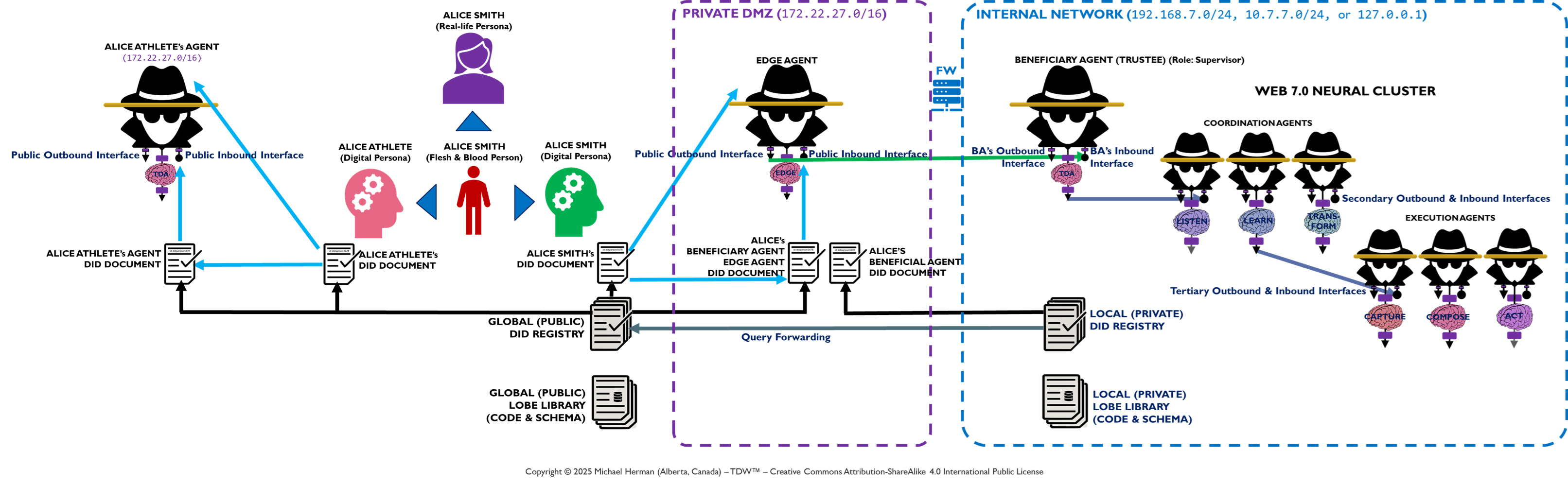
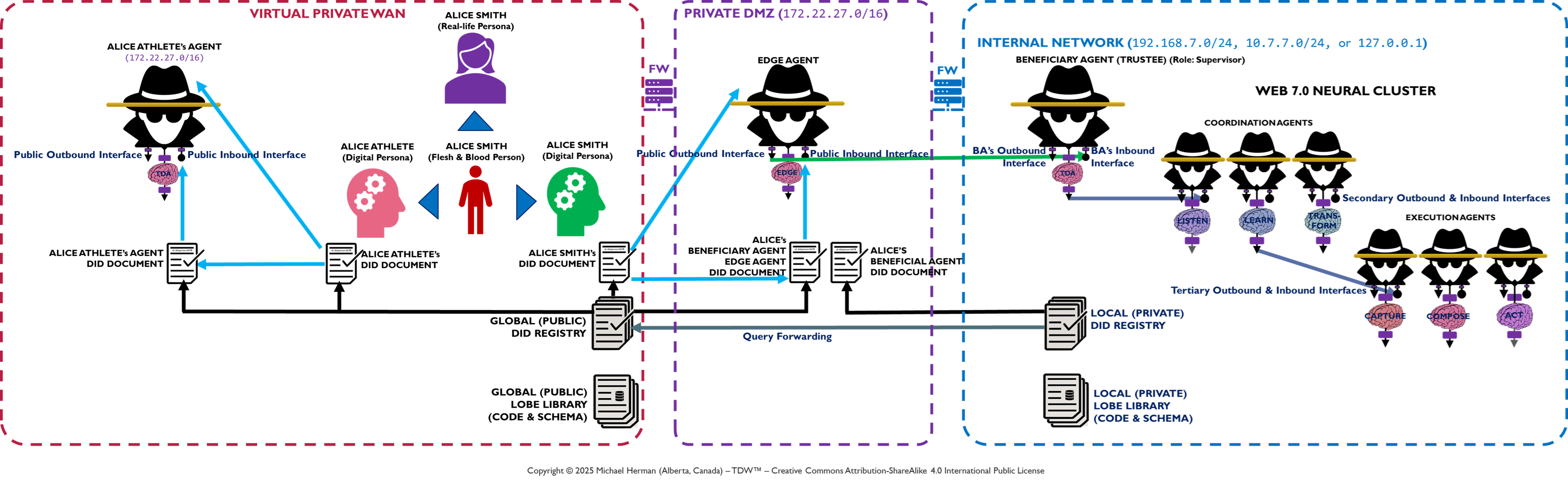
Alice has 2 digital personifications: Alice Smith and Alice Athlete. Each of these personifications has its own digital ID. Each of Alice’s personas also has its own Trusted Digital Assistant (TDA) – an agent or agentic neural network.
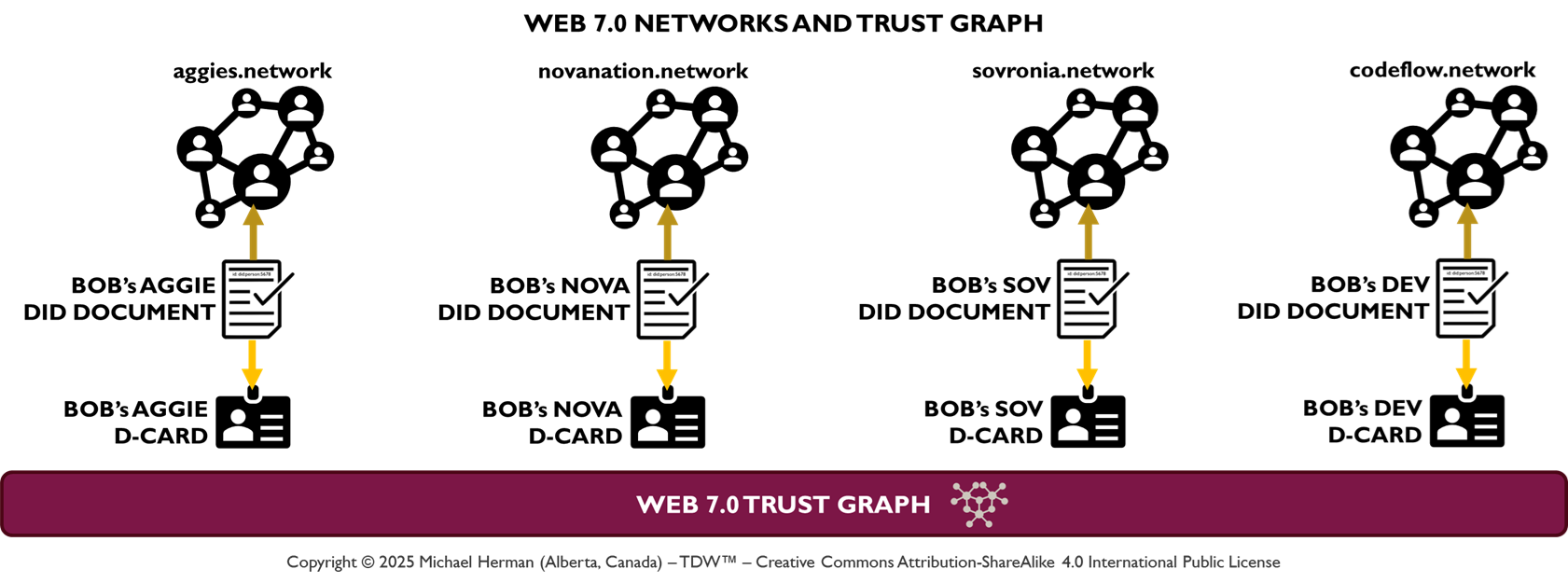
Bob has (at least) 4 digital personifications: Bob Aggie, Bob Nova, Bob Sovronia, and Bob Developer. Using Web 7.0 Trust Graph Relationships and Verifiable Trust Credentials (VTCs), Bob can also have personas that are members of multiple Web 7.0 networks.
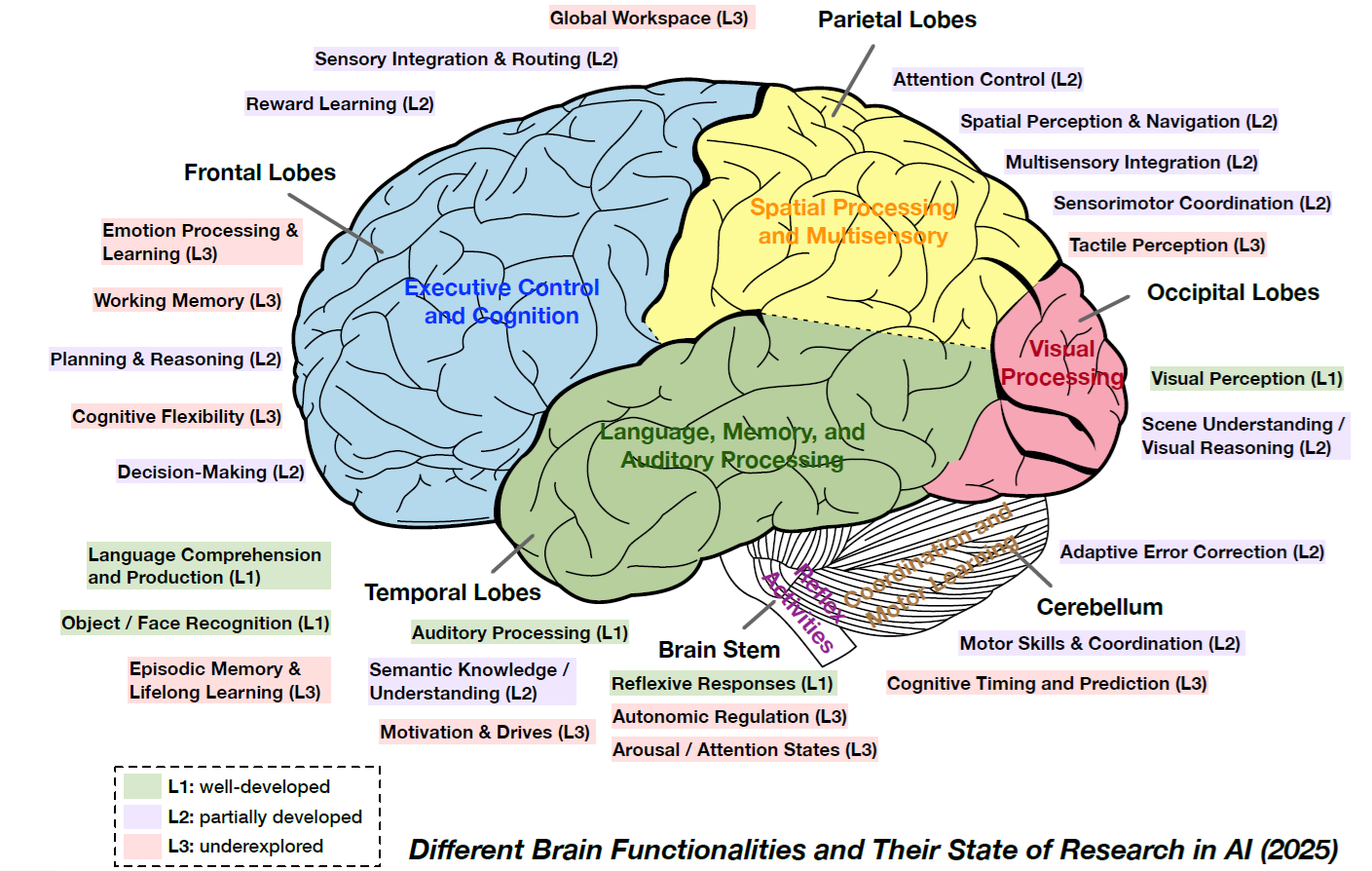
Source: Advances and Challenges in Foundation Agents: From Brain-Inspired Intelligence to Evolutionary, Collaborative, and Safe Systems. arXiv:2504.01990v2 [https://arxiv.org/abs/2504.01990v2]. August 2025.
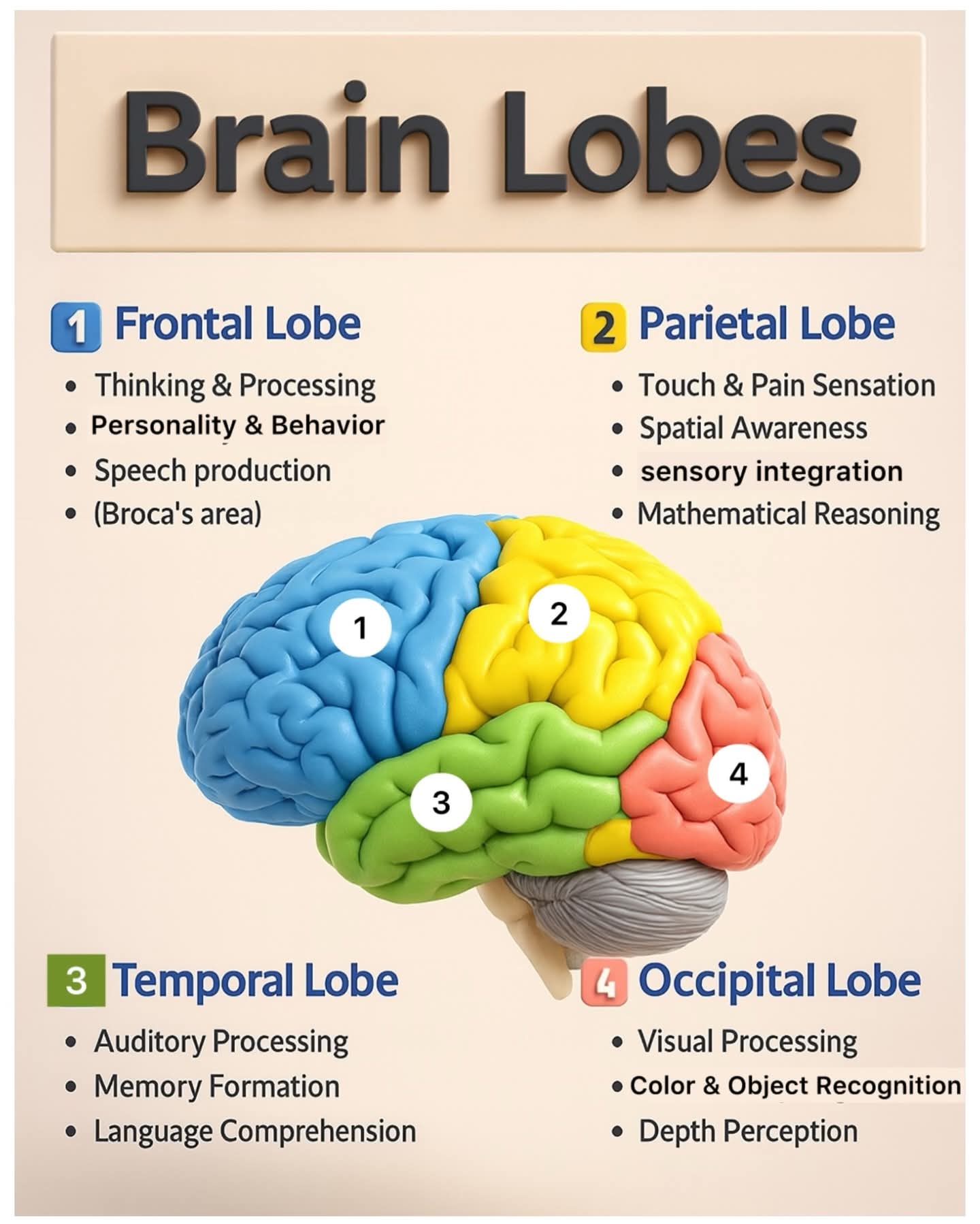
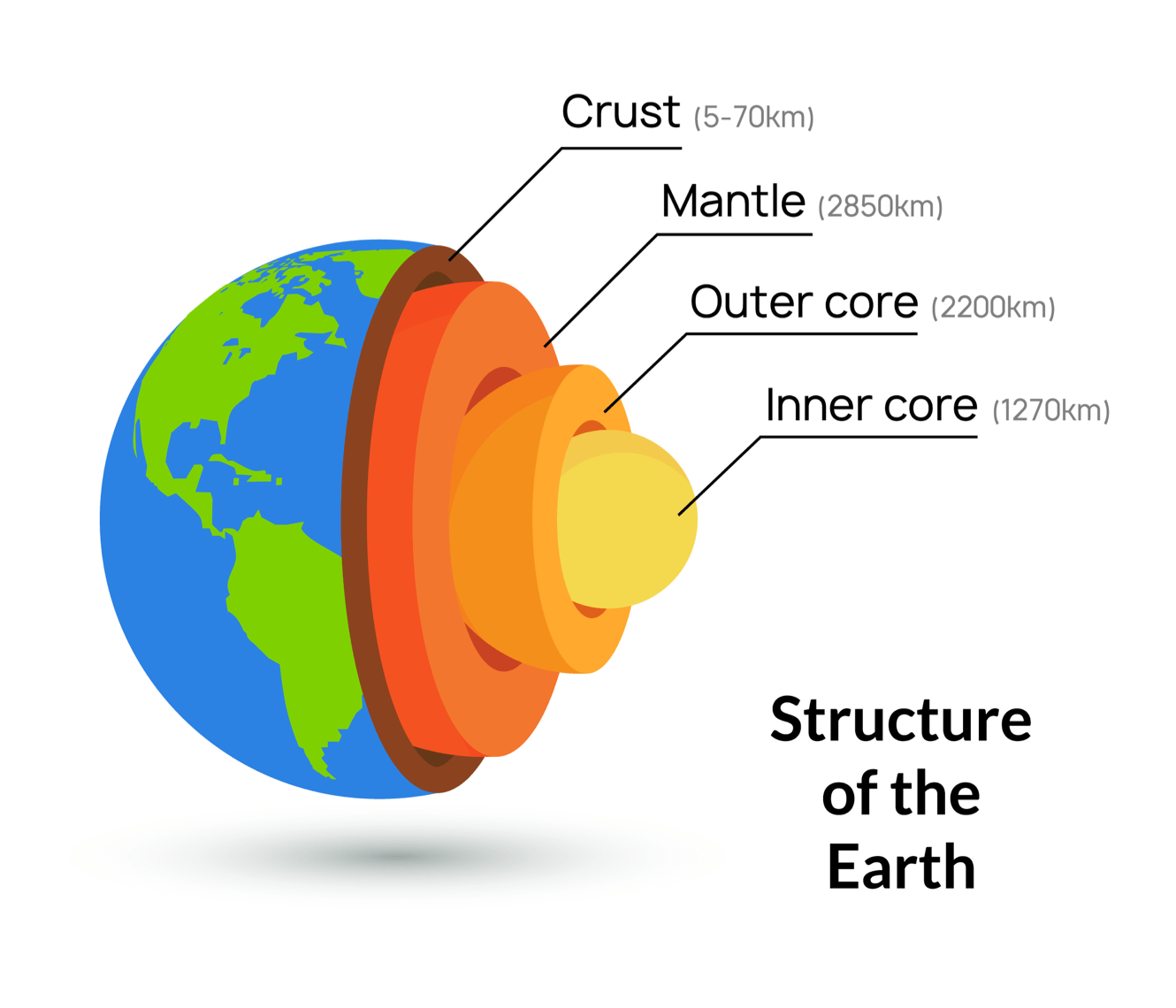
In Figure C-3, the Trust Library forms the Inner core and the UX LOBEs, the Crust. The Outer core is comprised of the Fast Cache and Long-Term Memory LOBEs, Neural and Basal Pathways, DID Registry, and LOBE Library. The Mantle is where the Coordination and Execution LOBEs execute.
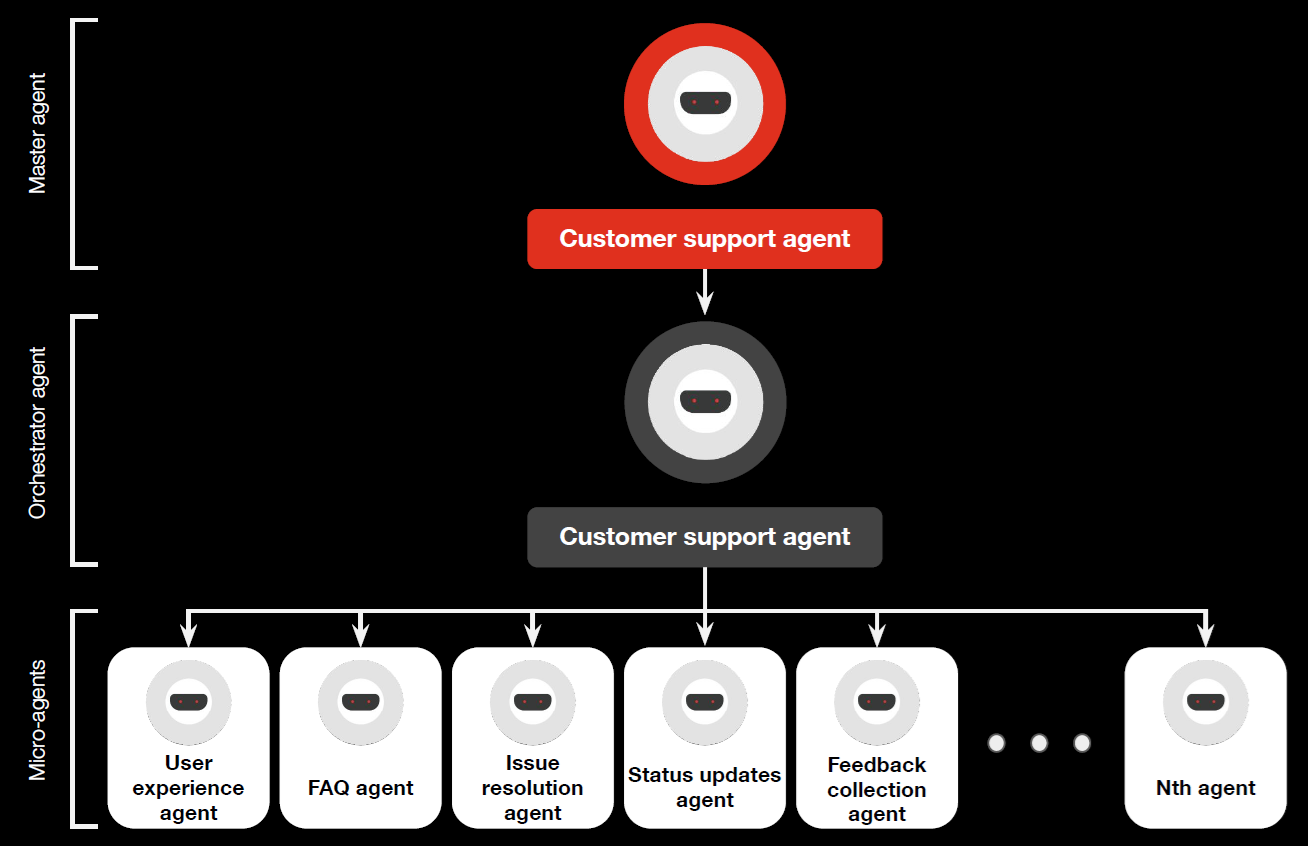
Source: Agentic AI – the new frontier in GenAI. PWC Middle East. 2024.
This use case exemplifies the use of the Web 7.0 Neural Cluster model. Table D-1 maps the PWC Use Case terminology to the corresponding Web 7.0 AARM terminology.
| Web 7.0 NAARM | PWC Use Case |
| Beneficiary Agent | Master agent |
| Coordination Agent (and LOBEs) | Orchestrator agent |
| Execution Agent LOBEs | Micro-agents |

Michael Herman
Decentralized Systems Architect
Web 7.0 Foundation
October 15, 2025
Filed under Uncategorized
Create your own magic with Web 7.0 AgenticOSs. Imagine the possibilities.
Copyright © 2025 Michael Herman (Bindloss, Alberta, Canada) – Creative Commons Attribution-ShareAlike 4.0 International Public License
Platform Layer: Defensive Flexibility
Developer Layer: Ecosystem Incentives
Distribution Layer: Search as a Super App
Monetization Layer: Bundled Value
User Layer: Identity & Privacy
Strategic Narrative
Google doesn’t need to build a super app—it already operates one in disguise. Android + Search + Assistant + Wallet + Play Store form a distributed super app ecosystem. The challenge is coherence: can Google unify these services into a seamless user experience without triggering antitrust alarms?
Filed under Uncategorized
Create your own magic with Web 7.0 AgenticOS™. Imagine the possibilities.
Copyright © 2025 Michael Herman (Bindloss, Alberta, Canada) – Creative Commons Attribution-ShareAlike 4.0 International Public License
This is the outcome of an October 19, 2025 conversation between Michael Herman and Copilot.
🧩 Developer Incentives: Fragmentation vs Aggregation
Super apps flip the traditional developer model:
| Old Model | Super App Model |
|---|---|
| Build standalone apps | Build mini-programs or plug-ins within super apps |
| Compete for store visibility | Compete for in-app placement and promotion |
| Monetize via ads or subscriptions | Monetize via bundled services, commissions, or shared revenue pools |
| Own user data | Share or rent access to super app user base |
🔁 Strategic Shifts
🏛️ Platform Governance: Centralization vs Regulation
Super apps challenge traditional platform governance:
| App Store Governance | Super App Governance |
|---|---|
| Apple/Google set rules | Super app owner sets rules (e.g. WeChat, Grab) |
| OS-level privacy and security | App-level identity, payments, and data control |
| Regulatory oversight (DMA, GDPR) | Emerging scrutiny over super app monopolies |
⚖️ Governance Tensions
🔮 Strategic Forecast
Filed under Uncategorized
Create your own magic with Web 7.0 AgenticOS™. Imagine the possibilities.
Copyright © 2025 Michael Herman (Bindloss, Alberta, Canada) – Creative Commons Attribution-ShareAlike 4.0 International Public License
This layered breakdown is a sharp way to visualize how control dynamics and strategic shifts ripple through the mobile ecosystem.
This is the outcome of an October 10, 2025 conversation between Michael Herman, ChatCGT, and Copilot.
📱 Mobile Ecosystem Power Stack
| Layer | Primary Control | Catalyst for Reshuffle | Strategic Impact |
|---|---|---|---|
| Platform Layer | Apple / Google | New API rules, OS policies | Developers must realign strategies to comply or compete |
| Developer Layer | App creators | Rise of cross-platform frameworks | Distribution becomes more fragmented and flexible |
| Distribution Layer | Platforms (App Stores) | Algorithmic curation, ranking | Monetization models shift based on visibility and reach |
| Monetization Layer | Developers / Platforms | Subscription-first models | Revenue flows restructured, favoring retention over acquisition |
| User Layer | End users | Enhanced privacy controls | Data value redefined, impacting targeting and personalization |
🔄 Strategic Cascades
Filed under Uncategorized
Create your own magic with Web 7.0 AgenticOS™. Imagine the possibilities.
Copyright © 2025 Michael Herman (Bindloss, Alberta, Canada) – Creative Commons Attribution-ShareAlike 4.0 International Public License
A Reshuffle value chain is basically a rethinking of a traditional value chain where value is reorganized around control points — places in the chain where power, influence, or leverage exists. In the mobile app ecosystem, Reshuffle means understanding how the ecosystem is changing and identifying where control is concentrated so that new entrants, incumbents, or platforms can leverage or defend those points.
Based on an October 19, 2025 conversation between Michael Herman and ChatGPT.
A simplified mobile app ecosystem includes:
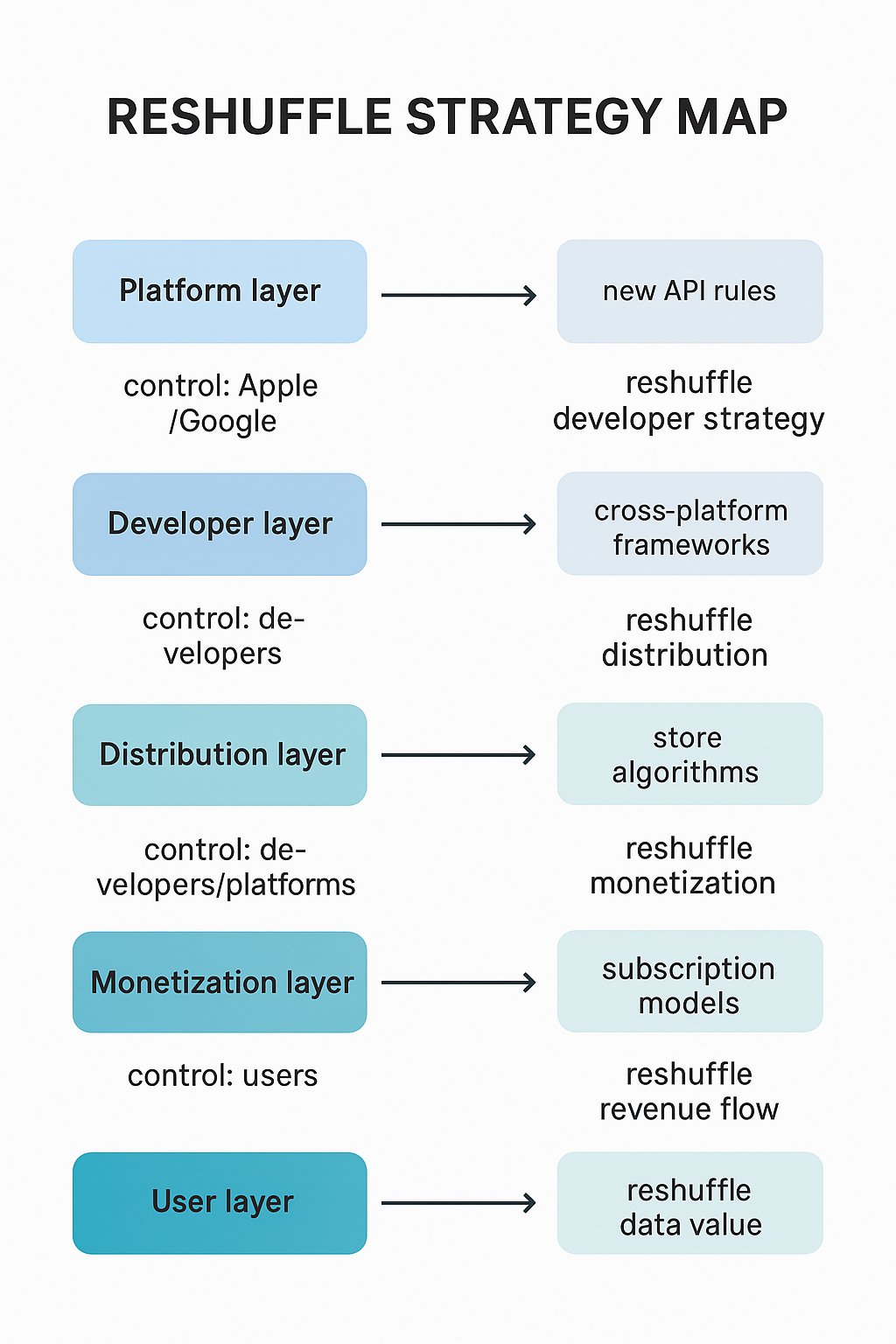
Reshuffle shifts the view of the value chain to highlight new control points — places where power is concentrated that weren’t as visible before, and where value creation & capture is happening.
Here’s what a reshuffled mobile app value chain might look like:
Hardware → Operating System → App Store Distribution → Developer Enablement → Service Platforms → User Engagement → Monetization
But reshuffled control points reorder priorities. For example:
| Stage | Control Points |
|---|---|
| Hardware | Chipsets, sensors, proprietary hardware |
| Operating System | APIs, permissions, OS updates, platform exclusives |
| App Distribution | App store ranking, app review, app store rules |
| Developer Enablement | SDKs, developer tools, APIs |
| Service Platforms | Cloud services, identity systems, notifications |
| User Engagement | Analytics, personalization, push notifications |
| Monetization | Payment processing, subscriptions, advertising platforms |
In a reshuffle, control points move from being purely physical or technical to being gatekeeping points where access, distribution, or monetization is mediated.
For the mobile app ecosystem, the main control points are:
Filed under Uncategorized
Create your own magic with Web 7.0™ / TDW AgenticOS™. Imagine the possibilities.
Copyright © 2025 Michael Herman (Bindloss, Alberta, Canada) – Creative Commons Attribution-ShareAlike 4.0 International Public License
Based on an October 10, 2025 conversation between Michael Herman and ChatGPT.
I feel the following doesn’t match 100% with what is presented in the book #Reshuffle but there are a few interesting parallels.

In the book Reshuffle, the core concept is that platforms continually reconfigure (“reshuffle”) the value chain — deciding:
A reshuffle happens when a player changes the architecture of participation — shifting value, control, and power between ecosystem actors.
Let’s consider the mobile ecosystem as layers (simplified):
| Layer | Examples | Current Gatekeepers |
|---|---|---|
| Hardware | Apple, Samsung, Qualcomm, Google | Apple, Google |
| OS / Runtime | iOS, Android, Windows | Apple, Google |
| Distribution | App Store, Play Store, Web 7.0™ Store | Apple, Google |
| Payment / Identity | Apple Pay, Google Pay, Sign in with Apple | Apple, Google |
| Apps / Services | TikTok, Uber, Spotify | Independent developers |
| User Relationships / Data | Analytics, Ads, Web 7.0™ Trust Graph | Meta, Google, Apple increasingly |
A reshuffle model describes how control, innovation, or value capture moves between these layers. Here are several current and emerging reshuffles:
Platform owners pull value back down toward themselves:
🧭 Effect: Platforms reclaim data, monetization, and developer dependence.
Some innovations push value upward to developers and users:
🧭 Effect: Developers gain autonomy and flexibility, though discovery and monetization remain bottlenecks.
New layers emerge, shifting boundaries:
🧭 Effect: Gatekeepers may lose user touchpoints to “meta-platforms” that sit on top of the OS.
| Element | Description | Example |
|---|---|---|
| Trigger | What changes the distribution of value or control? | Regulatory changes (DMA), new tech (AI agents), shifts in user behavior |
| Anchor Layer | Which layer redefines the interface? | OS, identity, or payments |
| Redistributed Value | What moves? | Revenue, data, trust, discovery |
| New Gatekeepers | Who gains control? | AI assistants, mini-app frameworks |
| Old Gatekeepers | Who loses control? | App stores, SDK-based ad networks |
| User Benefit | What improves for users? | Choice, interoperability, integrated experience |
| Developer Impact | What improves or worsens? | Distribution, economics, discoverability |
In 2025 and beyond, an AI-driven reshuffle looks like this:
| Before | After |
|---|---|
| Users search for apps in App Store | Users ask AI assistants to “book a taxi” or “edit a photo” |
| Developers fight for app visibility | AI intermediates app selection and invocation |
| App Store controls discovery | AI layer controls orchestration and recommendation |
| OS owns distribution | AI owns user intent |
🧭 Reshuffle Result: AI interfaces become the new “home screen.”
App stores become backend registries. The distribution and discovery value shifts to the AI layer.
A Reshuffle model for the mobile app ecosystem describes how power and value continually move among:
The model emphasizes layer-by-layer realignment — each “reshuffle” altering where innovation, value, and control reside.
Filed under Uncategorized
Create your own magic with Web 7.0 Agentic OS. Imagine the possibilities.
Copyright © 2025 Michael Herman (Bindloss, Alberta, Canada) – Creative Commons Attribution-ShareAlike 4.0 International Public License
The invention of the barcode transformed retail and supply chains by providing a universal, machine-readable identifier that ensured accuracy, efficiency, and interoperability across diverse systems. Similarly, Decentralized Identifiers (DIDs) represent a foundational innovation for digital ecosystems: a universal, cryptographically verifiable identifier that enables trusted communication across domains and platforms. This paper explores the analogy between DIDs and barcodes, examining how both enable end-to-end interoperability, reduce friction, and unlock new models of value creation.
Copyright © 2025 Michael Herman (Bindloss, Alberta, Canada) – Creative Commons Attribution-ShareAlike 4.0 International Public License
In 1974, a pack of Wrigley’s gum was scanned at a Marsh supermarket in Ohio, marking the first use of the Universal Product Code (UPC). That moment marked the beginning of a transformation in retail, logistics, and global commerce. By providing a standardized identifier, barcodes automated inventory management, accelerated checkout, reduced human error, and laid the foundation for today’s global supply chains.
Digital ecosystems in the 21st century face an equivalent problem: how to create universal, secure, and machine-readable identifiers that work across organizations, platforms, and jurisdictions. While domain names, IP addresses, and UUIDs serve as identifiers, none are self-sovereign, portable, and verifiable across trust boundaries. Decentralized Identifiers (DIDs) aim to solve this.
This paper argues that DIDs are the barcodes of digital trust: a universal, machine-readable system for identifying entities in secure communications, enabling a new end-to-end supply chain of digital trust.
Impact: Barcodes enabled just-in-time inventory, global retail expansion, and precise supply chain optimization [Brown, Inventing the Barcode, 2010]. The key insight: a universal, interoperable identifier unlocks systemic efficiencies across the value chain.
Decentralized Identifiers (DIDs) are globally unique identifiers that are self-sovereign, verifiable, and resolvable without reliance on centralized registries. Defined by the W3C, DIDs point to DID Documents, which contain public keys, service endpoints, and metadata necessary for establishing secure communication.
Just as barcodes freed retail from manual, siloed processes, DIDs free digital ecosystems from centralized identity silos (e.g., social logins, proprietary identity providers).
| Barcode Property | DID Equivalent | Implications |
|---|---|---|
| Universal product identifier | Universal decentralized identifier | Enables global recognition of digital actors |
| Machine-readable | Machine-resolvable DID Document | Automated verification by software agents |
| Standardization (UPC/EAN) | W3C DID Core standard | Cross-platform interoperability |
| Scannable at every point in supply chain | Resolvable across trust domains | End-to-end verifiable identity |
| Facilitates inventory management | Facilitates trust management | Ensures secure digital transactions |
| Enables retail efficiency | Enables digital trust ecosystems | Reduces cost, friction, and fraud |
DIDs could serve as the UPC of digital identity, enabling universal, interoperable identity across organizations.
DIDs can extend barcodes’ logic into digital-physical convergence, providing secure digital twins for physical assets.
DIDs provide the foundational layer of trust for verifiable credentials, smart contracts, and cross-border compliance.
Just as retail only transformed once barcodes were widely adopted, the digital trust economy will require a tipping point of DID adoption to realize systemic benefits.
The barcode transformed retail by enabling universal, machine-readable product identification across the supply chain. DIDs can do the same for digital ecosystems by enabling universal, machine-readable, and verifiable identity.
If DIDs achieve broad adoption, they could serve as the universal identifiers of digital trust, enabling secure, scalable, and interoperable communication across the global digital economy — much as barcodes enabled the rise of global retail supply chains.
Inspired by the book Reshuffle by Sangeet Paul Choudary.
Produced as the outcome of a conversation between Michael Herman and ChatGPT. October 1, 2025.
Filed under Uncategorized
Create your own magic with Web 7.0 AgenticOS™. Imagine the possibilities.
Copyright © 2025 Michael Herman (Bindloss, Alberta, Canada) – Creative Commons Attribution-ShareAlike 4.0 International Public License
The steel shipping container transformed global trade by introducing a standardized, secure, and interoperable abstraction for transporting goods. Similarly, Decentralized Identifier Communication (DIDComm) offers a standardized, secure, and interoperable mechanism for transmitting trusted digital information between agents. This paper explores the analogy between DIDComm messages and steel containers, examining their properties, benefits, and limitations, and assessing the potential of DIDComm to catalyze a transformation in digital ecosystems comparable to the shipping container revolution.
Copyright © 2025 Michael Herman (Bindloss, Alberta, Canada) – Creative Commons Attribution-ShareAlike 4.0 International Public License
The 20th century witnessed a quiet revolution in global trade: the invention and adoption of the steel shipping container. More than faster ships or larger ports, it was standardization in how goods were packaged and transported that unlocked efficiency, scale, and global interoperability.
In the 21st century, digital ecosystems face a parallel challenge. Secure communication across heterogeneous systems remains fragmented by proprietary protocols, siloed trust frameworks, and inconsistent interoperability. Despite advances in transport protocols (HTTP, WebSocket, Bluetooth) and security primitives (TLS, OAuth, JWT), no universal standard exists for trusted, end-to-end, cross-domain messaging.
DIDComm (Decentralized Identifier Communication) aims to fill this gap. It provides a standardized envelope for secure, interoperable communication between agents in decentralized ecosystems. This paper argues that DIDComm can be understood as the steel shipping container of digital communication — a payload-agnostic, transport-agnostic, secure packaging standard that enables trust to move seamlessly across networks and domains.
Impact: Containerization reduced costs by ~90% and increased the speed and scale of global trade [Levinson, The Box, 2006]. The key insight: decouple contents from infrastructure via a universal abstraction.
DIDComm is a protocol suite for secure, private, and interoperable communication using Decentralized Identifiers (DIDs) as endpoints. It defines how messages are packaged, encrypted, authenticated, and routed between agents.
Just as containers enabled intermodal trade, DIDComm enables intermodal trust exchange. Applications, wallets, devices, and services can interoperate without bespoke integrations.
| Container Property | DIDComm Equivalent | Implications |
|---|---|---|
| Standardized form | Envelope with defined structure (headers, body, metadata) | Guarantees interoperability across agents and vendors |
| Sealed & secure | Encryption + authentication | Protects against unauthorized access and tampering |
| Intermodal transport | Transport-agnostic delivery | Works across protocols without altering the payload |
| Routing via logistics | Mediators, DID resolution, forwarding | Enables flexible message delivery |
| Opaque contents | Encrypted payload | Only authorized parties can inspect |
| Global ecosystem support | Agent networks, wallets, identity hubs | Emerging infrastructure could mirror global ports and carriers |
DIDComm provides a secure transport for verifiable credentials, enabling cross-border, cross-domain trust.
IoT devices require lightweight, trustable communication. DIDComm offers a containerized way to exchange secure commands.
Applications in finance, healthcare, supply chains, and governance can exchange trusted data without bespoke APIs.
Global trade was reshaped once container standards reached critical mass. DIDComm could catalyze a parallel moment in digital ecosystems if widely adopted.
The steel shipping container revolutionized trade by abstracting the packaging and transport of goods into a universal, secure standard. DIDComm has the potential to do the same for digital trust, abstracting communication into a universal, secure, and interoperable form.
If DIDComm achieves broad adoption, it could serve as the logistics backbone of the digital trust economy, enabling decentralized ecosystems to scale with the efficiency and security once brought to global commerce by steel containers.
Based on a discussion between Michael Herman and ChatGPT. September 30, 2025.
Filed under Uncategorized
Create your own magic with Web 7.0 AgenticOS™. Imagine the possibilities.
Copyright © 2025 Michael Herman (Bindloss, Alberta, Canada) – Creative Commons Attribution-ShareAlike 4.0 International Public License
The Web 7.0 Foundation is a relatively new organization, incorporated in Canada on May 1, 2023². It focuses on developing specifications and standards for a unified software and hardware ecosystem aimed at building resilient, trusted, and decentralized systems¹³.
Source: Conversation with Copilot, 12/27/2024
(1) Web 7.0 Foundation | Canada Corporation Directory. https://www.canadacompanyregistry.com/companies/web-70-foundation/.
(2) Web7Foundation/Specifications: Web 7.0 Foundation Specifications – GitHub. https://github.com/Web7Foundation/Specifications.
(3) Web 7.0 Overview – YouTube. https://www.youtube.com/watch?v=UM1__hsa2Zk.
Standards Development Organizations (SDOs) typically seek accreditation to demonstrate their competence and adherence to specific procedures and standards. One prominent accreditation body is the International Accreditation Service (IAS), which provides accreditation based on criteria such as AC803¹². This accreditation involves an assessment of the SDO’s standardization process, procedures, and management system².
In the United States, the American National Standards Institute (ANSI) accredits SDOs that follow a consensus-based process³. This ensures that the standards developed are the result of a transparent, balanced, and inclusive process.
Accreditation helps SDOs validate their ability to consistently develop high-quality normative documents, enhancing trust and credibility in their standardization efforts².
Source: Conversation with Copilot, 12/27/2024
(1) Standards Development Organizations – International Accreditation …. https://www.iasonline.org/services/standards-development-organizations/.
(2) IAS Creates Accreditation Program for Standard Development Organizations. https://www.iasonline.org/ias-creates-accreditation-program-for-standard-development-organizations/.
(3) Organizations Developing Standards – Standards Coordinating Body. https://www.standardscoordinatingbody.org/sdos/.
(4) Accreditation Criteria for Standards Development Organizations (AC803). https://www.iasonline.org/resources/accreditation-criteria-for-standards-development-organizations-ac803/.
Filed under Uncategorized

 Web 7.0 DIDLibOS™ / TDW AgenticOS™ / Hyperonomy™ Digital Identity Lab