Create your own magic with Web 7.0™ / TDW AgenticOS™. Imagine the possibilities.
Copyright © 2025 Michael Herman (Bindloss, Alberta, Canada) – Creative Commons Attribution-ShareAlike 4.0 International Public License
Based on an October 10, 2025 conversation between Michael Herman and ChatGPT.
I feel the following doesn’t match 100% with what is presented in the book #Reshuffle but there are a few interesting parallels.

🧩 1. Background: What the “Reshuffle” Model Means
In the book Reshuffle, the core concept is that platforms continually reconfigure (“reshuffle”) the value chain — deciding:
- Where to play (which layers of the ecosystem to own, open, or delegate)
- How to win (by controlling key interfaces, user access, or data flows)
A reshuffle happens when a player changes the architecture of participation — shifting value, control, and power between ecosystem actors.
📱 2. Applying This to the Decentralized Mobile App Ecosystem
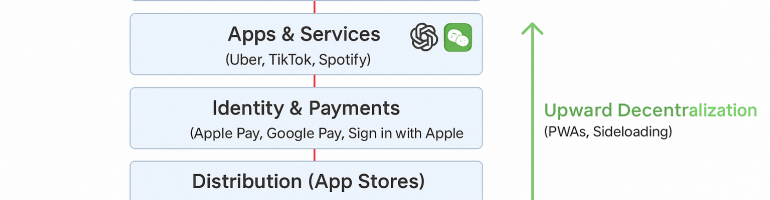
Let’s consider the mobile ecosystem as layers (simplified):
| Layer | Examples | Current Gatekeepers |
|---|---|---|
| Hardware | Apple, Samsung, Qualcomm, Google | Apple, Google |
| OS / Runtime | iOS, Android, Windows | Apple, Google |
| Distribution | App Store, Play Store, Web 7.0™ Store | Apple, Google |
| Payment / Identity | Apple Pay, Google Pay, Sign in with Apple | Apple, Google |
| Apps / Services | TikTok, Uber, Spotify | Independent developers |
| User Relationships / Data | Analytics, Ads, Web 7.0™ Trust Graph | Meta, Google, Apple increasingly |
🔀 3. What a “Reshuffle” Looks Like Here
A reshuffle model describes how control, innovation, or value capture moves between these layers. Here are several current and emerging reshuffles:
A. Reshuffle Downward (Re-integration)
Platform owners pull value back down toward themselves:
- Apple limits tracking (ATT) → cripples ad networks → reclaims privacy and ad advantage.
- Google moves privacy features into Android → weakens cross-app data collection.
- Super apps (WeChat, Grab) integrate multiple mini-apps inside one shell → pull distribution away from OS-level stores.
🧭 Effect: Platforms reclaim data, monetization, and developer dependence.
B. Reshuffle Upward (Decentralization / Open APIs)
Some innovations push value upward to developers and users:
- Progressive Web Apps (PWAs) bypass app stores.
- Cross-platform frameworks (Flutter, React Native) reduce dependency on native SDKs.
- Alternative app stores / sideloading (EU’s DMA) redistribute control.
🧭 Effect: Developers gain autonomy and flexibility, though discovery and monetization remain bottlenecks.
C. Reshuffle Laterally (New Platform Entrants)
New layers emerge, shifting boundaries:
- AI agents / assistants become new distribution channels (e.g., OpenAI’s ChatGPT apps, Perplexity’s mobile UI).
- Super app frameworks (e.g., Telegram mini-apps) become meta-platforms inside mobile OSes.
- Wallet-based ecosystems (identity, crypto, digital goods) create cross-platform continuity.
🧭 Effect: Gatekeepers may lose user touchpoints to “meta-platforms” that sit on top of the OS.
⚙️ 4. A “Reshuffle Business Model Canvas” for Mobile Apps
| Element | Description | Example |
|---|---|---|
| Trigger | What changes the distribution of value or control? | Regulatory changes (DMA), new tech (AI agents), shifts in user behavior |
| Anchor Layer | Which layer redefines the interface? | OS, identity, or payments |
| Redistributed Value | What moves? | Revenue, data, trust, discovery |
| New Gatekeepers | Who gains control? | AI assistants, mini-app frameworks |
| Old Gatekeepers | Who loses control? | App stores, SDK-based ad networks |
| User Benefit | What improves for users? | Choice, interoperability, integrated experience |
| Developer Impact | What improves or worsens? | Distribution, economics, discoverability |
🧠 5. Example: The “AI Agent Reshuffle”
In 2025 and beyond, an AI-driven reshuffle looks like this:
| Before | After |
|---|---|
| Users search for apps in App Store | Users ask AI assistants to “book a taxi” or “edit a photo” |
| Developers fight for app visibility | AI intermediates app selection and invocation |
| App Store controls discovery | AI layer controls orchestration and recommendation |
| OS owns distribution | AI owns user intent |
🧭 Reshuffle Result: AI interfaces become the new “home screen.”
App stores become backend registries. The distribution and discovery value shifts to the AI layer.
🏁 6. Summary
A Reshuffle model for the mobile app ecosystem describes how power and value continually move among:
- OS and hardware vendors (Apple, Google)
- Developers and third-party ecosystems
- New intermediaries (AI agents, super apps)
- Regulators (mandating openness)
The model emphasizes layer-by-layer realignment — each “reshuffle” altering where innovation, value, and control reside.


