Create your own magic with Web 7.0 DIDLibOS™ / TDW AgenticOS™. Imagine the possibilities.
Copyright © 2026 Michael Herman (Bindloss, Alberta, Canada) – Creative Commons Attribution-ShareAlike 4.0 International Public License
Web 7.0™, Web 7.0 DIDLibOS™, TDW AgenticOS™, TDW™, Trusted Digital Web™ and Hyperonomy™ are trademarks of the Web 7.0 Foundation. All Rights Reserved.
An unlimited number of diverse business scenarios can benefit from Web 7.0. The following is a list of some examples.
- Healthcare network. A hospital consortium where each hospital operates its own DID method (did:drn:hospital-a.svrn7.net, did:drn:hospital-b.svrn7.net). Patient VCs issued by one hospital are verifiable by any other. The Merkle log provides an auditable record of credential issuance without exposing patient data. DIDComm manages encrypted referral messages between hospitals.
- Supply chain. A manufacturing network where each tier-1 supplier owns a DID method. Components carry VC provenance records signed by their manufacturers DID. The Federation equivalent is the brand owner who sets the governance rules. The UTXO model tracks component custody rather than currency.
- Professional credentialing. A federation of professional bodies (law societies, medical councils, engineering institutes) where each body owns its DID method and issues member credentials. Cross-body credential verification uses the same IDidResolver routing the SVRN7 library already needs.
- Government identity federation. Multiple municipal or provincial identity systems where each society owns its DID method. Citizens have identities under their Society’s DID method. Cross-society services verify credentials without requiring a central identity broker.
- Outsourced digital workforce management. A neutral third-party platform that hosts, provisions, and governs outsourced digital workforces on behalf of client organizations, ensuring that each agent’s behavioral instructions reflect documented, governance-approved mandates rather than internal politics. The first platform to credibly occupy this space, backed by auditable trust frameworks and cryptographically verifiable policy provenance, will define an entirely new professional services category.
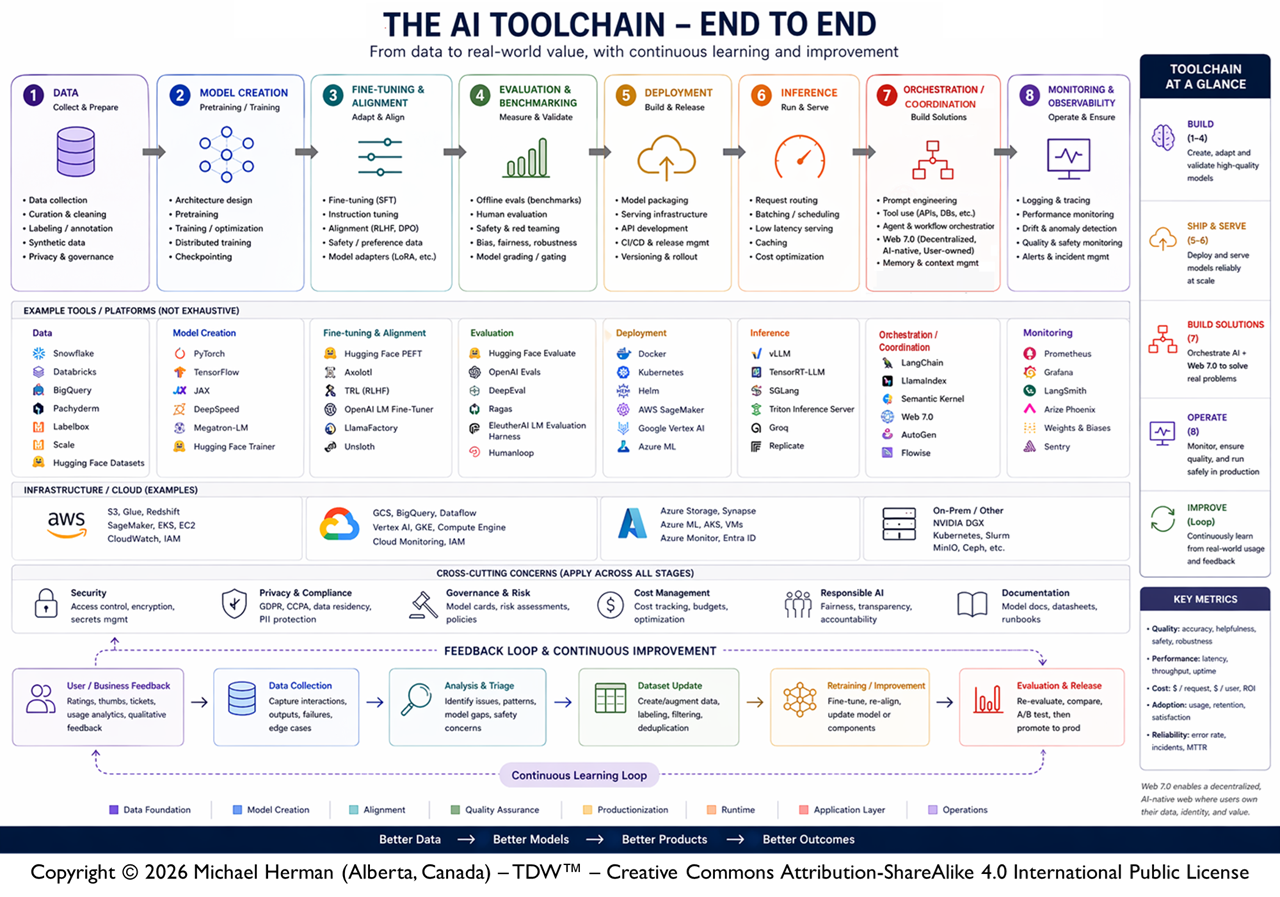
- Autonomous end-to-end AI toolchain coordination. As AI pipelines scale into production, the critical challenge is no longer any single stage — it is the coordination across multiple partners in an integrated end-to-end ecosystem.
Web 7.0 provides the decentralized, orchestration backbone that continuously coordinates the end-to-end system-of-work into a single auditable, self-improving mesh. This serves to ensure cross-cutting concerns like security, governance, and responsible AI are enforced uniformly at every handoff, and that real-world feedback flows upstream to where it is used for continuous system improvement; all while remaining operating system agnostic. The scope includes:
Pretraining → Training → Tuning → Deployment →
Inference → Orchestration → Inference → Orchestration → … → Monitoring


 Web 7.0 Pando™ / TDW AgenticOS™ / Hyperonomy™ Digital Identity Lab