The original 10 principles from Christopher Allen’s 2016 “The Path to Self-Sovereign Identity” remain a powerful foundation. (Life with Alacrity)
But over the past decade — as digital identity systems have begun to be built, debated, and challenged — new insights from academic research, real-world deployments, regulation and evolving tech (e.g. decentralized identifiers, verifiable credentials, blockchains, privacy-preserving proofs) suggest that an updated, expanded set of principles — a new update for self-sovereign identity (SSI) — could better reflect both opportunities and risks. Below is a proposed revised and expanded collection of SSI principles, integrating the original 10 while adding new ones to address trust, accountability, usability, governance, and compliance.
✅ What remains — Core Timeless Principles (original 10, refined)
I believe the original 10 remain largely valid; we restate them with slight refinement for modern context:
Existence (Human Primacy) The identity must be anchored in a real human being: digital identity cannot supplant the ineffable “I.” Systems should affirm human dignity and individuality. (Life with Alacrity)
Control (User Authority & Autonomy) Individuals must remain the ultimate authorities over their identity data. They should be able to create, modify, hide, or revoke identity data under secure, well-understood mechanisms. (Life with Alacrity)
Access (Transparency of Own Data) Users must have the ability to view (and where appropriate manage) all personal data and claims associated with their identity — no hidden data silos or gatekeepers. (Life with Alacrity)
Transparency (Open Systems & Algorithms) Identity systems, their governance, and the algorithms they rely on must be open, auditable, and as independent as possible from centralized authority. (Life with Alacrity)
Persistence (Longevity & Continuity) Identities should persist over time — ideally as long as the user desires — even if credential issuers or platforms change, while still respecting a user’s right to delete or abandon an identity. (Life with Alacrity)
Portability (Mobility & Transferability) Identity data and claims must be transportable across platforms, jurisdictions, devices — not locked into any one vendor, provider, or ecosystem. (Life with Alacrity)
Interoperability (Cross-system & Cross-jurisdiction Usability) Identities should work broadly across different systems, platforms, borders — enabling global, cross-context recognition while preserving user control. (Life with Alacrity)
Consent (Informed & Explicit Consent for Sharing) Any sharing or use of identity data must occur only with the individual’s informed and explicit consent. Consent mechanisms should be clear, user-friendly, and revocable. (Life with Alacrity)
Minimalization (Data Minimization & Selective Disclosure) Only the minimum required data should be disclosed for a given purpose (e.g. proving “over 18” without revealing date of birth). Use of selective-disclosure, zero-knowledge proofs, or cryptographic safeguards is encouraged. (Life with Alacrity)
Protection (Privacy, Security & Rights Safeguards) Users’ rights must be protected; identity systems must defend against abuse, resist censorship and coercion, secure data, and guard against identity theft or misuse. (Life with Alacrity)
➕ New Principles for SSI 7.0
Based on developments over the past decade — from academic critiques, real-world SSI schemes, regulatory pressures, and evolving threat models — I propose adding the following principles to make SSI more robust, practical, and trustworthy in modern contexts.
Accountability & Auditability While decentralization and user control are central, identity systems must also provide mechanisms for accountability — for misuse, fraud, or disputes. This may include revocation registries, audit logs, and cryptographic or institutional mechanisms that allow for tracking misuse without compromising user privacy. This balances user sovereignty with real-world responsibilities. For example, a recent SSI scheme augments privacy with joint accountability using threshold-based methods to prevent attacks while preserving user control. (arXiv)
Security & Resilience by Design SSI should rely on strong cryptographic foundations, resistance to key-compromise, replay or correlation attacks, and design for long-term resilience (including key recovery, revocation, migration, and backup). Academic surveys highlight that trust in SSI is still “complex and fragmented,” and robust security architecture is essential. (arXiv)
Privacy by Default & Contextual Confidentiality Beyond minimal disclosure, SSI systems should default to maximum privacy: user wallets, metadata protection, unlinkability across contexts, selective disclosure by default, and privacy-preserving authentication (e.g. zero-knowledge proofs, anonymous credentials). This becomes more critical especially with cross-platform and cross-jurisdiction use (e.g. in the context of the metaverse, or global Web3). (arXiv)
Usability & Accessibility SSI must be practical for real people — across digital-literacy levels, devices, geographies — and not just for technologists. Identity wallets and management tools should be easy to use, resilient to device loss, data corruption, or jurisdictional changes. Also, cost and usability barriers must be minimized so that SSI remains inclusive (“available to all”). This is especially important for global adoption (e.g. for refugees, under-served populations). (Sovereign Cities)
Governance & Community Stewardship Given SSI’s public-good dimensions (interoperability, privacy, security), there needs to be governance mechanisms — community, standard-bodies or decentralized governance — to steward protocols, resolve disputes, evolve standards, and ensure accountability. This ensures that identity systems remain aligned with human rights, collective interest, and social norms. Some proponents argue turning original principles into legally or socially codified “duties” rather than just “best practices.” (Life with Alacrity)
Compliance & Ethical Legality SSI systems should respect applicable laws, human rights, data-protection regulations (e.g. privacy laws, nondiscrimination), and ethical norms — especially when deployed globally across jurisdictions. This principle helps bridge SSI with regulatory realities (e.g. GDPR) while preserving user sovereignty. Indeed, recent literature critiques SSI schemes on GDPR compliance. (arXiv)
Recoverability & Continuity (Key/Access Loss Handling) Real people lose devices, forget credentials, or face emergencies. SSI must support mechanisms for recovery, transfer, or delegation — e.g. social recovery, multi-party escrow, recovery tokens — so that a user’s identity does not become irretrievably lost. This ensures persistence doesn’t become fragility.
Minimal Trust Assumptions (Decentralization of Trust) SSI should minimize reliance on central trusted parties; trust should be distributed, protocol-based, cryptographically verifiable, and avoid single points of failure (or control). This strengthens autonomy and reduces governance risk.
Transparency of Governance & Policy (Beyond Implementation) Not just open code, but also open governance: decisions, upgrades, policies for revocation, dispute resolution, credential issuance — should be transparent, documented, and participatory (ideally community-driven).
Inter-Community and Social Interoperability (Normalization of Claims & Contexts) Beyond technical interoperability, identity systems should support semantic and social interoperability: standard vocabularies, claim schemas, norms for credential issuance and verification, recognition across communities/jurisdictions. This avoids fragmentation even in decentralized ecosystems.
🧑🤝🧑 Why these additions — What changed since 2016
The rise of decentralized identity implementations (DIDs, verifiable credentials, wallets, blockchain-based registries) has shown the importance of security, recoverability, privacy by default, and regulatory compliance.
Academic scrutiny (e.g. risk of misuse, identity theft, trust fragmentation, accountability) reveals that pure decentralization without accountability can be risky. (arXiv)
Real-world scenarios — global mobility, cross-jurisdiction identity, refugees, displaced people — demand usability, accessibility, portability, and social interoperability to make SSI inclusive and effective.
Legal/regulatory frameworks (e.g. privacy laws, data protection, anti-money laundering) increasingly intersect with identity systems — forcing SSI to consider compliance, ethicality, and governance. (arXiv)
As identity becomes central to emerging domains (e.g. Web3, metaverse, decentralized finance), there is a need for governance, community stewardship, transparent policy, and inter-community standards to avoid fragmentation and fragmentation-driven insecurity. (arXiv)
⚠️ Challenges & Trade-offs — Why SSI 7.0 must be “balanced and diversified”
Adding more principles inevitably creates tension — greater security and governance can come at the cost of simplicity or decentralization; accountability mechanisms risk undermining privacy; recoverability may introduce attack surfaces; compliance may conflict with anonymity. A robust SSI 7.0 must therefore balance these trade-offs, offering diversified principles so that implementers can make conscious, value-driven design choices depending on the context (e.g. voting, healthcare, travel, social networking).
📝 SSI 7.0 Principles Proposal — Draft for Community Use
Here’s a draft list, which could serve as a starting point for community discussion, design, and standardization:
Protection (Privacy, Security & Rights Safeguards)
Accountability & Auditability
Security & Resilience by Design
Privacy by Default & Contextual Confidentiality
Usability & Accessibility
Governance & Community Stewardship
Compliance & Ethical Legality
Recoverability & Continuity (Key/Access Loss Handling)
Minimal Trust Assumptions (Decentralized Trust)
Transparent Governance & Policy
Inter-Community / Social Interoperability (Semantic & Contextual)
🎯 How This Might Be Used — Next Steps
Use this as a living framework: publish a draft “SSI 7.0 Principles” document (e.g. on GitHub) and invite contributions from technologists, regulators, civil-society, and end users — just as the 2025 revision project under the original author invites. (Life with Alacrity)
When designing or evaluating SSI systems (wallets, DIDs, credentials, revocation), use this expanded set to assess trade-offs — e.g. does this system meet privacy by default? Does it include recovery mechanisms? Is governance transparent?
For implementations in sensitive contexts (healthcare, refugees, KYC, cross-border identity) embed governance, compliance, accountability, and usability early — not as afterthoughts.
ChatGPT: I read Christopher Allen’s original “Ten Principles” (2016) and pulled a short set of modern, standards- and ecosystem-aware sources (W3C DID / Verifiable Credentials, Trust Over IP, Sovrin, EBSI) to make sure the updated set reflects real-world progress since 2016. (lifewithalacrity.com)
Below is a proposed updated & expanded collection of Principles of Self-Sovereign Identity — 16 principles grouped into themes, each with a short explanation and why it matters today. After the list I include a compact mapping to Allen’s original ten so you can see continuity.
Updated Principles of Self-Sovereign Identity 7.0
Core: sovereignty & agency
Existence & Agency — People (and other identity subjects) have an independent existence and agency over their identifiers and claims. Identity systems must start from the person (or subject) and preserve that agency. (recovers Allen’s Existence/Control). (lifewithalacrity.com)
User Control (Agency in Practice) — Users must be the operational controllers of their identifiers, credential stores (wallets/agents), and consent decisions — including fine-grained, revocable consent. Control must be meaningful (usable) not just theoretical. (walt.id)
Technical interoperability & standards
Standards-based Interoperability — Implementations should rely on open standards (e.g., W3C Decentralized Identifiers and Verifiable Credentials) to enable global, cross-vendor interoperability of identifiers, credentials, and presentations. Standards provide portability and composability across ecosystems. (W3C)
Protocol & Architectural Openness — Protocols (DID methods, messaging like DIDComm, wallet APIs) and reference architectures (e.g., Trust Over IP stack) must be open and modular so ecosystems can interoperate while allowing local innovation and governance. (Trust Over IP)
Privacy, minimal disclosure & security
Data Minimization & Selective Disclosure — Disclosures must reveal the minimum data necessary; support selective disclosure, zero-knowledge proofs, and anonymous/pseudonymous modes to reduce correlation and surveillance risks. (lifewithalacrity.com)
Privacy by Design & Accountability — Systems should be designed for privacy by default and include accountability mechanisms (consent logs, auditable policies) so misuse can be detected and remedied.
Security & Resilience — Identity systems must provide robust cryptographic security, threat-resistant key management (including social recovery and hardware wallet options), and resilience to compromise, outages, and future threats (e.g., post-quantum planning).
Lifecycle, governance & legal
Persistence & Manageable Lifecycle — Identities and credentials should be persistent as the holder requires, with clear, manageable lifecycle operations (issuance, renewal, revocation, expiry, archival, “right to be forgotten”). Allen’s persistence principle expanded to operational lifecycle. (lifewithalacrity.com)
Recoverability & Continuity — Systems must provide practical and secure recovery mechanisms (social recovery, delegated guardianship, legal recovery paths) so loss of keys or devices does not destroy access to identity or essential services.
Governance, Trust Frameworks & Legal Compatibility — Identity ecosystems require transparent governance and legal frameworks (e.g., ToIP governance, regional trust frameworks like EBSI) to mediate disputes, define liability, set assurance levels, and enable cross-jurisdictional recognition. (Trust Over IP)
Ecosystem & practical adoption
Usability & Accessibility — Real self-sovereignty only exists when interfaces, error recovery, and flows are usable by non-experts and accessible to people with disabilities and diverse contexts (language, literacy, device constraints).
Interoperability with Existing Systems — SSI should interoperate with existing eID, legal, financial, and institutional systems (bridging, translation, hybrid trust models) so real services can use SSI credentials today. (EBSI and other national/regional deployments show this direction). (European Commission)
Assurance, Provenance & Auditability — Verifiers need to rely on trustworthy evidence. Credential schemes should include provenance metadata, assurance levels, and revocation mechanisms so verifiers can make informed decisions without central control. (W3C)
Ethics, inclusivity & future proofing
Human Rights & Ethical Use — Identity systems must protect human rights (privacy, freedom of association, non-discrimination) and explicitly avoid enabling oppression, surveillance, or exclusion; risk assessments and ethical review should be part of deployment.
Inclusivity & Non-Discrimination — Systems must be designed to include people without formal credentials, low-resource settings, refugees, and marginalized communities; they must not require devices, connectivity, or literacy levels that exclude vulnerable populations.
Extensibility & Future-proofing — The model must support non-human subjects (devices, organizations, agents), evolving cryptography, new proof techniques, and new governance models — i.e., it must be extensible without breaking user sovereignty. W3C specs and ecosystem work (Sovrin/Hyperledger/ToIP) show that extensibility is central to adoption. (Sovrin)
Short rationale & evidence
Standards matter now. Since Allen’s post, the W3C DID and Verifiable Credentials work have become de-facto standards shaping implementations; any modern principles set must call out standards-based interoperability. (W3C)
Governance & trust frameworks are essential. Technical primitives alone don’t create real trust for large-scale public or cross-border use — frameworks like Trust Over IP and regional initiatives (EBSI) show the need for human/legal/governance layers. (Trust Over IP)
Practical recovery and UX are blockers for adoption. The community has learned that without recoverability and usable wallets/agents, people lose keys and services fail. That motivates explicit Recoverability and Usability principles. (See ecosystem projects and wallet tooling). (walt.id)
Mapping to Allen’s Original 10
To keep continuity: most of Allen’s ten are preserved but expanded into modern categories:
Allen’s Existence, Control, Access, Transparency, Persistence, Portability, Interoperability, Consent, Minimalization, Protection are preserved and appear across the updated list (Existence & Agency; User Control; Access incorporated into Usability/Recovery; Transparency → Architectural Openness and Governance; Minimalization → Data Minimization; Protection → Security & Human Rights). See Allen original. (lifewithalacrity.com)
The Renaissance, which took place from the 14th to the 17th century in Europe, was a time of great cultural, artistic, and scientific growth. During this period, artists, architects, and writers sought to revive the classical values of ancient Greece and Rome, leading to a revolution in style and subject matter in art.
One of the most notable features of Renaissance art is its realism and attention to detail. Artists, such as Leonardo da Vinci, Michelangelo, and Raphael, sought to create lifelike depictions of the human form and the natural world. This realism, combined with a focus on classical ideals, can be seen in works such as Leonardo’s “The Last Supper,” Michelangelo’s “David,” and Raphael’s “The School of Athens.”
In addition to realism, the Renaissance also saw a shift in subject matter. Instead of solely focusing on religious themes, artists began to depict a wider range of subjects, including landscapes, portraits, and historical events. This shift reflects the growing interest in the secular world and the rediscovery of classical learning during the Renaissance.
Renaissance art also had a profound impact on architecture. Architects, such as Filippo Brunelleschi and Leon Battista Alberti, sought to revive the classical styles of ancient Greece and Rome, leading to the development of Renaissance architecture. Notable examples include the Medici Palace in Florence and St. Peter’s Basilica in Rome.
In conclusion, the Renaissance was a period of great artistic and cultural growth, marked by a revolution in style and subject matter. From the realism of Leonardo da Vinci to the grandeur of Renaissance architecture, these artworks continue to inspire and captivate audiences to this day and serve as a testament to the cultural heritage of the Renaissance.
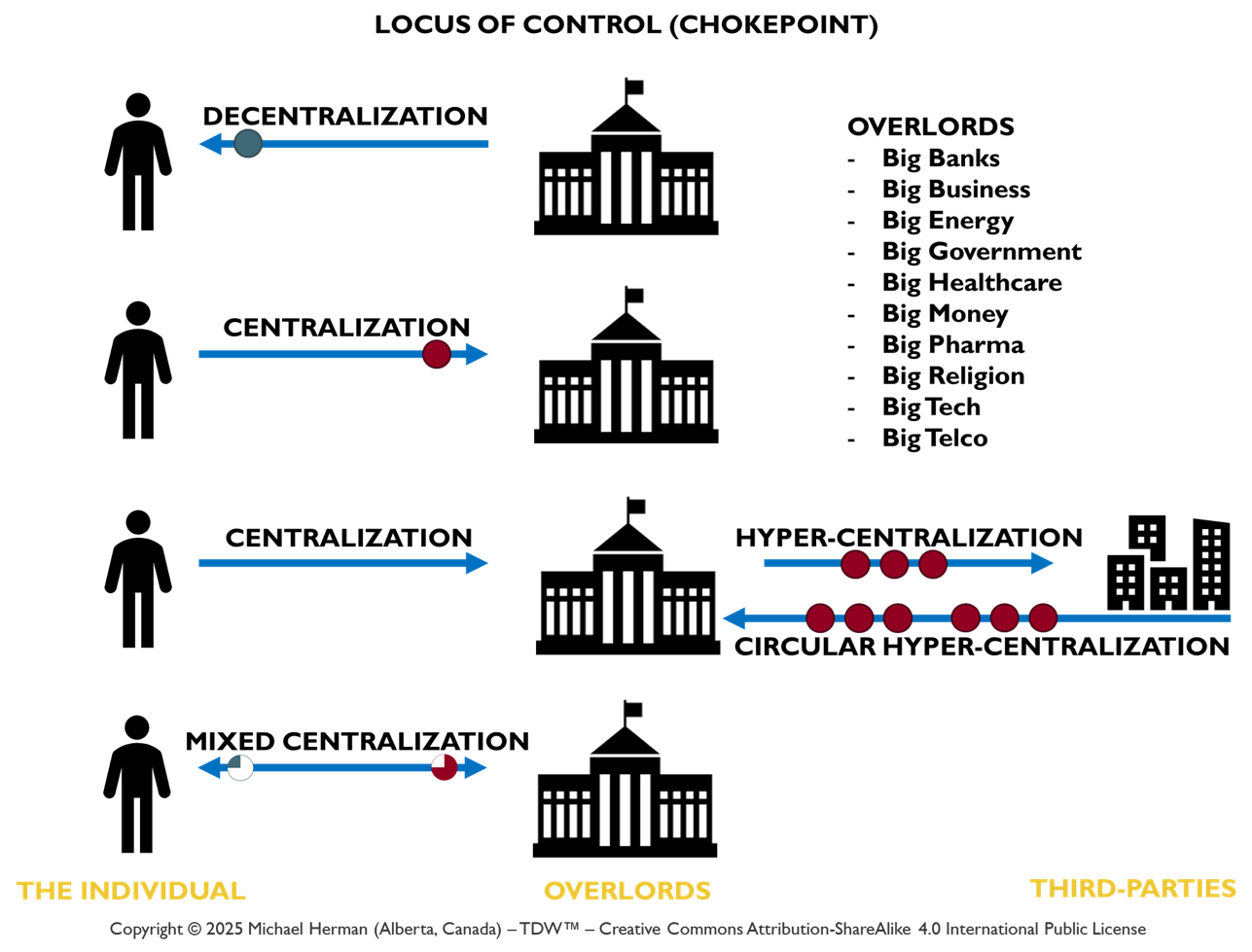
A Democracy can be viewed as a hybrid between Decentralization and Centralization, and considering it in this way helps clarify both its strengths and tensions. Using the framing and language from the article on Hyperonomy Digital Identity Lab™ (on decentralization/centralization) helps ground the idea. (hyperonomy.com)
Figure 1. Decentralization and Centralization: Locus of Control (Chokepoints)
What does Hyperonomy says about Decentralization
According to Hyperonomy, decentralization refers to shifting control (identity, data, decisions, etc.) away from a single central authority toward a distributed ecosystem — where trust and coordination emerge from autonomous agents, shared governance, or open protocols rather than top-down institutions. (hyperonomy.com)
The decentralization ideal emphasizes resilience, interoperability, autonomy, and giving individuals or smaller units more control over their own domain (e.g. identity or decisions), rather than placing everything under a monolithic centralized authority. (hyperonomy.com)
The broader literature on decentralization (in political science, public administration, etc.) elaborates that decentralization often aims to increase participation, local responsiveness, diversity in decision-making, efficiency in delivering services, and greater relevance to local conditions rather than one-size-fits-all centralized control. (Wikipedia)
Democracy is inherently a mix of Decentralization and Centralization
A democracy — especially representative democracies in modern states — naturally combines elements of both decentralization and centralization.
Decentralization in a Democracy
Local representation and decision-making: Democracies often allow (and sometimes require) that decisions be made at local or regional levels (municipalities, provinces/states, counties, districts), giving those sub-national units meaningful authority over many social, economic, or cultural issues.
Participation and diversity: By empowering individuals (or local communities) to elect their representatives, democracy channels a plurality of voices and interests, giving local context and grassroots concerns a say in governance — consistent with the decentralization ideal of distributing power rather than concentrating it.
Accountability and responsiveness: Local or regional governments that are closer to constituents are often better informed about local conditions; this promotes responsiveness and accountability, aligning with the benefits of decentralization described by governance scholarship. (ScienceDirect)
Centralization in a Democracy
Central institutions for broad coordination: Democracies typically rely on national (or higher-level) institutions — parliaments/congresses, courts, central banks, or executive branches — to make decisions that affect the whole polity (defense, trade, national infrastructure, monetary policy, etc.). Those central institutions enable coordination across diverse regions and populations.
Standardization, rule of law, and equal treatment: Centralization helps ensure common standards (laws, rights, regulatory frameworks) that apply across the country. Without a central authority, such coherence is hard to maintain.
Ability to manage large-scale, cross-regional issues: Some problems (e.g. national security, economic macro-policy, environmental regulation, pandemics) require centralized capacity and coordination across many localities — something that decentralized fragments alone may struggle to handle effectively.
Democracy as a “Hybrid” — a Delicate Balance
Given the above, Democracy functions as a hybrid system:
It decentralizes by distributing political power — giving individuals/communities representation, local governance, and a role in decision-making, enabling diversity, participation, and local responsiveness.
It centralizes by maintaining institutions that coordinate across the whole polity, ensure uniform rights and laws, manage shared resources, and handle collective action challenges that require unity.
That hybrid nature can be seen as a strength: it combines the flexibility, resilience, and responsiveness of decentralization with the coherence, scale, and coordination of centralization.
But it also introduces tensions:
Over-centralization can suppress local autonomy, reduce diversity, and disconnect decision-makers from local needs.
Over-decentralization (fragmentation) can lead to coordination failures, inequalities between regions, and difficulties in addressing problems that span local boundaries.
The “sweet spot” for a democracy — in this view — is finding a balance: enough decentralization to empower local voices and contexts; enough centralization to deliver unity, fairness, and capacity for collective action.
What does Democracy gain from using Hyperonomy’s Framing
Using the lens from Hyperonomy (originally articulated in the context of digital systems, identity, and governance architectures) helps generalize the decentralization–centralization tradeoff beyond institutions:
It shows that whether power, control, identity, or decision-making is central or distributed is not a binary choice — real systems (whether digital networks or democratic polities) often mix features depending on context, purpose, scale.
It highlights that decentralization is always “good” (nor centralization “bad”): what matters is architecture — how responsibilities, trust, and governance are designed and distributed.
It underscores resilience, interoperability, and autonomy as design goals — which map well onto democratic ideals like political participation, civil liberties, accountability, and adapting to diverse local conditions.
Conclusion: Democracy is a Regressive Decentralization-Centralization Hybrid
In short: democracy very often is a hybrid between centralization and decentralization. It draws on decentralizing impulses (local decision-making, representation, citizen participation) to ensure diversity and responsiveness, while relying on centralized structures to ensure coherence, rule of law, collective capacity, and fairness across the whole polity.
Using the conceptual framing from the Hyperonomy article helps emphasise that this isn’t a flaw or anomaly — but a necessary but regressive balancing act that shapes how democratic societies function, just as decentralized digital systems must balance autonomy and coordination.
Appendix A – Social Evolution: From Wanderer to Digital Nation State
The democratic principles discussed in this article apply to every stage of societal development, as illustrated in Figure 2. In hindsight, the left side of the diagram is decentralization leaning, while the right side is centralization leaning. The middle is a hybrid.
Figure 2. Social Evolution: Creation of a Nation State
Decentralization refers to the shift from centralized control of identity, data, compute, and decision-making toward a distributed ecosystem where trust emerges from cryptographic proofs, verifiable credentials, and autonomous agents—not institutions.
Instead of relying on a single platform or cloud to authenticate users, store data, run applications, or mediate transactions, decentralization enables individuals, organizations, and intelligent agents to interact through open protocols, self-sovereign identities, shared governance, and value-aligned automation. This creates a more resilient, equitable, and interoperable digital environment where trust is built into the architecture, users retain control over their digital existence, and intelligent agents operate collaboratively rather than being owned or constrained by proprietary platforms.





 Web 7.0 DIDLibOS™ / TDW AgenticOS™ / Hyperonomy™ Digital Identity Lab