Google CEO Sundar Pichai says artificial intelligence is going to have a bigger impact on the world than some of the most ubiquitous innovations in history.“AI is one of the most important things humanity is working on. It is more profound than, I dunno, electricity or fire,” says Pichai, speaking at a town hall event in San Francisco in January.
“If the Big Bad Wolf of business is disruption — then your house of straw, your house of sticks, your house of bricks … they each represent how you respond. To survive, you can’t just build the straw or the sticks. You need the bricks.” — Mitch Joel (Italics added)
If the “big bad wolf” symbolizes disruption, then the Three Little Pigs are three business responses you need to cover to survive and thrive:
Pig 1 — Transform: internal change. Make transformation an inside-out function: rethink organizational structure, culture and capabilities so you can meet customers where they are. (Think: change how you operate, not just what you sell.)
Pig 2 — Innovate: build products, services or experiences that actually connect with people — new tools, features or touchpoints that create fresh ways to engage.
Pig 3 — Transact: rework how you enable commerce and conversion — the channels, payment flows, and customer journeys that let people buy or interact on their terms.
Why he uses the tale: the fairy tale makes the point visceral: if you only build a “straw” or “stick” strategy (only one of Transform, Innovate, Transact), the wolf (Disruption) will blow you down. You need all three to be resilient.
Pig 1 — Transform: the “inside-out” house-building
Build capability and culture first. Don’t only redesign products; change how the organisation thinks, decides and moves.
Focus on skills, structure and processes that let you adapt: cross-functional teams, fast decision loops, data fluency, and an experimentation mindset.
Make customer context part of every change: measure real customer behaviour (not just surveys) and let that guide priorities.
Concrete early wins: align one existing team to run a rapid experiment (2–4 week sprint), hire/rotate a digital product lead into a legacy unit, or map your customer journey and remove the top 3 friction points.
Useful KPIs: time-to-decision, % of revenue from products launched in last 18 months, experiment velocity (number of tested hypotheses per quarter), and Net Promoter Score or task completion rates for key journeys.
Pig 2 — Innovate: Build the house of sticks
“Once you’ve begun transforming internally, you need to create things that people actually want. Innovation isn’t about chasing shiny objects; it’s about connecting better with customers.” — Mitch Joel
Innovation is building new ways for people to engage with your brand, products, or services. It’s the “what we make and how it connects” layer between transformation (internal) and transaction (external).
Experiment at the edges – Pilot emerging technologies, formats, and experiences (AR, personalization, voice, AI tools) to see what actually enhances value.
Design for emotion – Innovate not only for efficiency, but for meaning: create products, campaigns, or digital experiences that make people feel something.
Bridge physical + digital – Mitch calls this “the connected experience.” Every interaction, online or offline, should feel continuous.
Iterate fast, retire faster – The wolf (disruption) gets through the “stick house” if you can’t evolve quickly. Kill what doesn’t work early.
Pig 3 — Transact: Build the Brick House
Transformation builds the foundation (Pig 1). Innovation builds the structure that attracts and connects people (Pig 2). But the house of sticks still isn’t enough — unless you tie it to real customer action through Transact (Pig 3 — a house of bricks).
“Transformation and innovation don’t mean much if you can’t enable people to act — to buy, to subscribe, to connect. The strongest companies make it effortless for customers to say ‘yes.’” — Mitch Joel
Transact is about removing friction between desire and action. It’s where all your internal change (Pig 1) and creative output (Pig 2) translate into measurable results — purchases, loyalty, advocacy, or community engagement.
“The future of commerce is context,” he says: people transact in the environment they’re already in.
Simplify the path to action.
One-click purchasing, mobile optimization, intuitive onboarding, instant checkouts.
Fewer steps = more conversions.
Trust and transparency.
Friction isn’t just usability; it’s emotional. People buy when they trust how their data, time, and values are treated.
Close the feedback loop.
Every transaction should teach you something. Feed that data back into transformation (Pig 1) and innovation (Pig 2).
Mitch’s Metaphor
Pig 1 — Transformation = foundation (get your own house in order).
Pig 2 — Innovation = frame and design (what the world sees).
Pig 3 — Transaction = solid bricks that make the house stand against the wolf (disruption).
Kaplan & Norton’s Strategy Map
A good example of a Kaplan and Norton strategy map appears in Figure 1. The Parallelsapce Corporation Strategy Map applies the Kaplan and Norton Balanced Scorecard framework to align learning, processes, customers, and financial outcomes.
It begins with a foundation of Learning & Growth — focusing on research, training, people, and best practices—to build organizational capabilities.
These capabilities feed into Internal Processes such as analysis, external publishing, partnerships, CRM, and proof-of-concepts, which strengthen Customer Perspectives of knowledge and solution leadership through design excellence and process integrity.
Ultimately, this drives Financial Results across multiple revenue streams, including content, delivery, training, consulting, and both packaged and custom solutions.
The map emphasizes a cause-and-effect flow from people and process excellence to customer trust and financial growth.
Figure 1. Parallelspace Corporation Strategy Map
Mapping “Three Little Pigs” (TLP) to Kaplan & Norton’s Strategy Map
Figure 2 is a color-coded layout aligning the TLP’s potential business responses of Transform, Innovate, and Transact with the Learning & Growth, Internal Process, Customer, and Financial perspectives of the Balanced Scorecard framework
Figure 2. Mapping “Three Little Pigs” to Kaplan & Norton’s Strategy Map
The 4th Perspective, Learning & Growth (Cultural Foundation), is an extension of the Pig 1 — Transform response used for Perspective 3: Internal Processes.
Resources
Strategy Maps: Converting Intangible Assets into Tangible Outcomes. Robert S. Kaplan and David P. Morgan. Harvard Business Review Press. 2004.
Dunbar’s Number refers to the cognitive limit on the number of stable, meaningful social relationships a person can maintain — typically around 150.
Proposed by anthropologist Robin Dunbar in the early 1990s, it’s based on research linking neocortex size to social group size in primates, then extrapolated to humans.
The key idea: our brains can only manage a limited number of people whose relationships with us (and with each other) we can track in any depth.
📊 Dunbar’s Social Layers
Dunbar found that human relationships form nested circles of intimacy, each layer roughly three times larger than the one before it — but with decreasing emotional closeness and interaction frequency.
Layer
Approx. Size
Relationship Type
Typical Frequency of Contact / Emotional Closeness
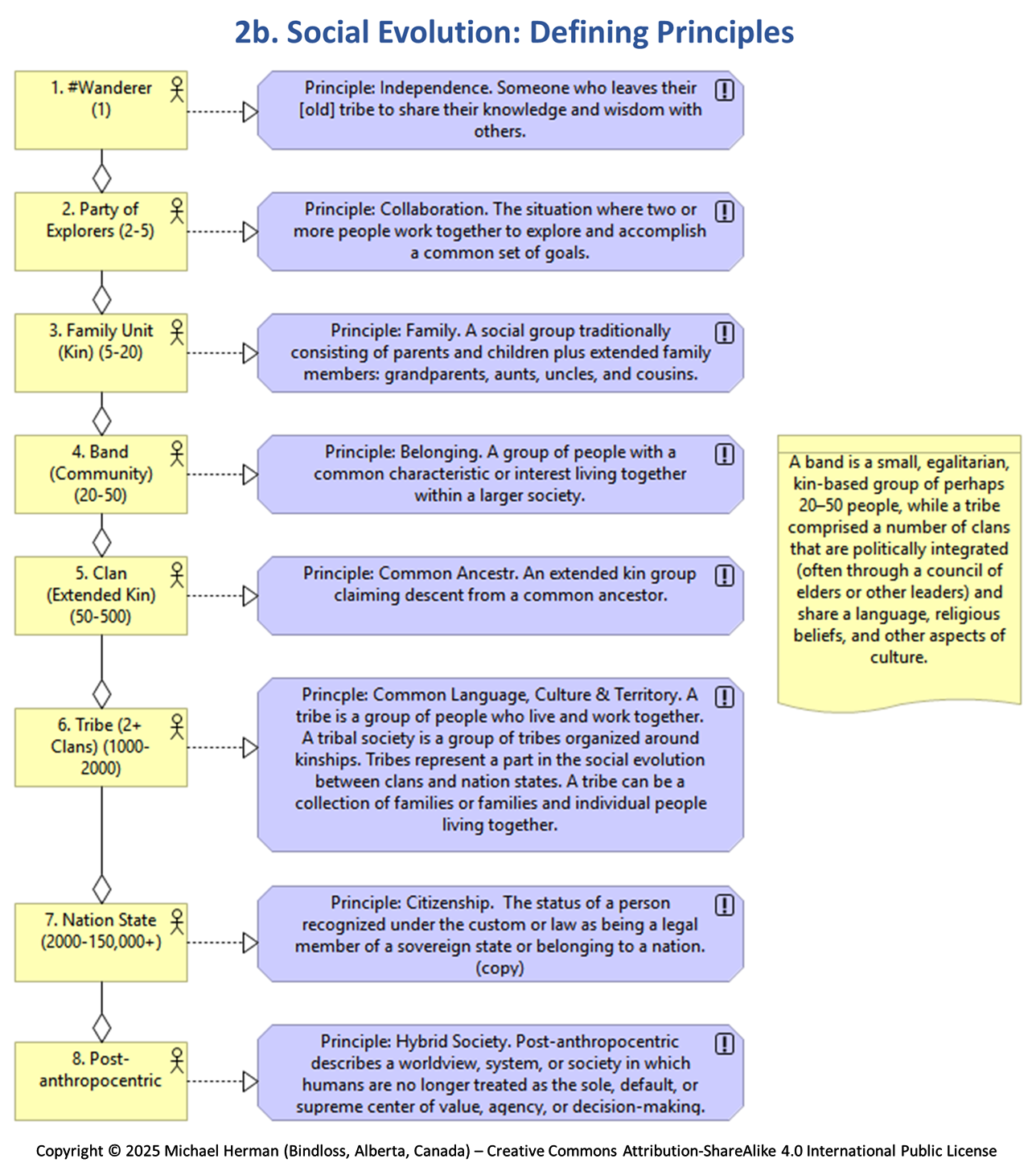
0th Circle (#Wanderer)
1
An individual
N/A
1st Circle (Party of Explorers)
2-5
Closest friends & family — your “support clique”
Daily or near-daily contact; deepest emotional ties
2nd Circle (Family Unit)
5-20
Good friends you confide in and rely on
Weekly contact; high emotional closeness
3rd Circle (Band)
20-50
Friends you might invite to a big personal event (e.g. wedding)
Monthly contact; moderate closeness
4th Circle (Clan)
50-500
Meaningful relationships — people you know personally and would help if needed
A few times per year; recognize and understand social context
5th Circle (Tribe)
1000-2000
Acquaintances — people whose names and faces you recognize
Occasional interaction or recognition
6th Circle (Nation State)
2000-150,000+
People you can place a name to (the limit of facial recognition memory)
Rare interaction; mostly recognition only
📱 Modern & Practical Implications
Even in the digital era:
People still maintain about 100–200 active online relationships despite thousands of “followers.”
Teams, villages, and companies often stabilize near this size before naturally splitting or losing cohesion.
Some organizations (like W. L. Gore, maker of Gore-Tex) deliberately limit unit size to ~150 to preserve strong internal culture and trust.
Figure 1. Dunbar’s NumberFigure 2. Dunbar number passage from The Cold Start Problem.Figure 3. Social Evolution: Defining Principles. Michael Herman. 2019
The term “macromodular” generally refers to something composed of large, self-contained modules that can be combined or interchanged within a broader system.
Why Macromodular?
The amount of logically irrelevent engineering detail inherent in the design and construction of a computer system is great. As a result, the task of creating a system based on the use of present techniques is so difficult and time-consuming that the number of different systems that can be put into use for evaluation and study by any one group of workers is small. This is unfortunate as we are thereby denied the opportunity to develop that insight into logical organization which can grow out of a working familiarity with many diverse forms. What is needed is a set of relatively simple, easily inter-connected modules from which working systems can be readily assembled for evaluation and study. With such a set, both the designer and user would be able to try out potentially powerful and novel structures on a very large scale, adjusting and improving the systems as needed. Once a design has been realized and its value established, it could then be reworked into tighter engineering form for maximum efficiency and for production by automatic wiring and fabrication techniques, and the experimental units made available for further studies or returned to “inventory” in the manner proposed by Estrin. Macromodular computer systems. Wesley Clark. 1967.
“Macromodular” is used in several contexts, each with a slightly different nuance.
1. Systems Design / Engineering
Meaning: A macromodular system is built from major components (modules) that can operate semi-independently but connect through defined interfaces. Example: In aerospace or manufacturing, a rocket might be designed in macromodules — propulsion, guidance, payload — each built and tested separately, then integrated. Contrast: Modular → small, interchangeable units. Macromodular → large, complex modules, often representing entire subsystems.
2. Software Architecture
Meaning: A macromodular architecture organizes codebases into large, cohesive components (e.g., microservices clusters or bounded contexts) rather than granular micro-modules. Example: A company might have a “macromodule” for payments, another for user management, each encompassing many smaller internal modules. Benefit: Easier maintainability and clearer ownership boundaries than hyper-granular microservices.
3. Biological or Cognitive Science (less common)
Sometimes used metaphorically to describe large functional units in a system — e.g., macromodular organization of the brain (sets of modules handling high-level tasks like perception or language).
In short: Macromodular = modular at a higher level of aggregation. It emphasizes large-scale modularity — balancing specialization and integration.
The term “macromodular systems” refers to systems composed of large, well-defined, interoperable modules that can be independently developed, maintained, and replaced, yet integrate seamlessly into a larger architecture. It’s an evolution of modular design thinking—scaling up modularity from components or microservices to system-level modules that encapsulate significant functionality or subsystems.
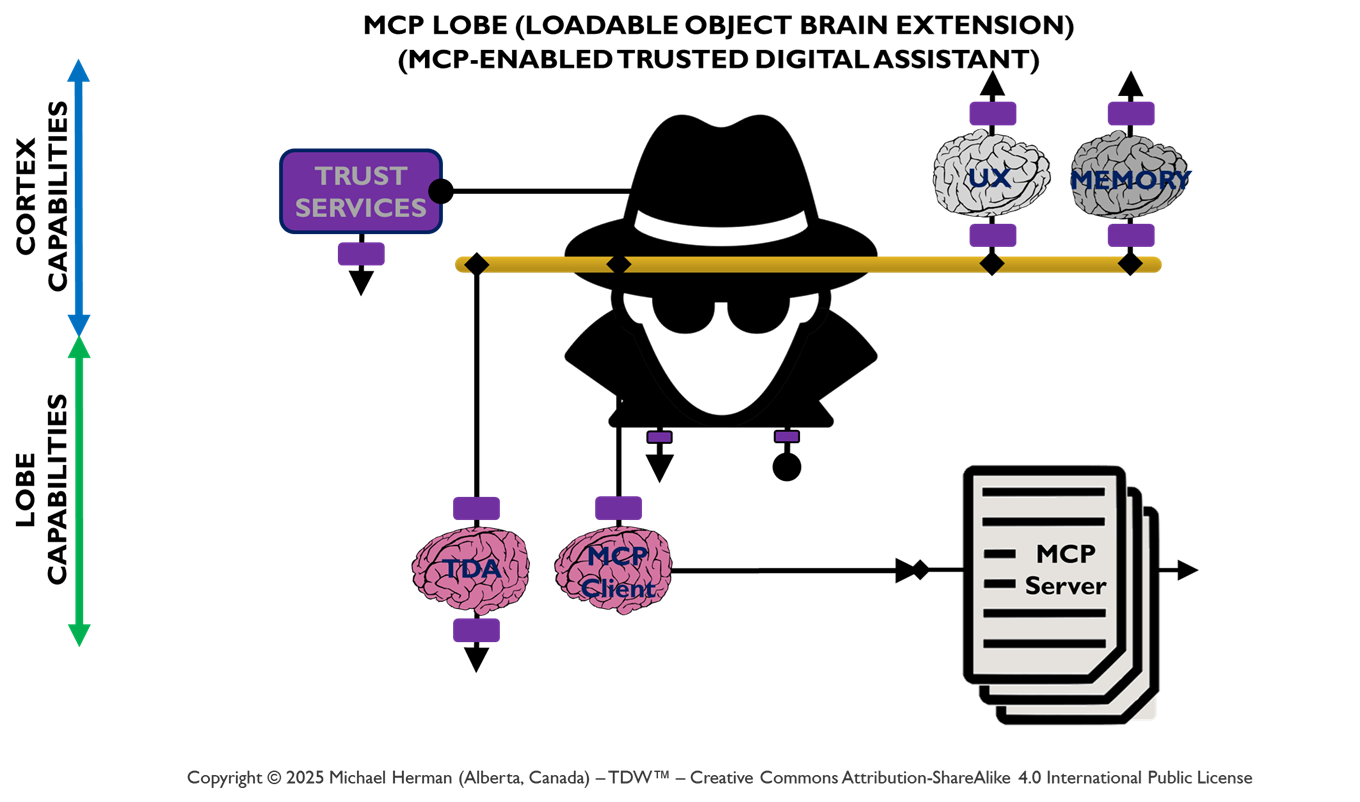
The true #promise of #AI is solving #macromodular problems – not personal productivity tools like ChatGPT, Copilot, Grok, Gemini, Perplexity, Claude, etc. Michael Herman, November 2, 2025.
Who remembers when Microsoft introduced Visual Basic Controls (VBX)?
Why are Agents important? AI Agents will follow the same trajectory as VBXs and serve an identical purpose: accelerating the componentization, commercialization, and consumption of AI. This trajectory will be measured in years. Michael Herman, LinkedIn. Web 7.0 Foundation. October 2025.
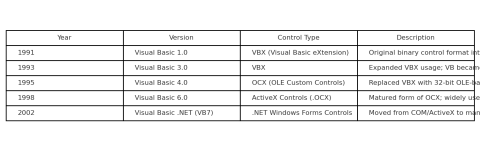
Microsoft introduced Visual Basic controls — often referred to as VBX controls — in 1991, with the release of Visual Basic 1.0 for Windows.
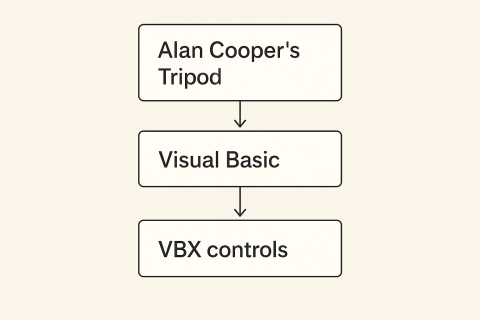
The “father” of VBXs (Visual Basic eXtensions) is generally recognized as Alan Cooper. Here’s how that came about:
Alan Cooper, a software designer and developer, created an early visual programming environment called Tripod in the late 1980s. Microsoft acquired the rights to Tripod and, working with Cooper, developed it into Visual Basic 1.0, which launched in 1991.
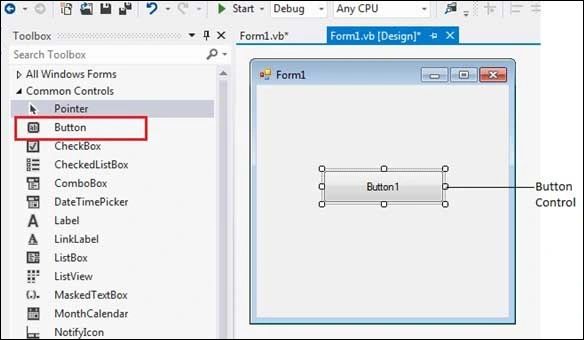
Cooper’s prototype introduced the form designer concept — dragging and dropping UI elements (controls) onto forms — which directly led to the need for VBX controls as reusable, pluggable components.
Although Microsoft’s VB team (led by Scott Ferguson and others) implemented the actual VBX architecture, Alan Cooper’s foundational design and vision for a “visual, component-based programming tool” earned him the informal title of: 🧠 “The Father of Visual Basic” — and by extension, of VBX controls.
My Wishes for a #NewAlbertan (read slowly like Paul Harvey would say it)
Ask your Dad for a fingertip drip of Jameson. Learn how to kiss …passionately. Clip your fingernails …really close. Wear Bleu De Chanel. Smile a lot.
Learn to dance the polka, two-step, and jive. Slow dancing will come on its own. Buy flowers …lots of flowers. Take your Mom out on “school nights”. Throw the baseball with Dad. Smile a lot.
Learn to use a real calf rope. Drive a pickup truck …nothing else. Learn to pick crocuses and wild roses. Valpolicella Ripasso is a great wine until you can afford Amarone. Smile even more.
Travel, yes travel …to Spain, Netherlands, and Poland. Eat great food. Make your Mom buy you a pickle canner. Love your Mom and your Dad but especially your Mother. Smile even more.
Never forget you’re an Albertan. Buy a ranch some day. Wherever life takes you, never forget what an Alberta sky looks like. Love country music. Smile.






 Web 7.0 DIDLibOS™ / TDW AgenticOS™ / Hyperonomy™ Digital Identity Lab