Category Archives: Enterprise Architecture

[Enterprise Architecture, Big Data, CRM, ERP, …] Tools and Methods Don’t Generate Business Value

[Updated: April 23, 2017]

Enterprise architecture and other tools and methods don’t generate business value – plain and simple; at least, not direct business value. This applies to many categories of enterprise software including but not limited to:

  • business intelligence
  • big data
  • enterprise analytics
  • CRM
  • ERP, etc.

It’s true. You don’t have to think about. You disagree? …or otherwise, want proof? Read on…

Read on…

At best, these tools and methods can enable or aid in the creation of increased business value.  This is actually pretty simple (in hindsight).

Real business value is only realized when an organization’s operational strategies, systems, assets, and processes experience measurable, positive Transformative Change – whether enabled by the use of a particular tool or method; or not.

Here’s the diagram… (click on any of these figures to enlarge them)

Parallelspace-Business Value from Transformative Change1

Figure 1. Enterprise Architecture Management

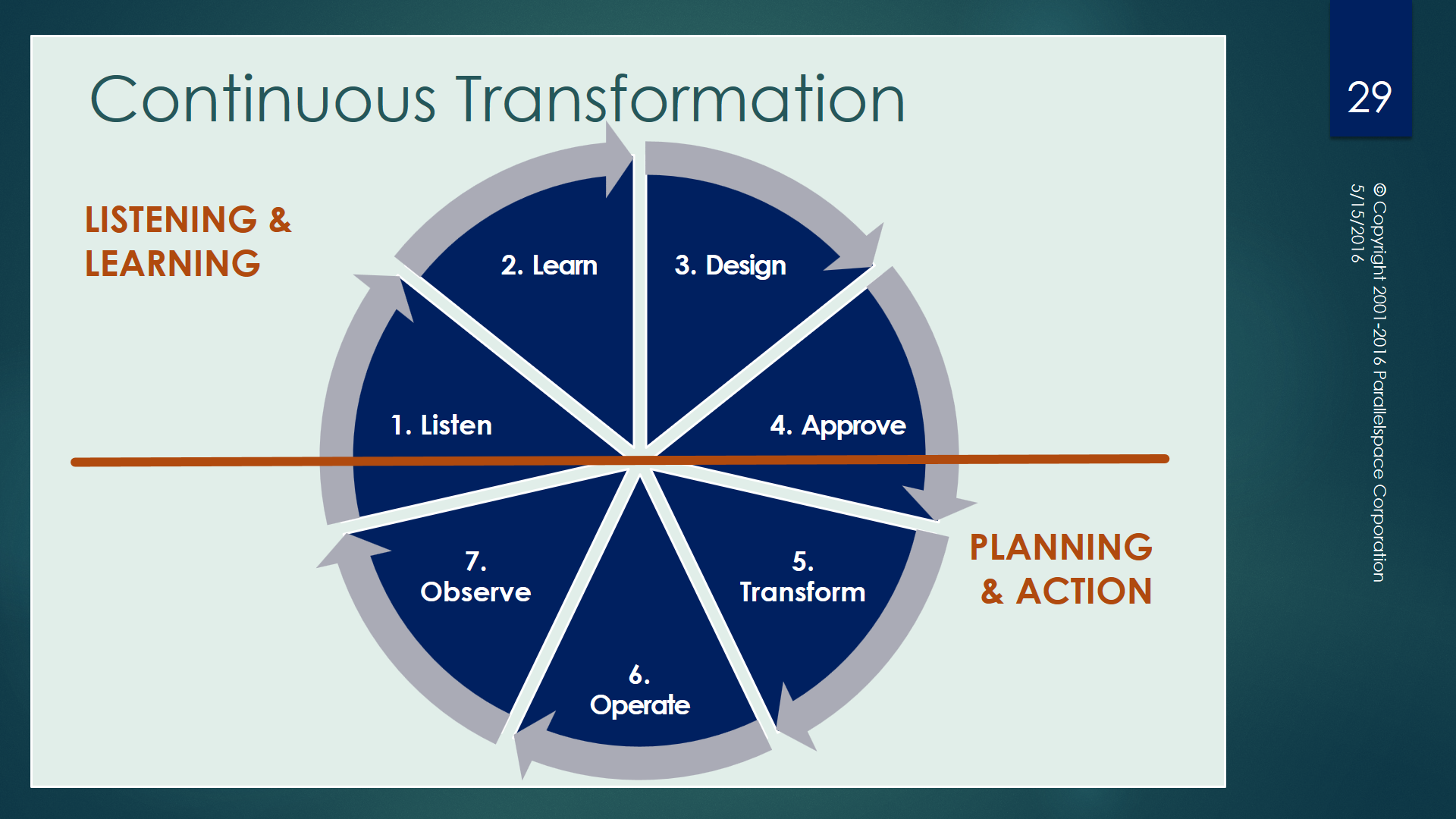
Here is some additional information on the ModelMate Continuous Transformation Framework as well as where and how business value is created.

Parallelspace-Business Value from Transformative Change2.png

Figure 2a. Continuous Transformation Framework
Parallelspace-Business Value from Transformative Change3.png

Figure 2b. Continuous Transformation Framework

Parallelspace-Business Value from Transformative Change4

Figure 2c. Continuous Transformation Framework

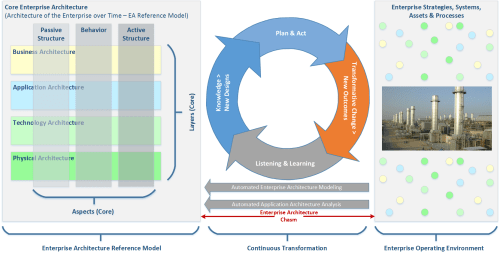
Here’s a more recent elaboration on the Continuous Transformation Framework described above.
progressive-ea-model-1-0-9-peam3-ea-chasm-auto-dots

Figure 3. Continuous Transformation Framework (updated)

The articles below go further to identify and define the gap that exists between the enterprise architecture reference model for the organization and the organization’s operational systems, assets and processes as the Enterprise Architecture Chasm. (Similarly, there is a gap between the strategy and reality is called the Strategy Chasm).

Related Articles

Best regards,
Michael Herman (Toronto)
mwherman@parallelspace.net

6 Comments

Filed under Business Value, Enterprise Architecture

Is there an Industry or Microsoft definition for Hyperscalability?

Is anyone aware of an industry or Microsoft definition for Hyperscalability? …for example, from an Internet of Things (IoT) perspective?

How about something like this?

Hyper Scalability 1-0-1.png

Best regards,

Michael Herman (Toronto)
Parallelspace Corporation
mwherman@parallelspace.net

2 Comments

Filed under Enterprise Architecture, Enterprise Architecture Chasm, Hyperscale, Microsoft Azure, Space Flight

Microsoft Azure Stack POC Architecture Reference Model (ARM): ArchiMate Model – version 1-0-7 – April 30, 2016

[Updated March 3, 2017]

PLEASE POST A COMMENT ABOUT WHY THIS PAGE IS IMPORTANT TO YOU.
This particular page is 1 of my top 5 most viewed pages (ever) and I’d like to understand why. Thank you!

MS Azure Stack POC 1-0-7

Figure 1. Parallelspace Logical/Physical Architecture View: Microsoft Azure Stack POC (April 2016)

[Click here for a larger version of the ArchiMate model]

Notes

  • The actual drive letters will vary from system to system. Don’t fret these details.
  • I’ll keep adding more detail to the model as I work through the full deployment of the Microsoft Azure Stack POC.

The above ArchiMate enterprise architecture model was created with Archi 3.2 – The Free ArchiMate Modeling Tool.  Download the latest version of Archi from here.

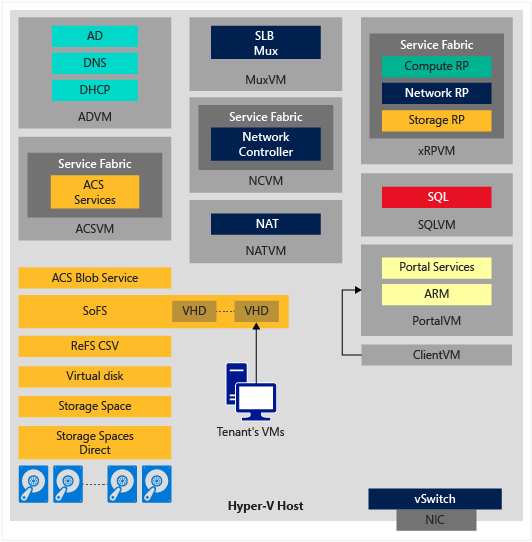
Here’s what the original Microsoft drawing (a Visio sketch – not a model) looks like in April 2016 (from https://azure.microsoft.com/en-us/documentation/articles/azure-stack-architecture/):

image1

Figure 2. Microsoft Azure Conceptual Architecture View: Microsoft Azure Stack POC (April 2016)

[Click here for a larger version of the Microsoft drawing.]  It’s mostly useless but typical of what you’d expect in a Microsoft marketecture diagram.

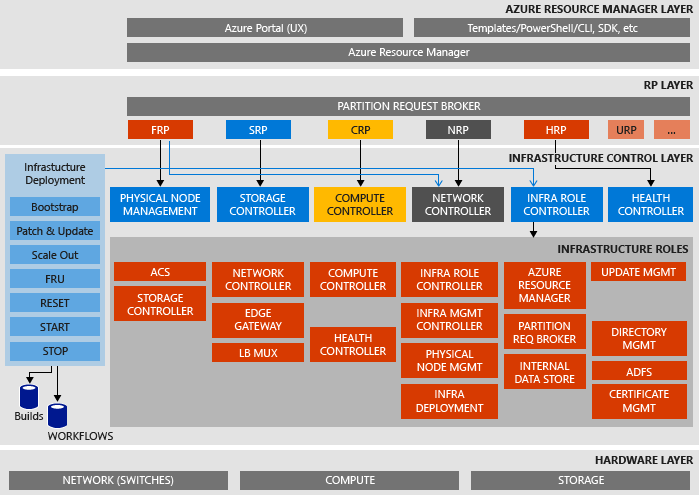
Microsoft has subsequently updated their conceptual architecture diagram (March 1, 2017). It now looks like this (at the same URL noted above).  The new diagram is an improvement and I can’t help but imagine it was influenced by my ArchiMate model.

ms-azure-stack-2017-image1

Figure 3. Microsoft Azure Architecture View: Microsoft Azure Stack POC (March 2017)

For a topic that in theory has a relatively narrow audience, this article has had an extraordinary number of views over the past year.

Best regards,
Michael Herman (Toronto)
mwherman@parallelspace.net

p.s. I can only assume it is Microsofties trying to learn a little bit more about enterprise architecture.  You can see the (good) results in Figure 3 (above).

7 Comments

Filed under ArchiMate, Architecture Reference Models, Crossing the EA Charm, Enterprise Architecture, Graphitization, IoT, Microsoft Azure, Parallelspace TDM

External IoT vs. Internal IoT: Beware of the Hype Cycle

Subtitle: Fusing Enterprise IoT and Traditional Enterprise Architecture

Context

External IoT – External world of devices, events, connections, storage, and analysis; the “traditional” Internet of Things; the world of devices outside the enterprise.

Internal IoT – Internal world within the enterprise consisting of business processes, business objects, actors and roles; application components, application services, application functionality, and data objects; and lastly, infrastructure consisting of servers, networks, data stores, foundation services, and foundational functionality. The “hum” within an Enterprise.

Enterprise IoT – The confluence or integration of External IoT and Internal IoT landscapes centered around a particular enterprise organization. Often represented and accessed as an enterprise graph.

Ecosystem IoT – The confluence or integration of 2 or more separate Enterprise IoT landscapes (complete or partial) centered around a specific ecosystem or community. Supporting Federated Enterprise Architecture.

Discussion

Do some of these latter terms sound familiar?  If so, you likely have some exposure, background, and experience with the practice of Enterprise Architecture Management (EAM).  Having lived on both sides of the IoT divide for more than a decade, it’s interesting to watch how the current rage around IoT is almost exclusively focused on External IoT and it’s coupling to Business Intelligence and Analysis.

What about what’s happening inside the business, information, application and infrastructure architecture of our own enterprises? …regardless of whether the “things” are internal to your organization, external to your organization, or, possibly, part of someone else’s organization (e.g. owned by a client, customer, partner, …), it’s all part of the Enterprise IoT landscape.

A good name for the combination of External IoT and Internal IoT is the “Enterprise of Things” …but another organization is already using this term.

Ultimately, this is all about the Internet of Things merged and being combined with Enterprise Architecture Management: Enterprise IoT.

“More news at 11…”

Michael Herman (Toronto)

4 Comments

Filed under Crossing the EA Charm, Definitions, Enterprise Architecture, Graphitization, IoT, Progressive Enterprise Architecture Map (PEAM)