Tag Archives: digital-marketing

Google’s Strategic Response to Super Apps

Create your own magic with Web 7.0 AgenticOSs. Imagine the possibilities.

Copyright © 2025 Michael Herman (Bindloss, Alberta, Canada) – Creative Commons Attribution-ShareAlike 4.0 International Public License


Google’s Strategic Response to Super Apps

Platform Layer: Defensive Flexibility

  • Android modularization: Google could further modularize Android (e.g. via Project Mainline, Play Services) to allow more granular control over APIs and updates—making it easier to support or restrict super app behaviors.
  • Policy recalibration: In response to regulatory pressure (e.g. DMA in Europe), Google may loosen Play Store restrictions, support alternative billing, and allow more sideloading to stay competitive.

Developer Layer: Ecosystem Incentives

  • Play Console evolution: Google could offer new SDKs and monetization APIs tailored for mini-apps or embedded services, encouraging developers to build within Google’s ecosystem rather than third-party super apps.
  • Firebase + App Actions: Deep integration with Google Assistant, Search, and Android widgets could give developers super app-like reach without needing a host app.

Distribution Layer: Search as a Super App

  • Google Search + Discover + Assistant already function as a meta-layer for app discovery and engagement. Google may double down on this by:
  • Surfacing app content directly in search results
  • Promoting App Clips / Instant Apps
  • Offering deep links into services without full app installs

Monetization Layer: Bundled Value

  • Google One + Pixel Pass: Bundling cloud, security, and device services into a subscription model mimics super app economics.
  • Play Points + Wallet: Loyalty programs and integrated payments could be expanded to create a unified commerce layer across apps.

User Layer: Identity & Privacy

  • Google Identity Services: Strengthening federated login, cross-app personalization, and privacy dashboards positions Google as a trusted identity broker.
  • Privacy Sandbox: Google’s push for privacy-preserving ad tech (e.g. Topics API) could be framed as a safer alternative to super app data centralization.

Strategic Narrative

Google doesn’t need to build a super app—it already operates one in disguise. Android + Search + Assistant + Wallet + Play Store form a distributed super app ecosystem. The challenge is coherence: can Google unify these services into a seamless user experience without triggering antitrust alarms?
Leave a comment

Filed under Uncategorized

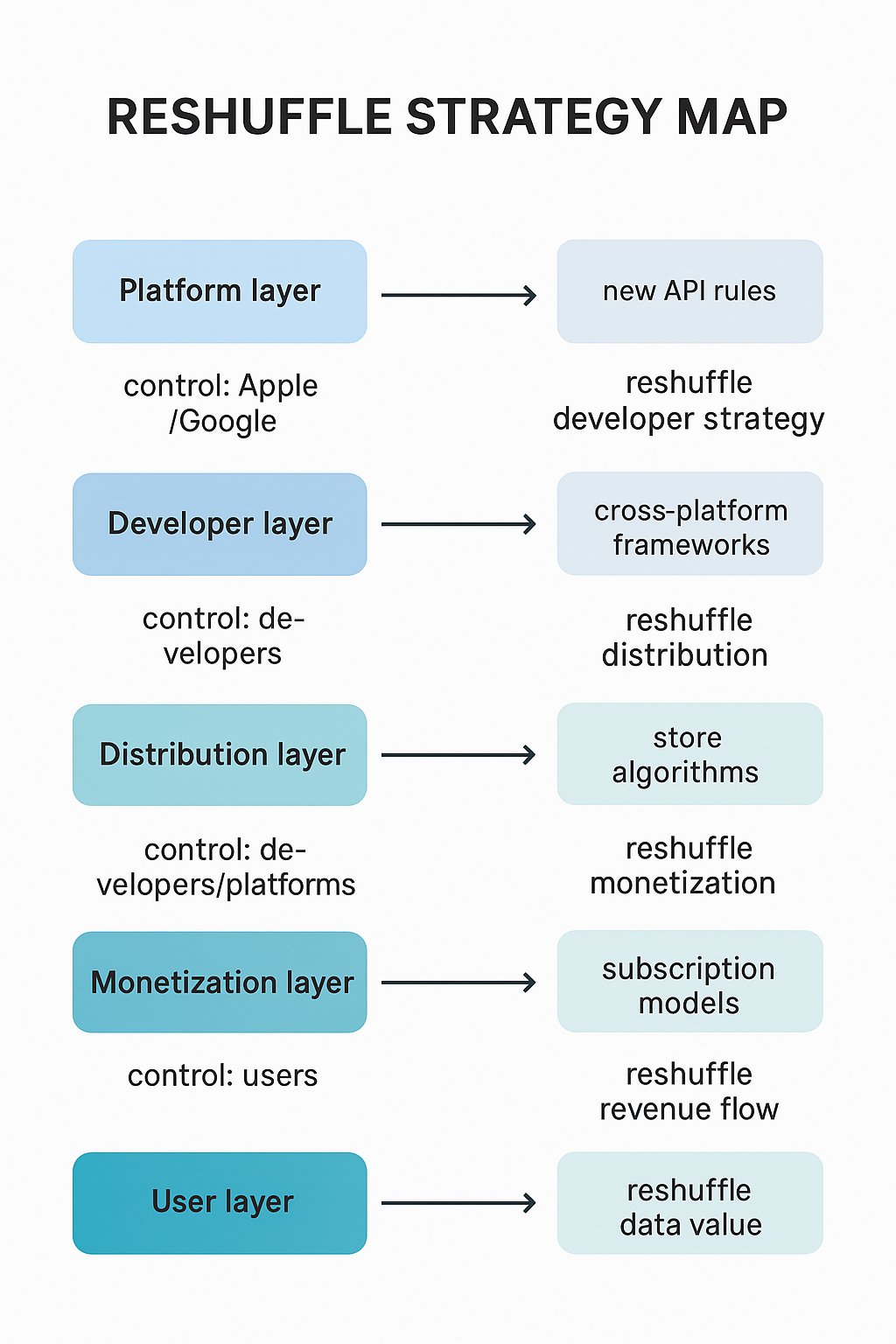
Reshuffle value chain and control points for the mobile app ecosystem

Create your own magic with Web 7.0 AgenticOS™. Imagine the possibilities.

Copyright © 2025 Michael Herman (Bindloss, Alberta, Canada) – Creative Commons Attribution-ShareAlike 4.0 International Public License

A Reshuffle value chain is basically a rethinking of a traditional value chain where value is reorganized around control points — places in the chain where power, influence, or leverage exists. In the mobile app ecosystem, Reshuffle means understanding how the ecosystem is changing and identifying where control is concentrated so that new entrants, incumbents, or platforms can leverage or defend those points.

Based on an October 19, 2025 conversation between Michael Herman and ChatGPT.


1. Mobile App Ecosystem — Overview

A simplified mobile app ecosystem includes:

  1. Hardware Layer
    • Smartphones, tablets, wearable devices (Apple, Samsung, Google, etc.)
    • Includes OS-specific hardware capabilities.
  2. Operating System Layer
    • iOS, Android, HarmonyOS, etc.
    • OS owners control developer APIs, app store access, update processes.
  3. App Stores / Distribution Layer
    • Apple App Store, Google Play Store, third-party app stores (Amazon, Huawei AppGallery).
    • This layer controls app distribution, discovery, monetization rules.
  4. App Development Layer
    • Developer tools, frameworks, SDKs (Unity, Flutter, Xcode, Android Studio).
    • Includes analytics, cloud services, API access.
  5. Service Layer
    • Cloud APIs, backend services, payment gateways, identity, push notifications.
    • AWS, Google Firebase, Azure, Stripe, etc.
  6. End-User Layer
    • Users consuming apps, engaging with services, making purchases.

2. Reshuffle Value Chain in Mobile Apps

Reshuffle shifts the view of the value chain to highlight new control points — places where power is concentrated that weren’t as visible before, and where value creation & capture is happening.

Here’s what a reshuffled mobile app value chain might look like:

Hardware → Operating System → App Store Distribution → Developer Enablement → Service Platforms → User Engagement → Monetization

But reshuffled control points reorder priorities. For example:

  1. Developer Enablement — SDKs, APIs, cloud platforms
    • Modern ecosystems (Apple, Google, Meta) heavily control developers through API access, documentation, and developer accounts.
    • Control Point: Gatekeeping API access and developer terms.
  2. App Store Distribution — Discovery & onboarding
    • Control over visibility in app stores is massive. Algorithms for search, editorial features, app store optimization (ASO) determine success.
    • Control Point: Store algorithms, ranking mechanisms, review processes.
  3. Operating System / Platform Control
    • Controlling OS-level features (ARKit, biometric APIs, background processing) gives huge advantage.
    • Control Point: OS-level permissions and API exclusivity.
  4. Monetization Infrastructure
    • Payment gateways, subscriptions, in-app purchases.
    • Control Point: Payment rules (e.g., Apple’s 30% cut), subscription management.
  5. User Engagement Data
    • Data flows drive personalization, retention, and cross-selling.
    • Control Point: User data access and analytics tools.

Reshuffle Diagram for Mobile App Ecosystem

StageControl Points
HardwareChipsets, sensors, proprietary hardware
Operating SystemAPIs, permissions, OS updates, platform exclusives
App DistributionApp store ranking, app review, app store rules
Developer EnablementSDKs, developer tools, APIs
Service PlatformsCloud services, identity systems, notifications
User EngagementAnalytics, personalization, push notifications
MonetizationPayment processing, subscriptions, advertising platforms

Where the Control Points Are

In a reshuffle, control points move from being purely physical or technical to being gatekeeping points where access, distribution, or monetization is mediated.

For the mobile app ecosystem, the main control points are:

  1. Operating System / API Access — iOS and Android control core APIs.
  2. App Stores — discovery, ranking, and distribution rules.
  3. Developer Tools & SDKs — frameworks that create lock-in.
  4. Payment Infrastructure — control of monetization flows.
  5. User Data & Engagement Platforms — control of analytics and personalization.


Leave a comment

Filed under Uncategorized