DSA v0.16 — Epoch 0 — Endowment Phase
Architecture Analysis, Zone Decomposition, and Runspace + Listener Integration Design
Michael Herman — Web 7.0 Foundation — Bindloss, Alberta, Canada
April 2026 — SVRN7 v0.7.1
© 2026 Michael Herman (Alberta, Canada) — Creative Commons Attribution-ShareAlike 4.0
1. Executive Summary
This document analyses the Web 7.0™ Decentralized System Architecture (DSA) v0.16 diagram and derives a complete design specification for the Citizen/Society Trusted Digital Assistant (TDA) — the sovereign, DID-native, DIDComm-native runtime at the centre of the Web 7.0 ecosystem.
The DSA diagram, captioned “Safe, Secure, Trusted, DID-native, DIDComm-native Web 7.0 DIDLibOS” and scoped to Epoch 0 (Endowment Phase), shows seven structural zones. This document reads each zone precisely, maps every component to the existing SVRN7 v0.7.1 C# library, and then specifies the four-layer TDA design: the DIDComm/HTTP Listener, the PowerShell Runspace Pool, the SVRN7 LOBE layer, and the LiteDB-backed storage tier.
| Document Scope |
| Scope: This document is an architecture and design specification. It does not generate or modify any code. All design decisions recorded here are intended as the authoritative input to future implementation sprints. |
Key Findings:
- The TDA is a self-hosting, recursive unit: every Citizen TDA in the VTC7 mesh runs the same software at the same architectural level.
- The DIDComm/HTTP Listener and the PowerShell Runspace Pool are deliberately separated: the Listener is a write-ahead log gate; the Pool is an execution environment. They share no threads.
- The DIDComm Message Switchboard — named explicitly in the diagram inside Agent 1’s Runspace — is the single component that reads from the durable inbox (IInboxStore / svrn7-inbox.db) and dispatches to agent runspaces.
- SVRN7 is positioned as a LOBE (Loadable Object Brain Extension), not as an agent task and not as a storage system. This is an architectural statement: the Shared Reserve Currency (SRC) is a cognitive capability available to all runspaces.
- The SVRN7 XFER rail is a dedicated transfer channel independent of the DIDComm message bus, preventing monetary operations from competing with messaging I/O on the same file lock.
2. Diagram Reading: DSA v0.16
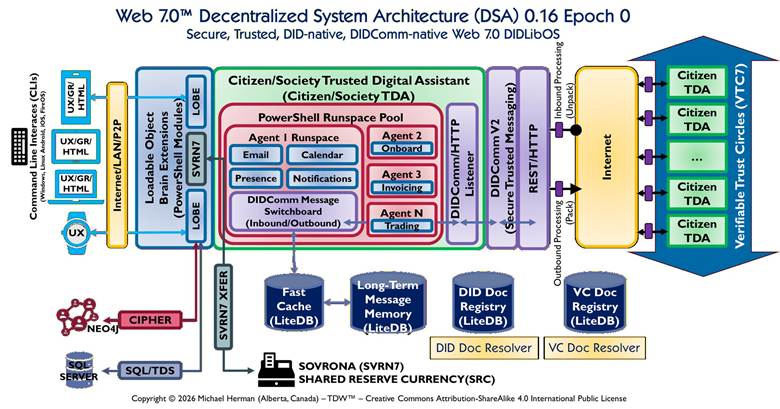
Figure 1. Web 7.0™ Decentralized System Architecture (DSA) 0.16 Epoch 0 — Citizen/Society Trusted Digital Assistant (TDA). © 2026 Michael Herman (Alberta, Canada) — TDW™ — CC BY-SA 4.0.
2.1 Diagram Identification
The diagram bears the following identifying information:
- Title: Web 7.0™ Decentralized System Architecture (DSA) 0.16
- Subtitle: Epoch 0 — Secure, Trusted, DID-native, DIDComm-native Web 7.0 DIDLibOS
- Copyright: © 2026 Michael Herman (Alberta, Canada) — TDW™ — Creative Commons Attribution-ShareAlike 4.0
The Epoch 0 designation constrains the permissible transfer matrix. In Epoch 0 (Endowment Phase), citizens may transfer only to their own Society wallet or to the Federation wallet. Cross-Society citizen-to-citizen transfers (Epoch 1) and open-market operations (Epoch 2) are not yet active. All agent routing logic must enforce these epoch rules.
2.2 Seven Structural Zones
Reading the diagram from left to right, seven distinct structural zones are visible. Each zone has a clear role boundary; no two zones share responsibility.
| Zone | Label | Description |
| 1 | Command-Line Interfaces (CLIs) | Human-facing surface: Windows/Linux, Android, iOS, and FireOS platform shells, plus a smartwatch UX. These are the entry points where human intent enters the system. No agent logic executes here. |
| 2 | Internet / LAN / P2P Transport Rail | A vertical transport bridge between the CLIs and the TDA interior. Explicitly transport-agnostic — Internet, LAN, and P2P are treated equivalently. DIDComm envelope security means the transport layer is untrusted and interchangeable. |
| 3 | Loadable Object Brain Extensions (LOBEs) | The cognitive/capability layer. Two LOBE blocks flank a central SVRN7 label. LOBEs are PowerShell Modules dynamically loaded into the Runspace Pool InitialSessionState. SVRN7 between the LOBEs signals that the Shared Reserve Currency is a first-class brain capability, not an external service. |
| 4 | Citizen/Society Trusted Digital Assistant (TDA) | The primary subject (green outer box). Contains the PowerShell Runspace Pool (red inner box) with Agent 1–N slots and the DIDComm Message Switchboard, plus the DIDComm/HTTP Listener (purple box) at the right edge. |
| 5 | Internet Cloud | Standard transport cloud bridging the TDA’s DIDComm/HTTP Listener to the VTC7 federation zone. Annotated arrows indicate Inbound Unpack and Outbound Pack operations at the Listener boundary. |
| 6 | Storage Layer | Four LiteDB databases (Fast Cache, Long-Term Message Memory, DID Doc Registry, VC Doc Registry), plus NEO4J (via CIPHER) and SQL Server (via SQL/TDS). A dedicated SVRN7 XFER channel connects the LOBE layer to the SOVRONA (SVRN7) SRC terminal. |
| 7 | Verifiable Trust Circles (VTC7) | Large blue arrow on the right encompassing five Citizen TDA nodes connected via purple DIDComm-secured connectors into a federated mesh. The architecture is recursive: each VTC7 peer is a full TDA instance running identical software. |
2.3 Zone 3 — LOBE Layer Detail
The LOBE layer is the most architecturally distinctive zone. Two LOBE blocks are shown with a SVRN7 label centred between them. This layout carries three architectural assertions:
- LOBEs are PowerShell Modules. In the v0.7.1 implementation they are Svrn7.Federation.psm1 (35 cmdlets) and Svrn7.Society.psm1 (15 Society-native cmdlets). They are loaded into the RunspacePool InitialSessionState once at startup, available to every runspace without per-invocation import cost.
- SVRN7 is a brain capability. Its placement between the LOBEs — not inside the Runspace Pool and not in the storage layer — asserts that ISvrn7SocietyDriver is a cognitive faculty available to all agents as a direct in-process call, not a message-passing request to an external service.
- A third LOBE slot is implied for domain-specific extensions (e.g., Society.Medicine.psm1, Society.Education.psm1). The architecture is open-ended: new capabilities are added as LOBEs, not as agent modifications.
2.4 Zone 4 — The TDA Detail
2.4.1 PowerShell Runspace Pool
The red inner box contains the Runspace Pool. Its named slots visible in the diagram are:
- Agent 1 Runspace — Coordinator. Contains four specialised sub-agents (Email, Calendar, Presence, Notifications) and the DIDComm Message Switchboard (Inbound/Outbound). The Switchboard is the internal routing hub: every DIDComm message — whether arriving from the internet or generated by a sub-agent — passes through it.
- Agent 2 — Onboard. Handles citizen registration flows.
- Agent 3 — Invoicing. Processes payment and transfer request messages.
- Agent N — Trading. Handles Epoch 1+ market operations. Inactive in Epoch 0.
Each of Agents 2–N has bidirectional arrows to the Switchboard, establishing it as the internal message bus. No agent communicates directly with another agent or with the DIDComm/HTTP Listener.
2.4.2 DIDComm/HTTP Listener
The purple box at the right edge of the TDA is the single inbound/outbound gate to the internet. Two annotations are explicit in the diagram:
- Inbound Processing (Unpack) — upper annotation: all messages arriving from the internet are unpacked (JWE decrypted, JWS signature verified) before entering the system. The Listener never passes ciphertext to agent logic.
- Outbound Processing (Pack) — lower annotation: all messages leaving the system are packed (JWS signed, then JWE encrypted via SignThenEncrypt). The Listener never sends plaintext over the internet.
A separate REST/HTTP rail runs alongside the DIDComm rail. This supports interactions (balance queries, transfer submissions from a mobile app) more naturally expressed as REST calls than as DIDComm messages.
2.4.3 DIDComm Message Switchboard
The Switchboard is the most significant architectural element named in the diagram that is not yet explicitly modelled in the v0.7.1 codebase. The diagram shows it as a named, first-class component inside Agent 1’s Runspace with bidirectional arrows to every other agent. Its architectural role:
- It is the sole reader of the durable inbox (IInboxStore / svrn7-inbox.db). No agent polls the inbox directly.
- It inspects each message’s DIDComm protocol URI (“type” field) and routes it to the correct agent runspace.
- It handles idempotency: if a TransferId has already been processed (via IProcessedOrderStore), it returns the cached packed receipt without invoking any agent.
- It enforces epoch rules: messages of types not permitted in the current epoch are rejected with a DIDComm error response, not silently dropped.
2.5 Zone 6 — Storage Layer Detail
The storage layer sits below the TDA and consists of six data stores:
| Store | Technology / v0.7.1 File | Role |
| Fast Cache (LiteDB) | LiteDB or IMemoryCache | Holds last-N unpacked message bodies keyed by TransferId for duplicate-delivery acceleration. Bidirectional arrow to Long-Term Memory = cache-miss read-through. |
| Long-Term Message Memory | svrn7-inbox.db (IInboxStore) | All InboxMessage records with full Pending→Processing→Processed/Failed lifecycle. Implemented in v0.7.1. |
| DID Doc Registry | svrn7-dids.db (DidRegistryLiteContext) | Stores DidDocument records. Resolved via IDidDocumentResolver / LocalDidDocumentResolver / FederationDidDocumentResolver. |
| VC Doc Registry | svrn7-vcs.db (VcRegistryLiteContext) | Stores VcRecord records. Resolved via IVcDocumentResolver / LiteVcDocumentResolver / FederationVcDocumentResolver. |
| NEO4J (via CIPHER) | Neo4j Graph DB | Not yet implemented. Intended for graph-structured VTC7 trust relationship queries and Society governance lineage. |
| SQL Server (via SQL/TDS) | SQL Server | Not yet implemented. Intended for high-volume relational reporting, UTXO ledger analytics, and regulatory export. |
The SVRN7 XFER dedicated channel connects the LOBE layer directly to the SOVRONA (SVRN7) SRC terminal at the bottom of the diagram. This is the UTXO transfer pipeline: Invoke-Svrn7Transfer → ISvrn7Driver.TransferAsync → 8-step validator → UTXO commit. The dedicated channel prevents monetary operations from competing with DIDComm message I/O on the same LiteDB file lock.
2.6 Zone 7 — VTC7 Mesh
The large blue VTC7 arrow on the right encompasses five Citizen TDA nodes. Each node connects to neighbours via purple DIDComm-secured connector nodes. Three observations:
- The architecture is recursive and peer-symmetric. Every Citizen TDA in the mesh runs the same software. There is no central broker. The purple connectors represent the DIDComm/HTTP Listener instances of each peer TDA.
- Cross-Society communication flows through Listener instances only, not through a shared database. FindVcsBySubjectAcrossSocietiesAsync and FederationDidDocumentResolver implement this fan-out pattern in v0.7.1.
- VTC7 governance is enforced by the LOBE layer, not by network topology. A TDA that presents a valid Society DID and a current Svrn7VtcCredential VC is a legitimate VTC7 member.
3. Correspondence to SVRN7 v0.7.1
3.1 Component-to-Code Mapping
| Diagram Component | v0.7.1 Implementation | Status |
| LOBE — Federation | Svrn7.Federation.psm1 / ISvrn7Driver | Implemented. 35 cmdlets. Loaded into Runspace Pool InitialSessionState. |
| LOBE — Society | Svrn7.Society.psm1 / ISvrn7SocietyDriver | Implemented. 15 Society-native cmdlets. |
| SVRN7 (between LOBEs) | $SVRN7 session variable / Svrn7RunspaceContext (design) | Partially implemented. ISvrn7SocietyDriver singleton exists in DI; named context class not yet formalised. |
| DIDComm/HTTP Listener — Unpack | IDIDCommService.UnpackAsync / DIDCommPackingService | Implemented. Missing: Kestrel HTTP server entry point calling IInboxStore.EnqueueAsync. |
| DIDComm/HTTP Listener — Pack | IDIDCommService.PackSignedAndEncryptedAsync | Implemented. SignThenEncrypt default throughout. |
| DIDComm Message Switchboard | DIDCommMessageProcessorService (partially) | Routing logic exists but not yet a named Switchboard with epoch enforcement and idempotency gating. |
| Agent 1 — Email sub-agent | Not yet implemented | Microsoft.Graph / EWS PowerShell commands in Agent 1 Runspace. |
| Agent 1 — Calendar sub-agent | Not yet implemented | Calendar events cross-referenced with Society membership DIDs. |
| Agent 1 — Presence sub-agent | Not yet implemented | Publishes presence/1.0/status DIDComm messages to VTC7 peers. |
| Agent 1 — Notifications sub-agent | Not yet implemented | Alerts on inbox threshold, balance change, VC expiry events. |
| Agent 2 — Onboard | Register-Svrn7CitizenInSociety | Implemented. Needs routing: onboard/1.0/request → Agent 2 Runspace. |
| Agent 3 — Invoicing | Invoke-Svrn7Transfer / Invoke-Svrn7ExternalTransfer | Implemented. Needs routing: invoice/1.0/request → Agent 3 Runspace. |
| Agent N — Trading | Not yet implemented | Epoch 1+ only. Switchboard drops trading/1.0/* in Epoch 0. |
| Fast Cache (LiteDB) | Not yet implemented | Design: fifth LiteDB (svrn7-cache.db) or IMemoryCache. |
| Long-Term Message Memory | IInboxStore / InboxLiteContext / svrn7-inbox.db | Implemented in v0.7.1. |
| DID Doc Registry | IDidDocumentRegistry / DidRegistryLiteContext | Implemented. |
| VC Doc Registry | IVcRegistry / VcRegistryLiteContext | Implemented. |
| NEO4J / CIPHER | Not yet implemented | Future sprint. |
| SQL Server / SQL/TDS | Not yet implemented | Future sprint. |
| SVRN7 XFER rail | SvrN7TransferService (design) | 8-step validator exists; dedicated transfer queue (ITransferQueue) not yet separate from agent call paths. |
| SOVRONA SRC terminal | ISvrn7Driver.TransferAsync → UTXO commit | Implemented. svrn7.db UTXO store is the terminal. |
| VTC7 peer connectors | DIDComm/HTTP Listener per peer TDA | Implemented per-TDA. Cross-Society routing implemented. |
3.2 Epoch Alignment
The diagram’s Epoch 0 designation aligns precisely with Svrn7Constants.Epochs.Endowment (= 0) in the v0.7.1 codebase. The transfer epoch matrix enforced by TransferValidator Step 2 (ValidateEpochRulesAsync) covers all three epochs and requires no code changes. The Switchboard needs to read the current epoch via Get-Svrn7CurrentEpoch before routing trading messages.
| Epoch | Constant | Permitted Operations |
| Epoch 0 — Endowment | Svrn7Constants.Epochs.Endowment | Citizens may transfer only to their Society wallet or the Federation wallet. Switchboard rejects trading/1.0/* messages. |
| Epoch 1 — Ecosystem Utility | Svrn7Constants.Epochs.EcosystemUtility | Cross-Society citizen-to-citizen transfers permitted. Agent N (Trading) becomes active. |
| Epoch 2 — Market Issuance | Svrn7Constants.Epochs.MarketIssuance | Open-market operations. Full VTC7 mesh trading enabled. |
4. TDA Design Specification
The following layers specify the complete TDA design. No code is generated here; this is the design record from which implementation sprints are planned.
4.1 Layer 0 — DIDComm/HTTP Listener
Overview
A minimal Kestrel HTTP server (ASP.NET Core minimal API, no MVC) running on a configurable port. The Listener is the single inbound/outbound gate to the internet. It has exactly one responsibility: receive packed messages, unpack them at the cryptographic boundary, and enqueue them for processing.
| Layer Boundary Rule |
| Design Rule: The Listener never executes agent logic. It only enqueues. The Runspace Pool never binds to a port. It only processes. These two systems share no threads and no direct call paths. |
Routes
- POST /didcomm — Receives a packed DIDComm message (Content-Type: application/didcomm-encrypted+json). Calls IDIDCommService.UnpackAsync to verify and decrypt. Calls IInboxStore.EnqueueAsync(messageType, unpackedBody). Returns 202 Accepted immediately. If UnpackAsync fails, returns 400 Bad Request with a DIDComm problem-report — no message is enqueued.
- POST /rest/transfer — Convenience REST endpoint for synchronous UX-driven transfer submissions. Validates a signed TransferRequest JSON body and calls ISvrn7SocietyDriver.HandleIncomingTransferMessageAsync directly. Returns 200 OK with the packed receipt.
- GET /health — Returns JSON health status: inbox queue depth by status, Merkle tree head age, current epoch, Listener up/down. Used by the smartwatch UX and monitoring.
Pack/Unpack Boundary
- All inbound messages are unpacked before anything else. Unpack = JWE decrypt using the Society’s Ed25519 messaging private key + JWS signature verify using the sender’s Ed25519 public key. Both steps must succeed; a failure at either point results in 400 and no enqueue.
- All outbound messages are packed before leaving the Listener. Pack = JWS sign using the Society’s Ed25519 private key, then JWE encrypt using the recipient’s Ed25519 public key (SignThenEncrypt default, matching DIDCommPackMode throughout v0.7.1).
- Agents work with plaintext only. This is the invariant enforced by the Pack/Unpack boundary. Runspaces never need access to cryptographic keys.
Inbound Processing Flow
POST /didcomm
→ IDIDCommService.UnpackAsync(body, societyPrivateKey)
→ JWE decrypt (Society Ed25519 key → X25519 key agreement)
→ JWS verify (sender public key from DID Document)
→ Extract: messageType, from, body
→ IInboxStore.EnqueueAsync(messageType, body)
→ 202 Accepted
4.2 Layer 1 — LOBE: PowerShell Module Loader
LobeManager
A LobeManager singleton reads a lobes.config.json manifest at startup, listing module paths in load order. It creates a shared InitialSessionState with each LOBE pre-imported and a shared $SVRN7 session variable (a Svrn7RunspaceContext object) injected into every runspace.
The Svrn7RunspaceContext holds:
- A reference to the ISvrn7SocietyDriver singleton.
- A reference to the IInboxStore singleton (svrn7-inbox.db).
- A reference to the IProcessedOrderStore singleton.
- The current epoch value, refreshed periodically via Get-Svrn7CurrentEpoch.
LOBE Load Order
- Svrn7.Common.psm1 — shared helpers. Must be loaded first (dot-sourced by both modules).
- Svrn7.Federation.psm1 — ISvrn7Driver cmdlets (35 functions).
- Svrn7.Society.psm1 — ISvrn7SocietyDriver Society-native cmdlets (15 functions).
- Domain LOBEs (optional) — e.g., Svrn7.Medicine.psm1, Svrn7.Education.psm1. Loaded only if present in lobes.config.json.
4.3 Layer 2 — PowerShell Runspace Pool
Pool Configuration
A RunspacePool with configurable min/max (recommended: min=2, max=ProcessorCount×2). Each runspace shares the same InitialSessionState from the LobeManager. The pool is not shared with the HTTP Listener thread.
4.3.1 Agent 1 — Coordinator Runspace
Agent 1 is always open (min runspaces ≥ 1). It owns the DIDComm Message Switchboard and four specialised sub-agents.
DIDComm Message Switchboard
A continuous loop running inside Agent 1’s Runspace on a dedicated thread (not a PeriodicTimer — it runs with a short sleep on empty inbox). Its processing cycle:
while ($true) {
$batch = $SVRN7.InboxStore.DequeueBatchAsync(20).GetAwaiter().GetResult()
if ($batch.Count -eq 0) { Start-Sleep -Milliseconds 100; continue }
foreach ($msg in $batch) {
$epoch = Get-Svrn7CurrentEpoch
# Idempotency check via IProcessedOrderStore
$cached = $SVRN7.ProcessedOrders.GetReceiptAsync($msg.Id).GetAwaiter().GetResult()
if ($cached) { $SVRN7.InboxStore.MarkProcessedAsync($msg.Id); continue }
# Epoch-gated routing by DIDComm protocol URI
switch -Wildcard ($msg.MessageType) {
“*/transfer/*” { Invoke-AgentRunspace Invoicing $msg }
“*/onboard/*” { Invoke-AgentRunspace Onboard $msg }
“*/trading/*” { if ($epoch -lt 1) { Send-EpochError $msg } }
“*/presence/*” { Invoke-PresenceAgent $msg }
default { $SVRN7.InboxStore.MarkFailedAsync($msg.Id, “Unknown type”) }
}
}
}
Email Sub-Agent
Wraps Microsoft.Graph or Exchange EWS PowerShell commands. Cross-references sender email addresses with Society member DIDs via Resolve-Svrn7CitizenPrimaryDid. Structured results are placed back into the Switchboard’s outbound queue.
Calendar Sub-Agent
Reads and writes calendar events via Microsoft.Graph. Calendar events can carry did: URI identity claims in their extended properties, linking appointments to Society membership records and VTC7 governance meetings.
Presence Sub-Agent
Publishes the TDA’s availability status as a https://svrn7.net/protocols/presence/1.0/status DIDComm message to subscribed VTC7 peers. Receives presence updates from peers and maintains a local presence cache.
Notifications Sub-Agent
Dispatches alerts to the UX layer (smartwatch, mobile) when: inbox depth exceeds a configurable threshold; a citizen’s SVRN7 balance changes by more than a configurable amount; a Verifiable Credential is within 7 days of expiry; or the Society wallet balance falls below CitizenEndowmentGrana (overdraft draw trigger).
4.3.2 Agents 2–N — Task Runspaces
| Agent | DIDComm Protocol URI | SVRN7 Cmdlets | Epoch |
| Agent 2 — Onboard | https://svrn7.net/protocols/onboard/1.0/request | Register-Svrn7CitizenInSociety Add-Svrn7CitizenDid | Epoch 0+ |
| Agent 3 — Invoicing | https://svrn7.net/protocols/invoice/1.0/request | Invoke-Svrn7Transfer Invoke-Svrn7ExternalTransfer Invoke-Svrn7FederationTransfer | Epoch 0+ |
| Agent 4 — VC Issuance | https://svrn7.net/protocols/vc/1.0/issue | Get-Svrn7VcById Get-Svrn7VcsBySubject Find-Svrn7VcsBySubject | Epoch 0+ |
| Agent N — Trading | https://svrn7.net/protocols/trading/1.0/* | Invoke-Svrn7BatchTransfer (custom market cmdlets) | Epoch 1+ only |
Each task runspace is opened from the pool on demand by Invoke-AgentRunspace and returns to the pool when the task completes. The pool thread is occupied only for the duration of the operation.
4.4 Layer 3 — Storage
LiteDB Database Topology
| Database | Context Class | Collections | Access Pattern |
| svrn7.db | Svrn7LiteContext | Wallets, UTXOs, Citizens, CitizenDids, Societies, Memberships, KeyBackups, Overdrafts, LogEntries, TreeNodes, TreeHeads, Nonces (ITransferNonceStore) | High-write on transfers |
| svrn7-dids.db | DidRegistryLiteContext | DID Documents and version history | Read-heavy; write on DID create/update/deactivate |
| svrn7-vcs.db | VcRegistryLiteContext | VcRecords, RevocationEvents | Write on VC issuance and expiry sweeps |
| svrn7-inbox.db | InboxLiteContext | InboxMessages (IInboxStore) and ProcessedOrders (IProcessedOrderStore) | High-write on message receipt |
| svrn7-cache.db (proposed) | CacheLiteContext (new) | Fast Cache: last-N TransferId → packed receipt pairs | Or IMemoryCache for pure in-process speed |
4.5 SVRN7 XFER Dedicated Channel
The SVRN7 XFER rail in the diagram is a dedicated channel from the LOBE layer to the SOVRONA SRC terminal. A SvrN7TransferService BackgroundService is designed to run alongside DIDCommMessageProcessorService:
- Agents post a TransferQueueRecord to a dedicated ITransferQueue collection in svrn7-inbox.db rather than calling ISvrn7Driver.TransferAsync directly.
- SvrN7TransferService drains ITransferQueue on its own loop, runs the 8-step TransferValidator, and commits the UTXO.
- Retry semantics: up to 3 attempts (mirroring IInboxStore). After maxAttempts, the record is dead-lettered with LastError populated.
- This decouples agent logic from the UTXO commit path and prevents monetary operations from competing with DIDComm inbox I/O on the same LiteDB file lock.
5. Key Design Principles
Five principles emerge from careful reading of the DSA diagram. These are structural rules that the diagram enforces by its construction, not interpretive opinions.
| # | Principle | Definition | Rationale |
| P1 | Listener and Pool are separate systems | The Listener never executes agent logic; it only enqueues. The Pool never binds to a port; it only processes. No shared threads. | Prevents a slow agent from blocking inbound receipt. Prevents a message burst from exhausting runspaces. |
| P2 | Switchboard is the sole inbox reader | No agent polls IInboxStore directly. Only the Switchboard does, then hands work to agent runspaces. | Single point for epoch enforcement, idempotency checking, and routing. Single LiteDB writer. |
| P3 | Pack/Unpack at Listener boundary only | Agents work with unpacked plaintext. Agents produce plaintext responses; the Listener packs them. | Security guarantee (no agent receives unverified data) and architectural simplification (runspaces need no crypto keys). |
| P4 | SVRN7 is a LOBE, not an agent | ISvrn7SocietyDriver is available to all agents via $SVRN7 session variable — direct in-process cmdlet invocation, not message-passing. | This is why SVRN7 sits between the LOBE blocks in the diagram, not inside a specific agent box. |
| P5 | VTC7 peers are structurally identical | Every Citizen TDA in the mesh runs the same software. No central broker. Cross-Society communication flows through DIDComm/HTTP Listener instances only. | Self-hosting, recursive design. FindVcsBySubjectAcrossSocietiesAsync and FederationDidDocumentResolver implement the fan-out pattern. |
6. Implementation Gaps
Components identified in the diagram but not yet implemented in SVRN7 v0.7.1, representing the work backlog for future sprints.
| Gap | Priority | Design Decision |
| HTTP/Kestrel Listener Entry Point | Critical | ASP.NET Core minimal API with POST /didcomm (enqueue), POST /rest/transfer (synchronous), and GET /health routes. Calls IInboxStore.EnqueueAsync. This is the missing bridge between the internet and DIDCommMessageProcessorService. |
| DIDComm Message Switchboard (named) | Critical | Extract routing logic from DIDCommMessageProcessorService into a named SwitchboardService with explicit epoch gating, IProcessedOrderStore idempotency check, and per-protocol-URI routing to agent runspace slots. |
| Svrn7RunspaceContext + $SVRN7 | High | Formalise the $SVRN7 PSCustomObject as a named class holding ISvrn7SocietyDriver, IInboxStore, IProcessedOrderStore, and current epoch. Inject via RunspacePool InitialSessionState. |
| LobeManager + lobes.config.json | High | Singleton that reads the manifest, builds the InitialSessionState, and manages hot-reload of domain LOBEs without full TDA restart. |
| Agent 1 Sub-Agents (Email, Calendar, Presence, Notifications) | High | Four PowerShell pipeline scripts inside Agent 1 Runspace. Microsoft.Graph for Email and Calendar. Custom DIDComm presence/1.0/status protocol for Presence. Event-driven Notifications. |
| Fast Cache (svrn7-cache.db) | Medium | CacheLiteContext (fifth LiteDB) or IMemoryCache. Stores last-N TransferId → packed receipt pairs for Switchboard hit-before-dequeue. |
| SvrN7TransferService + ITransferQueue | Medium | Dedicated BackgroundService draining a TransferQueueRecord collection in svrn7-inbox.db, decoupling agent UTXO commit from agent message processing. |
| Agent N — Trading | Low (Epoch 1) | Implement when Get-Svrn7CurrentEpoch returns ≥ 1. Switchboard routing stub (drop trading/* in Epoch 0) should be added now. |
| NEO4J / CIPHER integration | Low (Future) | Graph store for VTC7 trust path queries. Out of scope for v0.7.x. |
| SQL Server / SQL/TDS integration | Low (Future) | Relational reporting. Out of scope for v0.7.x. |
7. Glossary
| Term | Definition |
| TDA | Trusted Digital Assistant. The sovereign, DID-native, DIDComm-native runtime at the centre of the Web 7.0 ecosystem. A citizen or Society operates one TDA. |
| DSA | Decentralized System Architecture. The architectural diagram describing the TDA and its surrounding ecosystem. Current version: DSA v0.16. |
| LOBE | Loadable Object Brain Extension. A PowerShell Module loaded into the Runspace Pool InitialSessionState, providing capabilities (SVRN7 cmdlets, domain functions) available to all runspaces. |
| VTC7 | Verifiable Trust Circle. A federated mesh of TDA nodes that mutually recognise each other’s DIDs and VCs, enabling cross-Society communication and cross-Society VC resolution. |
| SRC | Shared Reserve Currency. The SVRN7 / SOVRONA monetary unit. 1 SVRN7 = 1,000,000 grana. Citizen endowment in v0.7.1: 1,000 grana = 0.001 SVRN7. |
| DIDComm | Decentralized Identifier Communication. A message protocol providing transport-agnostic, end-to-end secure messaging between DID-identified parties. Version 2 used throughout Web 7.0. |
| SignThenEncrypt | The default DIDComm pack mode in SVRN7 v0.7.1. Payload is JWS-signed with the sender’s Ed25519 private key, then JWE-encrypted with the recipient’s Ed25519 public key (X25519 via RFC 7748 birational map). |
| Switchboard | The DIDComm Message Switchboard. Named component inside Agent 1’s Runspace. The sole reader of the durable inbox. Routes messages to agent runspaces by protocol URI. |
| Pack / Unpack | Pack = sign + encrypt an outbound DIDComm message. Unpack = decrypt + verify signature on an inbound message. Both operations occur exclusively at the Listener boundary. |
| Epoch | A governance phase of the SVRN7 ecosystem. Epoch 0 (Endowment): citizen→Society and citizen→Federation transfers only. Epoch 1 (Ecosystem Utility): cross-Society. Epoch 2 (Market Issuance): open-market trading. |
| UTXO | Unspent Transaction Output. Atomic unit of SVRN7 wallet balance. Every transfer creates new UTXOs and marks spent UTXOs. Conservation invariant: sum of all UTXOs = TotalSupplyGrana − unallocated Federation balance. |
| grana | Atomic monetary unit of SVRN7. 1 SVRN7 = 1,000,000 grana. All storage, arithmetic, and transfer amounts are in grana. SVRN7 is display-only. |
| IInboxStore | Durable inbox interface backed by svrn7-inbox.db. Implements EnqueueAsync, DequeueBatchAsync, MarkProcessedAsync, MarkFailedAsync, ResetStuckMessagesAsync, GetStatusCountsAsync. |
| ITransferNonceStore | Durable nonce replay protection backed by svrn7.db. Implements IsReplayAsync with sweep-then-insert LiteDB semantics. 24-hour replay window. |
| IProcessedOrderStore | Cross-Society TransferOrder idempotency store backed by svrn7-inbox.db. Caches packed DIDComm receipts keyed by TransferId. |
8. Document Control
| Field | Value |
| Document Title | Web 7.0 DSA-TDA Design |
| Document ID | WEB7-DSA-TDA-001 |
| Version | 1.0 — Initial release |
| Date | April 2026 |
| Author | Michael Herman, Web 7.0 Foundation, Bindloss, Alberta, Canada |
| Based on | DSA v0.16 Diagram — Epoch 0 (Endowment Phase) |
| SVRN7 Version | v0.7.1 (Svrn7.Federation + Svrn7.Society .NET 8) |
| License | Creative Commons Attribution-ShareAlike 4.0 International (CC BY-SA 4.0) |
| Canonical URL | https://svrn7.net/docs/dsa-tda-design |
| Status | Design Specification — No code generated |
End of Document

 Web 7.0 DIDLibOS™ / TDW AgenticOS™ / Hyperonomy™ Digital Identity Lab