
Create your own magic with Web 7.0™ / TDW AgenticOS™. Imagine the possibilities.
Copyright © 2019-2025 Michael Herman (Bindloss, Alberta, Canada) – Creative Commons Attribution-ShareAlike 4.0 International Public License
Web 7.0™, TDW AgenticOS™ and Hyperonomy™ are trademarks of the Web 7.0 Foundation. All Rights Reserved.
Dunbar’s Number refers to the cognitive limit on the number of stable, meaningful social relationships a person can maintain — typically around 150.
Proposed by anthropologist Robin Dunbar in the early 1990s, it’s based on research linking neocortex size to social group size in primates, then extrapolated to humans.
The key idea: our brains can only manage a limited number of people whose relationships with us (and with each other) we can track in any depth.
📊 Dunbar’s Social Layers
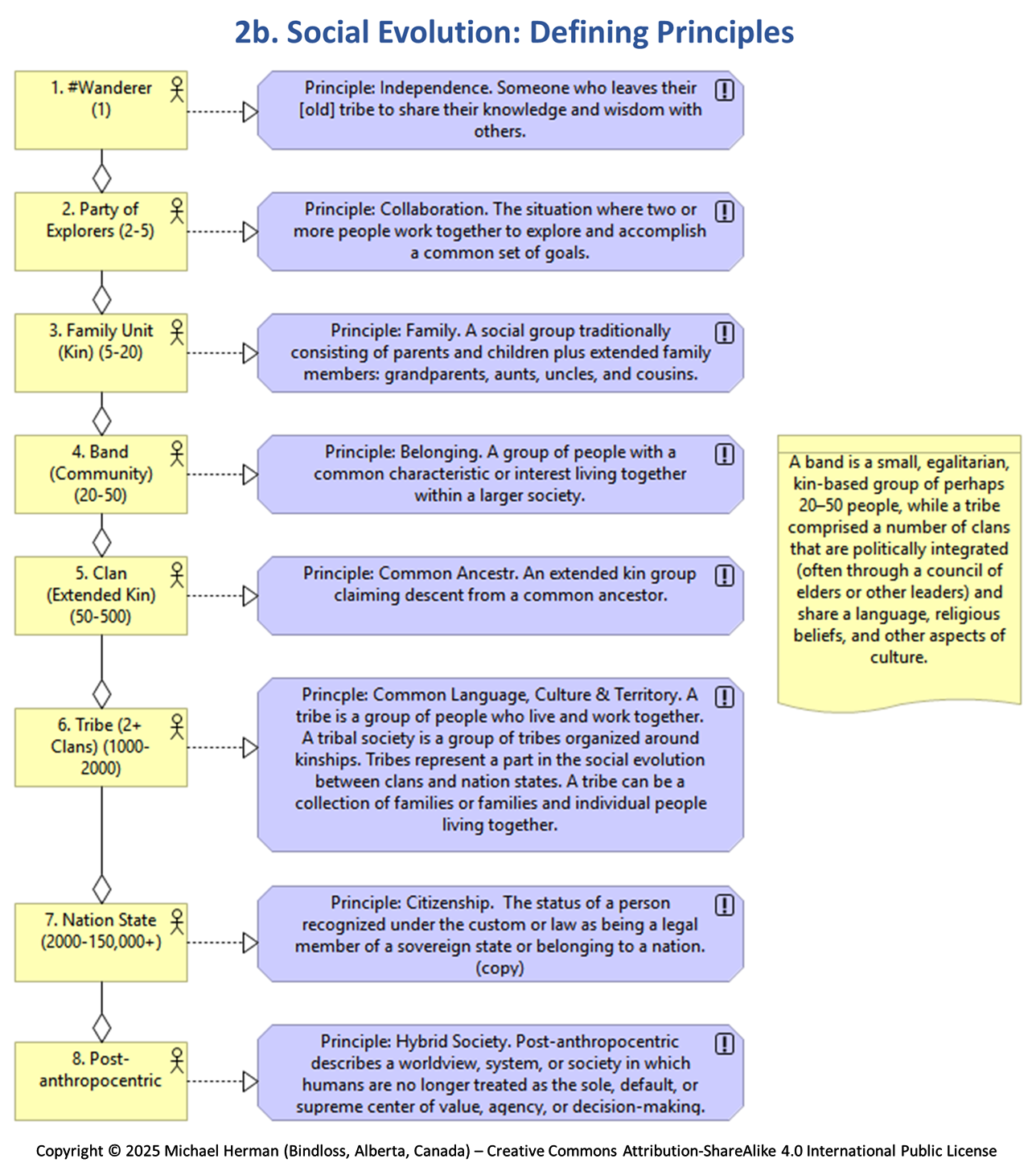
Dunbar found that human relationships form nested circles of intimacy, each layer roughly three times larger than the one before it — but with decreasing emotional closeness and interaction frequency.
| Layer | Approx. Size | Relationship Type | Typical Frequency of Contact / Emotional Closeness |
|---|---|---|---|
| 0th Circle (#Wanderer) | 1 | An individual | N/A |
| 1st Circle (Party of Explorers) | 2-5 | Closest friends & family — your “support clique” | Daily or near-daily contact; deepest emotional ties |
| 2nd Circle (Family Unit) | 5-20 | Good friends you confide in and rely on | Weekly contact; high emotional closeness |
| 3rd Circle (Band) | 20-50 | Friends you might invite to a big personal event (e.g. wedding) | Monthly contact; moderate closeness |
| 4th Circle (Clan) | 50-500 | Meaningful relationships — people you know personally and would help if needed | A few times per year; recognize and understand social context |
| 5th Circle (Tribe) | 1000-2000 | Acquaintances — people whose names and faces you recognize | Occasional interaction or recognition |
| 6th Circle (Nation State) | 2000-150,000+ | People you can place a name to (the limit of facial recognition memory) | Rare interaction; mostly recognition only |
📱 Modern & Practical Implications
Even in the digital era:
- People still maintain about 100–200 active online relationships despite thousands of “followers.”
- Teams, villages, and companies often stabilize near this size before naturally splitting or losing cohesion.
- Some organizations (like W. L. Gore, maker of Gore-Tex) deliberately limit unit size to ~150 to preserve strong internal culture and trust.


Copyright © 2025 Michael Herman (Bindloss, Alberta, Canada) – Creative Commons Attribution-ShareAlike 4.0 International Public License


 Web 7.0™ / TDW AgenticOS™ / TDW™ / Hyperonomy™ Digital Identity Lab