
Web 7.0 DIDLibOS™ / TDW AgenticOS™ / Hyperonomy™ Digital Identity Lab
Skip to content
  • Home
  • About Michael Herman (Web 7.0™ / TDW™ / TDW AgenticOS™)
← Crossing the EA Chasm: Re-visioning ArchiMate 3.0 Relations as Verbs
Crossing the EA Chasm: Re-visioning ArchiMate 3.0 Elements as Adjectives [WIP] →
January 17, 2017 · 11:44 am
↓ Jump to Comments

Crossing the EA Chasm: #Graphitization of ArchiMate 3.0 – Iteration 1

COPYRIGHT © 2016-2017 by Michael Herman, Toronto Canada. All rights reserved.

While working on a new series of projects and articles on #graphitization I pondered the following question:

Wouldn’t it be nice to have an authoritative reference for ArchiMate 3.0, more specifically, a repository for the enterprise architecture language‘s elements and relationship matrix, that is queryable.

Queryable being the keyword.  This article describes the ArchiMate Graphitization Project.

Background

“The nice thing about standards is that you have so many to choose from.”
[Andrew S. Tanenbaum]

Today, there are at least 4 authoritative, semi-authoritative, or at least machine-readable, versions of the ArchiMate 3.0 relationship matrix:

  1. The 4 “Appendix B Tables” in Appendix B of the ArchiMate 3.0 Specification
  2. The “relationships.xml” file in the Archi [4.0] github repository (which also includes Issue #164 that is being used to track problems in the relationships.xml file as well as the Appendix B Tables)
  3. Gerben Wierda‘s “ArchiMate 3.0 metamodel PDF“
  4. ARKWRT, Colin Coate‘s “CLI (command-line interface) tool that provides a partial implementation of the ArchiMate 2.1 [and 3.0] Specification”

The first step in the ArchiMate Graphitization Project was to consolidate and make consistent these 4 data sources; or rather, attempt to consolidate and make them consistent. The Appendix B Tables are not very usable (i.e. not machine-readable in their current form) and hence, can only be used as a secondary, passive reference. These tables are also known to have some bugs which are expected to be fixed in the next release of the ArchiMate Specification.

The most reliable, most usable, and most complete data source is the Archi 4.0 project’s relationships.xml file; defining 11,000+ relationships. This file’s only drawback is that it includes all relationships – both Derived as well as the Core Subset – and does not have any tags or other markings to identify the Core relations; regardless, this file proved to be exceedingly valuable. The Appendix B Tables suffer from this same problem: no tagging to help identify the Core relationships.

Gerben Wierda’s ArchiMate 3.0 metamodel PDF is the best and internationally renown reference for the most commonly used ArchiMate relationships (what I think of as the ArciMate Core Subset). Gerben has done an excellent job of documenting these for ArchiMate 2.1, and now, ArchiMate 3.0. Using his PDF data, we were able to troubleshoot a number of missing as well as extra relationships across all 4 data sources [Thank you Gerben].

Colin Coate’s ARKWRT is also an excellent tool. I learned about Colin’s tool too late into my project cycle to use it; regardless, Colin has also been very helpful based on his deep knowledge of the ArchiMate specifications.

For this iteration of the ArchiMate Graphitization Project, I combined the relationship.xml data with Gerben’s PDF data. I was careful to tag each element and relation with its data source(s). The Appendix B Tables were used as a secondary reference for verification purposes.

Graphitizing the ArchiMate Relationship Table

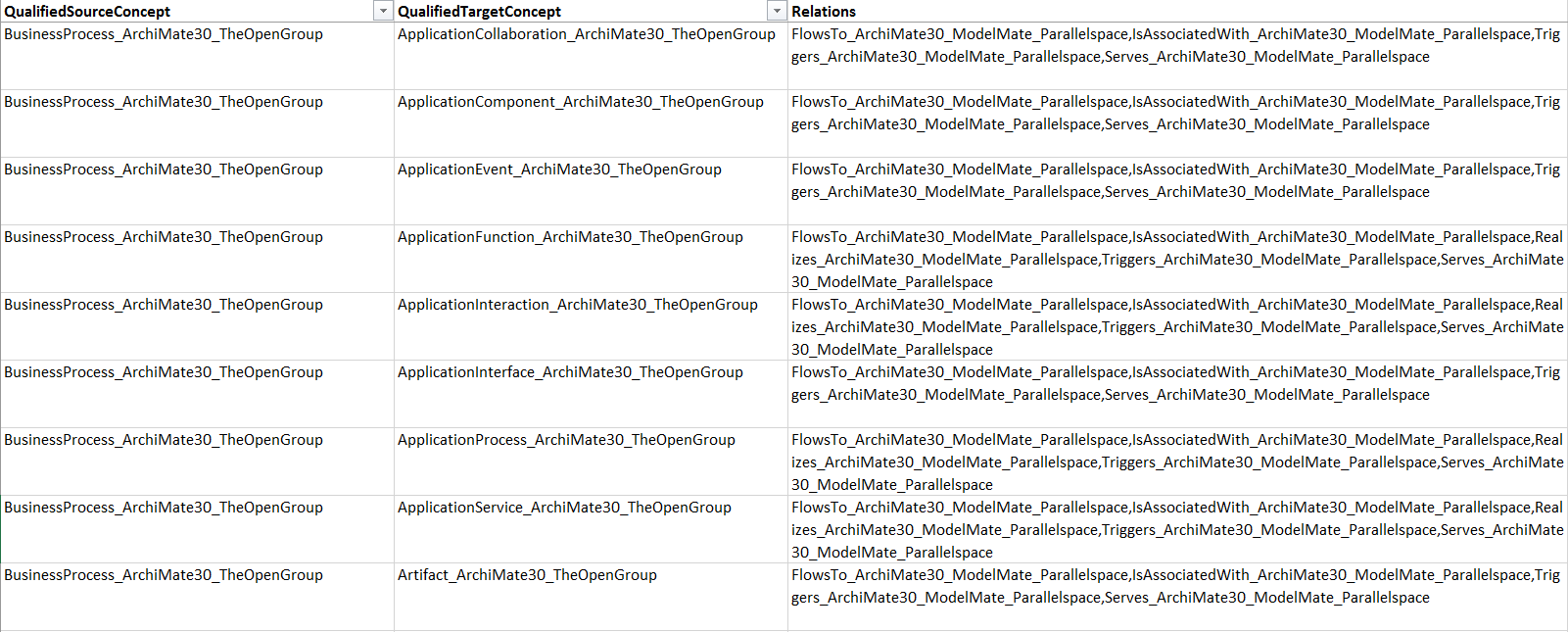
I won’t go into detail about all the steps but I do want to emphasize that this was a very straightforward process once I had some good data – as in any Data Science project. The relationships.xml file is well formed and opened nicely in Excel 2016 (as well as earlier versions of Excel no doubt). It was simple to save it out as a CSV file (after some preformatting to create namespaces for the AchiMate element and relationship names). Here’s a sample that resembles what the final CSV file looked like before ingesting it into Neo4j graph database (click the figure below to enlarge it).
graphitization-of-gerben-wierdas-archimate-3-0-metamodel-d

The relationship naming scheme is based on the ModelMate Verbs notation described in the article Crossing the EA Chasm: Re-visioning ArchiMate 3.0 Relations as Verbs.

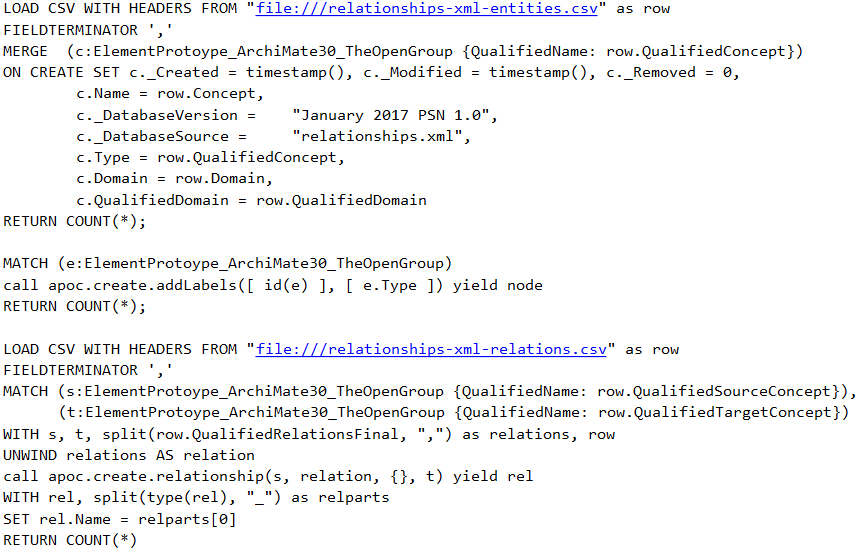
Ingesting the CSV file, creating the graph nodes, labeling them based on ArchiMate element type (i.e. ModelMate Verb), and finally, creating the relationships were also pretty easy to accomplish using the Cypher language. Here’s the actual query:
graphitization-of-gerben-wierdas-archimate-3-0-metamodel-f

There were a couple of additional steps such as assigning weights (strengths) to each of the relationships based on the relationship type, tagging relations with a data source code, etc. that were part of the overall process.

Recreating a Rendering of Gerben’s PDF

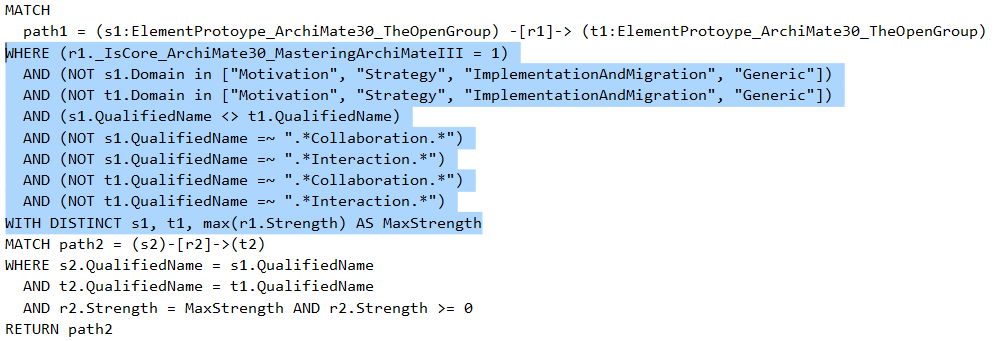
The biggest challenge for the project was to see how easy it would be to recreate something that looked similar to Gerben’s ArchiMate 3.0 metamodel PDF. Here’s a copy of the actual Cypher query. It’s not optimized but only takes a few seconds to run.
graphitization-of-gerben-wierdas-archimate-3-0-metamodel-e

The highlighted clauses encode the margin notes on page 1 of Gerben’s PDF. The unhighlighted clauses at the bottom (that refer to Strength) reduce the multiple relations-per-element-pair returned by the first half of the query to a single relation per distinct element-pair (based on the relative weight or strength of the relationships for each pair of elements).

The initial graph looked like this:

Graphitization of Gerben Wierda's ArchiMate 3.0 Metamodel g.png

Because all of the elements are connected together with relations that act like springs, it took only a couple minutes to manually produce this layout (very similar to page 1 of Gerben’s PDF):

graphitization-of-gerben-wierdas-archimate-3-0-metamodel-b

More importantly, I can now answer questions like:

Show me how Nodes are connected to Products 
using only Core Subset relationships
using 2 hops
in the ArchiMate 3.0 metamodel

Graphitization of Gerben Wierda's ArchiMate 3.0 Metamodel h.png

Please post your feedback, questions, and comments below.

Best regards,
Michael Herman (Toronto)
Parallelspace Corporation
mwherman@parallelspace.net

*ArchiMate is a registered trademark of The Open Group.

Share this:

  • Tweet
  • More
  • Email a link to a friend (Opens in new window) Email
  • Share on Telegram (Opens in new window) Telegram
  • Share on WhatsApp (Opens in new window) WhatsApp
Like Loading...

3 Comments

Filed under ArchiMate, Architecture Reference Models, Crossing the EA Charm, Data Science, graph database, Graphitization, Master Metadata Management, ModelMate, ModelMate Information Architecture for ArchiMate, ModelMate Information Architecture for Languages

Tagged as ArchiMate, Graphitization

← Crossing the EA Chasm: Re-visioning ArchiMate 3.0 Relations as Verbs
Crossing the EA Chasm: Re-visioning ArchiMate 3.0 Elements as Adjectives [WIP] →

3 responses to “Crossing the EA Chasm: #Graphitization of ArchiMate 3.0 – Iteration 1”

  1. Pingback: Crossing the EA Chasm: Graphitization of ArchiMate 3.0 – Iteration 2[WIP] | hyperonomy.com - digital intelligence

  2. Pingback: Crossing the EA Chasm: How to use the ModelMate Master Online Repository (MMOR) | hyperonomy.com - digital intelligence

  3. Pingback: Michael Herman, Blockchain Developer, Enterprise Architect and Data Scientist: #Graphitization Inventor | hyperonomy.com - digital intelligence

Leave a comment Cancel reply

  • Recent Posts

    • DSA: Which field values of the following documents are locator DIDs and which are identity DIDs?
    • SDO: Verifiable Trust Circles (VTCs) using VC Proof Sets (Web 7.0)
    • Web 7.0 DIDLibOS Whitepaper
    • Decentralized Universal Resource Name (URN) DID Method (Web 7.0)
    • SDO: W3C Decentralized Resource Name (DRN) DID Method
    • Web 7.0 DIDLibOS™ DID-native Decentralized Library OS / Trusted Digital Web AgenticOS™: Webcast, Transcript & Analysis
    • PowerShell Android App (client-server)
    • DID7: Authority-Scoped Decentralized Identifier Scheme
    • SDO: Authority-Scoped Decentralized Identifiers (DID7)
    • SDO: Authority-Scoped Decentralized Identifiers (DID7)
  • Categories

    • .NET Development
    • ArchiMate
    • Architecture Reference Models
    • Automated Application Architecture Analysis
    • Automated Enterprise Architecture Modeling
    • blockchain
    • Business Value
    • continuous transformation
    • Cortana
    • Crossing the EA Charm
    • Data Science
    • Definitions
    • Digital Transformation
    • Domain Specification Languages (DSL)
    • Enterprise Architecture
    • Enterprise Architecture Chasm
    • Ethereum
    • Every Little Thing
    • General
    • graph database
    • Graphitization
    • How do we think
    • Humor
    • Hyperscale
    • IoT
    • JSON Messages
    • Master Data Management
    • Master Metadata Management
    • Microsoft Azure
    • ModelMate
    • ModelMate Information Architecture for ArchiMate
    • ModelMate Information Architecture for Languages
    • Nethereum
    • Operational Data Chasm
    • Parallelspace TDM
    • Power BI
    • Process
    • Product Management
    • Progressive Enterprise Architecture Map (PEAM)
    • Salesforce
    • SharePoint
    • Space Flight
    • TDW
    • The Open Group
    • The Principles
    • Trusted Digital Web
    • Uncategorized
  • Meta

    • Create account
    • Log in
    • Entries feed
    • Comments feed
    • WordPress.com
  • Archives

    • March 2026
    • February 2026
    • January 2026
    • December 2025
    • November 2025
    • October 2025
    • September 2025
    • December 2024
    • November 2024
    • June 2024
    • July 2023
    • March 2023
    • February 2023
    • January 2023
    • December 2022
    • November 2022
    • January 2022
    • September 2021
    • July 2021
    • June 2021
    • May 2021
    • April 2021
    • March 2021
    • February 2021
    • January 2021
    • December 2019
    • November 2019
    • October 2019
    • April 2019
    • March 2019
    • February 2019
    • January 2019
    • December 2018
    • April 2018
    • January 2018
    • December 2017
    • May 2017
    • April 2017
    • February 2017
    • January 2017
    • December 2016
    • November 2016
    • October 2016
    • September 2016
    • August 2016
    • June 2016
    • May 2016
    • April 2016
    • January 2016
    • July 2015
  • Recent Comments

    Unknown's avatarWeb 7.0™: Architectu… on Web 7.0 DIDLibOS™ / TDW Agenti…
    Unknown's avatarDAVOS2026 EXCLUSIVE:… on DAVOS2026: The Second Reformat…
    Unknown's avatarDAVOS2026 EXCLUSIVE:… on DAVOS2026: Highly Effective Co…
    Unknown's avatarDAVOS2026 EXCLUSIVE:… on DAVOS2026: Identic AI –…
    Unknown's avatarDAVOS2026 EXCLUSIVE:… on DDR: DAVOS2026: Self-Sovereign…
  • Recent Posts

    • DSA: Which field values of the following documents are locator DIDs and which are identity DIDs?
    • SDO: Verifiable Trust Circles (VTCs) using VC Proof Sets (Web 7.0)
    • Web 7.0 DIDLibOS Whitepaper
    • Decentralized Universal Resource Name (URN) DID Method (Web 7.0)
    • SDO: W3C Decentralized Resource Name (DRN) DID Method
  • Recent Comments

    Unknown's avatarWeb 7.0™: Architectu… on Web 7.0 DIDLibOS™ / TDW Agenti…
    Unknown's avatarDAVOS2026 EXCLUSIVE:… on DAVOS2026: The Second Reformat…
    Unknown's avatarDAVOS2026 EXCLUSIVE:… on DAVOS2026: Highly Effective Co…
    Unknown's avatarDAVOS2026 EXCLUSIVE:… on DAVOS2026: Identic AI –…
    Unknown's avatarDAVOS2026 EXCLUSIVE:… on DDR: DAVOS2026: Self-Sovereign…
  • Archives

    • March 2026
    • February 2026
    • January 2026
    • December 2025
    • November 2025
    • October 2025
    • September 2025
    • December 2024
    • November 2024
    • June 2024
    • July 2023
    • March 2023
    • February 2023
    • January 2023
    • December 2022
    • November 2022
    • January 2022
    • September 2021
    • July 2021
    • June 2021
    • May 2021
    • April 2021
    • March 2021
    • February 2021
    • January 2021
    • December 2019
    • November 2019
    • October 2019
    • April 2019
    • March 2019
    • February 2019
    • January 2019
    • December 2018
    • April 2018
    • January 2018
    • December 2017
    • May 2017
    • April 2017
    • February 2017
    • January 2017
    • December 2016
    • November 2016
    • October 2016
    • September 2016
    • August 2016
    • June 2016
    • May 2016
    • April 2016
    • January 2016
    • July 2015
  • Categories

    • .NET Development
    • ArchiMate
    • Architecture Reference Models
    • Automated Application Architecture Analysis
    • Automated Enterprise Architecture Modeling
    • blockchain
    • Business Value
    • continuous transformation
    • Cortana
    • Crossing the EA Charm
    • Data Science
    • Definitions
    • Digital Transformation
    • Domain Specification Languages (DSL)
    • Enterprise Architecture
    • Enterprise Architecture Chasm
    • Ethereum
    • Every Little Thing
    • General
    • graph database
    • Graphitization
    • How do we think
    • Humor
    • Hyperscale
    • IoT
    • JSON Messages
    • Master Data Management
    • Master Metadata Management
    • Microsoft Azure
    • ModelMate
    • ModelMate Information Architecture for ArchiMate
    • ModelMate Information Architecture for Languages
    • Nethereum
    • Operational Data Chasm
    • Parallelspace TDM
    • Power BI
    • Process
    • Product Management
    • Progressive Enterprise Architecture Map (PEAM)
    • Salesforce
    • SharePoint
    • Space Flight
    • TDW
    • The Open Group
    • The Principles
    • Trusted Digital Web
    • Uncategorized
  • Meta

    • Create account
    • Log in
    • Entries feed
    • Comments feed
    • WordPress.com
Web 7.0 DIDLibOS™ / TDW AgenticOS™ / Hyperonomy™ Digital Identity Lab · Web 7.0 DIDLibOS™ / TDW AgenticOS™ / TDW™ / Hyperonomy™ Digital Identity Lab
Blog at WordPress.com.
  • Comment
  • Reblog
  • Subscribe Subscribed
    • Web 7.0 DIDLibOS™ / TDW AgenticOS™ / Hyperonomy™ Digital Identity Lab
    • Join 26 other subscribers
    • Already have a WordPress.com account? Log in now.
    • Web 7.0 DIDLibOS™ / TDW AgenticOS™ / Hyperonomy™ Digital Identity Lab
    • Subscribe Subscribed
    • Sign up
    • Log in
    • Copy shortlink
    • Report this content
    • View post in Reader
    • Manage subscriptions
    • Collapse this bar
 

Loading Comments...
 

    %d